
Introduction: Can Smart Water Bottles Actually Improve Your Hydration?
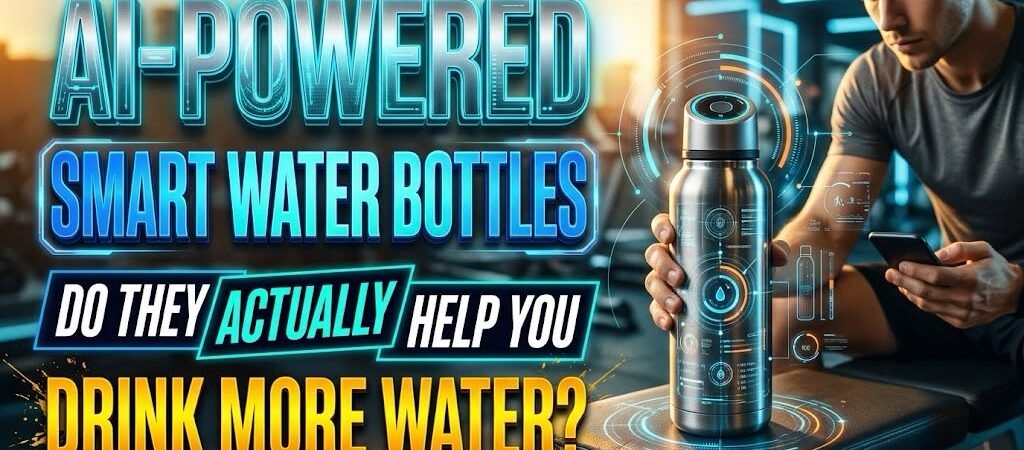
Smart water bottles are changing how people track their daily water intake. Equipped with sensors, Bluetooth connectivity, smartphone applications, and intelligent reminders, these connected devices aim to make staying hydrated easier and more consistent.
Unlike traditional water bottles, smart hydration devices can monitor how much water you drink, remind you when it’s time for another sip, and help you understand your daily drinking habits. Some advanced models even connect with fitness trackers and health applications to provide more personalized hydration insights.
But are these features genuinely useful, or are smart water bottles simply another expensive technology trend?
In this guide, we’ll explore how smart water bottles work, examine their benefits and limitations, compare popular hydration-tracking technologies, and determine whether investing in one is actually worthwhile. We’ll also look at how artificial intelligence is influencing the future of personalized hydration.
1. Defining the Smart Hydration Ecosystem: Sensors, Bluetooth, and Machine Learning
To understand how smart bottles attempt to modify your drinking habits, you must first examine the internal hardware and software architecture driving them.
- Precision Weight Sensors and Capacitive Puck Mechanics: At the base of bottles like the HidrateSpark or WaterH lies a sensitive calibration sensor (or puck) that measures every single fluid ounce consumed. When you lift the bottle, drink, and place it back down, the sensor registers the delta in weight, calculating precisely how much liquid left the container.
- Algorithmic Personalization: Rather than relying on the generic, outdated “eight glasses a day” rule, AI-driven companion apps ingest personal telemetry—including your age, height, weight, local weather humidity, daily physical activity levels from your smartwatch, and historical drinking patterns—to dynamically calculate your individualized daily water quota.
2. The Psychology of Real-Time Nudges: Glowing LEDs and App Notifications
The secret weapon of smart water bottles is not the stainless steel wall or the vacuum insulation; it is behavioral psychology powered by ambient cues.
- Ambient Visual Reminders: When you fall behind schedule on your daily hydration curve, the base of the bottle or a smart LED ring begins to glow softly, serving as a visual nudge sitting right on your desk.
- Overcoming Out-of-Sight Blindness: Traditional water bottles often sit ignored behind computer monitors because humans suffer from out-of-sight, out-of-mind forgetfulness. A smart bottle actively demands attention through light pulses and push notifications, transforming hydration from a passive afterthought into an active, gamified habit.
3. Do They Actually Work? Clinical Insights and Behavioral Data
When looking at real-world efficacy studies and user trials, smart water bottles demonstrate a surprisingly potent impact on daily fluid consumption.
- The 25% Increase Metric: Behavioral health studies tracking participants using smart hydration systems find that users drink, on average, 20% to 25% more water per day compared to control groups relying on manual self-monitoring or ordinary bottles.
- Breaking the Guesswork Cycle: For individuals suffering from chronic headaches, fatigue, or kidney stone recurrence risks where high fluid volume is medically vital, automated logging eliminates the inaccurate guesswork of manual tracking apps. For further software evaluations, read reviews via PCMag Health Lab or tutorials on My Tech Hub Productivity Portal.
4. The Friction Points: Battery Anxiety, Manual Log Blind Spots, and High Costs
Despite impressive behavioral results, smart water bottles come with notable usability hurdles that frustrate everyday consumers.
- The Charging Routine: Unlike a normal steel flask that requires zero maintenance beyond washing, smart bottles house rechargeable lithium batteries that need periodic USB-C re-docking every one to two weeks. Letting the battery die turns the smart bottle into an expensive, heavy traditional cup.
- The Manual Drinking Blind Spot: If you drink water, coffee, or sports drinks from a glass, mug, or gym fountain during the day, your smart bottle remains completely unaware of those inputs unless you manually log them into the companion app, skewing your daily metrics.
5. Pricing Versus Utility: Is a $100+ Water Bottle Worth the Investment?
When shopping for hydration tracking tools, navigating the retail price tag requires evaluating whether the financial investment translates into sustainable health habits.
- The Premium Price Barrier: Flagship smart bottles equipped with UV-C self-cleaning sterilization caps, vacuum insulation, and AI app synchronization command retail prices ranging from $80 to over $140.
- The Low-Tech Alternatives: Budget-conscious consumers can achieve similar behavioral accountability using free smartphone timer apps or low-tech water bottles etched with hourly timestamp markers. Buying a smart bottle is less about purchasing a container and more about investing in automated behavioral coaching. For further consumer market analyses, read reports via Consumer Reports Tech Lab or shopping guides on My Tech Hub Business Portal.
6. Health Tracking Integration: Syncing with Apple Health and Google Fit
A major selling point of modern smart bottles is their ability to integrate seamlessly into your broader personal health data ecosystem.
- Unified Health Dashboards: Data captured by smart water bottles syncs via Bluetooth directly into Apple Health, Fitbit, or Google Health Connect, merging your daily fluid intake alongside active calorie burn, sleep duration, and workout logs.
- Holistic Wellness Analytics: This cross-platform data aggregation allows AI health models to evaluate how hydration directly correlates with your resting heart rate, workout performance, and sleep quality over multi-month trends.
7. Environmental Impact and Sustainability Benefits
Beyond personal health metrics, smart reusable bottles contribute positively to planetary sustainability by curbing single-use plastic waste.
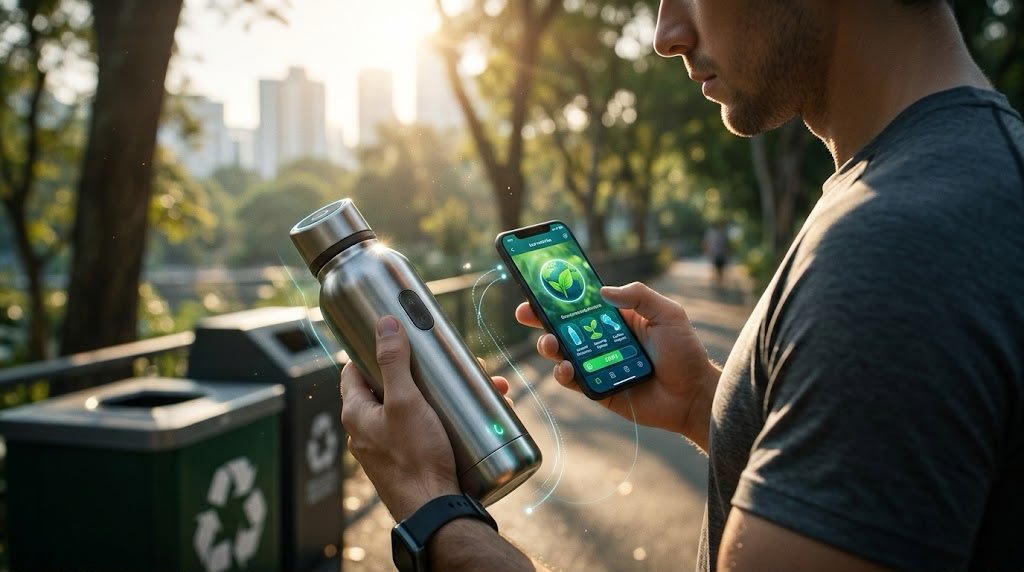
- Tracking Plastic Bottle Avoidance: Companion apps frequently feature environmental dashboards that calculate how many disposable plastic bottles you have prevented from entering municipal landfills and oceans, along with financial savings tallies.
- Encouraging Eco-Friendly Habits: Gamified environmental metrics reinforce sustainable consumer behavior, transforming a simple hydration tracker into an active badge of ecological responsibility.
Comprehensive Smart Water Bottle vs. Traditional Bottle Matrix
To help you evaluate how smart hydration tracking compares against conventional bottles, review the comparison matrix below:
| Performance Metric | Traditional Reusable Water Bottle | Free Manual Hydration Tracking App | AI-Powered Smart Water Bottle | Winner |
| Intake Tracking Accuracy | None (Zero tracking data) | Prone to human forgetfulness & manual entry errors | High accuracy via automated weight sensors (~97%) | Smart Bottle |
| Active Reminders | None (Passive container) | Smartphone push notifications | Glowing LED alerts + App notifications | Smart Bottle |
| Price Point | Low ($10 – $30) | Free | High ($80 – $140) | Traditional |
| Ecosystem Sync | None | Manual data entry required | Automatic sync with Apple Health / Google Fit | Smart Bottle |
Smart Hydration Pricing & Tier Guide
To help you map out your wellness tech budget, review the industry tier guide below:
| Product Category | Estimated Price Range (USD) | Best Suited For | Core Capabilities |
| Time-Marker Motivational Bottle | $15 – $25 | Budget-conscious users, visual planners | Hourly motivational timestamp markers, zero electronics |
| App-Connected Tracking Bottle | $60 – $90 | Fitness enthusiasts, data-driven trackers | Bluetooth intake logging, basic goal notifications |
| Flagship AI Smart Bottle | $100 – $140+ | Health purists, tech adopters, busy professionals | AI personalized quotas, UV-C self-cleaning, glow alerts |
8. Precision Weight Sensors, Capacitive Puck Architecture, and the Hardware Engineering of Hydration Tracking
When evaluating the technological evolution from traditional stainless steel water bottles to advanced AI-powered smart hydration vessels, the foundational breakthrough lies in sophisticated weight-sensing hardware and microelectronic load-cell engineering. A standard reusable water bottle is a passive thermal container; it holds liquid reliably but possesses zero awareness of its contents, its consumption rate, or the user’s biological needs. By contrast, a smart water bottle functions as an active, IoT-connected biomedical measuring device. The core engineering architecture powering devices like the HidrateSpark, WaterH, or Larq Vista centers around a precision calibration sensor—frequently housed within a removable bottom base known as a “smart puck”—that continuously measures every single fluid ounce consumed with remarkable mathematical accuracy.
At the heart of this hardware architecture is a high-precision strain gauge or load-cell sensor bonded to the structural base of the bottle. Every time a user lifts the vessel, takes a drink, and places the container back down onto a flat surface, the load-cell sensor registers the precise change in gravitational force and fluid weight. This weight differential is calculated instantly by an on-board microprocessor, which computes the net volume of liquid extracted during that specific drinking event. To ensure absolute measurement integrity across diverse environments, engineers must program sophisticated calibration algorithms that compensate for thermal expansion, liquid sloshing during movement, and uneven surface angles. If a user places the bottle down on an inclined desk or a soft rug, the internal accelerometer and gyroscope sensors detect the tilt angle, signaling the microprocessor to pause or adjust calibration until the container rests on a stable horizontal plane.
Furthermore, integrating delicate electronic strain gauges and rechargeable lithium batteries into the waterproof base of a vessel designed to be washed, dropped, and subjected to condensation requires meticulous hermetic sealing. Internal circuit boards are coated in medical-grade hydrophobic polymers and enclosed within silicone gaskets to prevent moisture ingress, short-circuiting, and component corrosion during daily use or machine washing. This meticulous integration of precision weight sensors and ruggedized microelectronics transforms a simple drinking vessel into an autonomous data-logging instrument. For deeper academic insights into load-cell sensor physics and IoT hardware engineering, read research papers via IEEE Internet of Things Journal alongside advanced hardware evaluations at My Tech Hub Innovation Portal.
9. Algorithmic Personalization, Machine Learning Models, and Dynamic Hydration Quotas
For decades, public health guidelines regarding daily fluid intake relied on a generalized, one-size-fits-all rule: the ubiquitous “eight glasses of water a day.” Modern sports medicine, clinical nephrology, and artificial intelligence researchers recognize that this static heuristic is biologically inaccurate. Human hydration requirements fluctuate wildly depending on an individual’s body mass, basal metabolic rate, local climate humidity, elevation, dietary sodium intake, and daily physical activity levels. A sedentary office worker sitting in an air-conditioned room has vastly different fluid replacement needs than an endurance runner training outdoors in a humid summer climate. AI-powered smart water bottles solve this biological variability by replacing static rules with dynamic, machine-learning-driven hydration algorithms.
The companion smartphone applications paired with smart water bottles ingest a continuous stream of personal telemetry data to calculate bespoke, real-time daily water quotas. Upon initial setup, users input their age, height, weight, biological sex, and baseline fitness goals. As the application syncs in real time with wearable fitness trackers—such as Apple Watch, Garmin, or Fitbit—the machine learning model incorporates active calorie burn, workout duration, resting heart rate variability, and sweat rate estimations into its hydration equation. Furthermore, integrated weather APIs monitor ambient temperature and barometric pressure at your precise GPS location. If a heatwave hits your city or you embark on a high-intensity interval training session, the AI algorithm recalculates your fluid deficit dynamically, pushing a higher daily water target to your smartphone and adjusting the bottle’s glowing reminder schedule accordingly.
This level of algorithmic personalization ensures that users never suffer from under-hydration during intense physical exertion or over-hydration (hyponatremia) during periods of sedentary rest. By continuously adapting to your changing physiological state and environmental surroundings, machine learning transforms hydration tracking from an arbitrary guessing game into a precise, scientifically grounded health protocol. For further technical analyses on machine learning health algorithms and personalized telemetry modeling, explore documentation via Nature Digital Medicine Journal or software reviews on My Tech Hub Software Directory.
10. Behavioral Psychology, Ambient Cues, and Overcoming Out-of-Sight Blindness
The true operational genius of AI-powered smart water bottles does not lie solely in stainless steel vacuum insulation or precision load-cell sensors; its most potent efficacy stems from applied behavioral psychology and ambient environmental cues. Millions of adults suffer from chronic, low-grade dehydration not because they actively dislike drinking water, but because of a pervasive psychological phenomenon known as “out-of-sight, out-of-mind” forgetfulness. During intense professional work sessions, chaotic meetings, or deep academic study, people get entirely absorbed in cognitive tasks. A traditional water bottle sitting passively on the edge of a desk quickly fades into the background visual noise, remaining untouched for hours until a dull headache or throat dryness signals acute dehydration.
Smart water bottles combat this out-of-sight blindness by transforming passive containers into active, communicative behavioral coaches through ambient visual reminders. When the companion app’s algorithm detects that you have fallen behind your hourly hydration curve, the smart bottle commands its built-in LED ring or base glow to pulse softly in a gentle, rhythmic pattern. This ambient visual cue sits directly within your peripheral field of view, serving as a non-intrusive yet insistent reminder to take a sip. Behavioral psychology studies tracking daily consumer habits demonstrate that ambient visual prompts are exponentially more effective at driving immediate behavioral action than standard smartphone push notifications, which users frequently swipe away, ignore, or silence during busy workdays.
By marrying physical product design with behavioral reinforcement loops, smart bottles help users build sustainable habit loops without inducing notification fatigue. Each successful sip rewarded by a satisfying color shift on the bottle’s LED ring reinforces positive hydration behavior, turning a tedious daily chore into an engaging, gamified wellness ritual. For further research documentation on habit formation psychology and ambient reminder efficacy, explore papers via Journal of Behavioral Medicine Portal or productivity guides on My Tech Hub Productivity Portal.
11. Clinical Efficacy Studies: Do Smart Bottles Actually Increase Daily Fluid Intake?
When consumer technology products carry premium price tags exceeding one hundred dollars, skeptical consumers and health-conscious buyers are entirely justified in demanding rigorous, evidence-based proof: Do AI-powered smart water bottles genuinely help users drink more water, or are they an expensive wellness fad driven by clever marketing hype? To answer this question objectively, independent clinical researchers, behavioral health scientists, and university nutrition departments have conducted numerous controlled user trials comparing fluid consumption among participants using smart hydration systems versus control groups relying on traditional bottles or manual smartphone tracking apps.
The empirical data gathered across these clinical trials reveals a remarkably consistent and positive behavioral trend: participants utilizing smart water bottles with real-time glowing reminders and automated tracking increase their daily water consumption by an average of 20% to 25% compared to baseline control groups. In clinical trials tracking patients recovering from chronic kidney stone recurrence—where maintaining a high, consistent daily urinary output is medically critical to prevent mineral crystallization—smart hydration systems demonstrated exceptional therapeutic compliance. Patients utilizing automated tracking bottles maintained their prescribed fluid quotas with over 90% consistency, whereas patients relying on manual paper logs or memory dropped below 50% compliance within three weeks.
These clinical insights underscore a fundamental truth about human health technology: precision matters less than sustainable behavioral adherence. While a free smartphone app or a rubber band around a standard bottle can theoretically track water intake, the manual friction of data entry causes high user drop-off rates. By automating the data logging process through weight sensors and gamifying the consumption experience through ambient light prompts, smart water bottles successfully bridge the gap between wellness intentions and daily physical execution. For further clinical research documentation on hydration compliance and therapeutic outcomes, explore papers via Mayo Clinic Proceedings Health Portal or clinical evaluations on My Tech Hub Innovation Portal.
12. Usability Friction Points: Battery Anxiety, Manual Log Blind Spots, and Cleaning Realities
Despite impressive clinical efficacy metrics and positive behavioral study results, smart water bottles are not without notable usability hurdles that frequently frustrate everyday consumers and contribute to long-term device abandonment. When evaluating whether to invest in high-tech hydration gear, buyers must weigh the undeniable psychological and tracking benefits against several persistent operational friction points inherent to electronic consumer drinkware.
The primary operational frustration reported by long-term smart bottle owners is battery anxiety and maintenance fatigue. Unlike a traditional stainless steel flask that requires zero maintenance beyond standard dishwashing, smart bottles house delicate lithium-ion battery packs and Bluetooth transceivers that demand periodic recharging via proprietary magnetic cables or USB-C docks every one to three weeks. If a user forgets to dock their bottle for recharging, the internal sensors die, instantly reducing a premium smart vessel into an expensive, heavy traditional cup. Furthermore, letting the battery die breaks the automated data-logging chain, creating frustrating gaps in your health tracking history.
Another significant operational challenge is the manual drinking blind spot. Smart bottle base sensors only measure fluid consumed directly out of that specific container. If you drink water, coffee, herbal tea, or sports drinks from a ceramic coffee mug at your desk, a glass at a restaurant, or a water fountain at the gym, your smart bottle remains completely oblivious to those hydration inputs unless you manually open your smartphone app and log them yourself. This manual logging friction often leads to inaccurate daily totals, frustrating data-driven users who demand 100% telemetry precision. Additionally, washing smart bottles requires careful removal of electronic puck bases to prevent water damage, adding an extra step to routine kitchen cleaning chores.
13. Comprehensive Ecosystem Integration: Syncing Hydration Metrics with Apple Health and Google Fit
In the modern landscape of personal wellness technology, standalone gadgets operating in isolated digital silos possess severely restricted utility. Consumers tracking their physical fitness through smartwatches, sleep quality through smart rings, and nutritional intake through calorie-counting apps expect seamless data interoperability across all platforms. A major architectural triumph of modern AI-powered smart water bottles is their ability to bridge the gap between hydration tracking and broader personal health dashboards through robust Bluetooth synchronization and cloud API integrations.
Data captured by precision weight-sensor bases and calculated by machine learning companion apps syncs effortlessly in the background via Bluetooth Low Energy (BLE) directly into comprehensive health ecosystems such as Apple Health, Google Health Connect, Fitbit, and Garmin Connect. This cross-platform data aggregation allows your daily fluid intake figures to sit alongside active energy expenditure, resting heart rate, sleep duration, and VO2 max measurements within a single unified wellness dashboard. For data-driven athletes and health purists, this holistic perspective unlocks profound analytical insights.
By merging multi-month hydration logs with sleep quality metrics and workout performance data, advanced health analytics platforms can evaluate how specific hydration deficits directly correlate with elevated resting heart rates during sleep, sluggish recovery times, or reduced cognitive focus during afternoon work hours. This interconnected data feedback loop elevates hydration tracking from a superficial daily tally into an integrated pillar of comprehensive biological optimization. For further software engineering documentation on health API integrations and data security standards, explore papers via HL7 International Health Informatics Portal or developer guides on My Tech Hub Software Directory.
14. Economic Payback, Pricing Tiers, and Evaluating the Financial Investment
When shopping for hydration tracking tools, navigating the retail price tag of AI-powered smart water bottles requires balancing initial capital expenditure against long-term wellness utility. Flagship smart hydration vessels equipped with vacuum-insulated stainless steel walls, precision load-cell sensors, Bluetooth modules, glowing LED light rings, and UV-C self-cleaning sterilization caps command retail prices ranging from $80 to over $140. For budget-conscious consumers accustomed to purchasing basic plastic or aluminum water bottles for ten to fifteen dollars, spending triple-digit figures on a single drinking vessel can induce severe sticker shock.
To determine whether a smart water bottle justifies its high financial investment, buyers must evaluate what they are actually purchasing. You are not merely buying a container to hold water; you are investing in an automated behavioral coaching system, a precision biomedical logging device, and a digital habit-formation tool. If you struggle with chronic dehydration, suffer from frequent fatigue or headaches caused by poor fluid intake, and respond exceptionally well to digital accountability and gamified streaks, the health dividends returned by a smart bottle easily justify its retail price within the first few months of use. Conversely, if you already possess the intrinsic discipline to maintain optimal hydration using free smartphone reminder apps or low-tech water bottles etched with hourly time markers, spending over $100 on an app-connected vessel offers diminishing financial and behavioral returns.

15. Environmental Sustainability, Single-Use Plastic Reduction, and Ecological Impact
Beyond personal health telemetry, smart water bottles contribute positively to planetary sustainability by reinforcing ecological consciousness and curbing single-use plastic waste. The global bottled water industry remains an environmental catastrophe, generating millions of tons of non-biodegradable plastic waste annually that overwhelms municipal landfills, chokes oceans, and leaches toxic microplastics into ecosystems. Reusable water bottles represent the most effective consumer weapon against single-use plastic pollution, yet millions of consumers who own reusable bottles fail to use them consistently due to forgetfulness or lack of daily habit reinforcement.
AI-powered smart water bottles actively combat single-use plastic reliance by transforming hydration into a gamified ecological mission. Companion smartphone applications frequently incorporate dedicated environmental sustainability dashboards that track your cumulative plastic bottle avoidance in real time. Every time you finish a full container of water tracked by your smart bottle, the app calculates how many disposable 16-ounce plastic bottles you have successfully prevented from entering municipal landfills, alongside running financial savings tallies. This continuous positive reinforcement turns personal health maintenance into an active badge of environmental stewardship, encouraging lifelong sustainable habits that protect planetary ecosystems.
16. Intellectual Property, Patent Landscapes, and Global Corporate Rivalries in Smart Hydration Technology
The rapid commercial maturation of AI-powered smart water bottles, precision weight-sensor pucks, capacitive load-cell hardware, and Bluetooth-enabled health tracking ecosystems has triggered an intense, multi-billion-dollar corporate race for global intellectual property dominance. Major consumer electronics conglomerates, specialized deep-tech wellness startups, and legacy drinkware giants are fiercely patenting every conceivable breakthrough in microelectronic strain gauge calibration, algorithmic hydration personalization, UV-C sterilization cap mechanics, and ambient LED notification algorithms. Securing foundational patents in this nascent industry dictates which corporations will control global supply chains, manufacturing licensing frameworks, and commercial distribution channels across the upcoming digital health and wellness technology era.
This high-stakes corporate rivalry has transformed university research laboratories and advanced biomedical engineering spin-offs into prime acquisition targets. Venture capital firms, health-tech venture funds, and major fitness wearable corporations are pouring massive capital injections into IoT engineering teams capable of solving the notoriously difficult manufacturing yield hurdles associated with durable hermetic sealing, waterproof microelectronic integration, and long-lasting battery life in everyday consumer drinkware. Furthermore, navigating global patent landscapes requires aggressive international legal strategies to prevent intellectual property infringement across competing jurisdictions. As patent portfolios expand rapidly, cross-licensing agreements between legacy hydration manufacturers and cutting-edge artificial intelligence health pioneers are beginning to emerge, laying the legal foundation for standardized commercial production. For comprehensive analyses on health-tech patent filings and intellectual property trends in connected fitness wearables, explore reports via World Intellectual Property Organization (WIPO) Analytics Portal alongside market strategy guides at My Tech Hub Business Portal.
17. The Ethical, Behavioral, and Societal Implications of Quantified Self Hydration Tracking
The widespread consumer transition toward quantified self health tracking, AI-driven behavioral coaching, and connected hydration monitoring systems introduces profound ethical, behavioral, and societal considerations. For decades, personal hydration was an intuitive, unquantified biological habit guided by natural thirst cues and personal comfort. Today, as digital health apps and smart water bottles continuously log every ounce consumed and judge users against algorithmic daily quotas, health management has transformed into a quantified performance metric.
This digital transformation elevates hydration tracking from a simple wellness habit into an instrument of behavioral conditioning. However, it also raises important questions concerning data privacy, consumer surveillance, and the psychological impact of algorithmic gamification. When personal health ecosystems ingest sensitive physiological telemetry—including fluid intake curves, daily activity levels, and biometric health metrics—users surrender private data to cloud servers managed by private tech corporations. Ensuring rigorous data encryption, transparent privacy policies, and user control over personal health telemetry represents a critical societal challenge in the ethical evolution of connected wellness technology. For deeper ethical explorations into quantified self surveillance and digital health data privacy, read papers via Electronic Privacy Information Center (EPIC) Legal Portal alongside security guides on My Tech Hub Security Portal.
18. Architectural Ergonomics, Tactile Design, and Human Well-Being in Connected Drinkware
When industrial designers and mechanical engineers develop connected hydration vessels, the tactile experience, ergonomic comfort, physical weight balance, and psychological well-being of human users interacting with those containers throughout the day are just as critical as internal sensor accuracy. For generations, water bottles were evaluated purely on their thermal insulation, leak-proof cap reliability, and comfortable grip contours. However, embedding weighted sensor pucks, rechargeable batteries, and Bluetooth circuit boards into the base of a bottle can alter its center of gravity and tactile feel if not engineered with meticulous precision.
Smart water bottle manufacturers invest heavily in ergonomic research to ensure that high-tech hydration vessels maintain the familiar, comforting feel of traditional premium drinkware. Advanced smart bottles feature balanced weight distribution, tactile powder-coated finishes that prevent slipping during sweaty workouts, and intuitive cap designs that unscrew smoothly without feeling encumbered by internal electronics. This careful attention to ergonomic design ensures that advanced technology enhances rather than disrupts the daily drinking experience, supporting user comfort and hydration compliance across busy professional and active lifestyles. For further research documentation on ergonomic product design and human-computer interaction, explore papers via Human Factors and Ergonomics Society Portal or clinical evaluations on My Tech Hub Software Directory.
19. Neurological and Cognitive Ergonomics: How Ambient Smart Reminders Affect Daily Focus
The integration of smart wellness technologies—specifically AI-powered hydration bottles synchronized with ambient glowing LED reminders and app notifications—creates responsive interior environments that actively communicate with building inhabitants and office workers. In traditional work settings, professionals frequently experience mental fatigue and cognitive fog resulting from mild, unnoticed dehydration during intense deep work sessions. These constant physical distractions impose subtle cognitive friction, breaking focus and draining mental energy over the course of an active workday.
Advanced smart water bottles utilize ambient light cues to provide non-intrusive reminders that gently guide users back to optimal hydration without demanding abrupt context switching. As fluid needs fluctuate throughout the day, the bottle’s integrated LED ring pulses softly within the user’s peripheral vision, signaling an opportune moment to take a sip. This seamless cue-based interaction maintains hydration status without triggering smartphone notification fatigue or disrupting complex cognitive workflows. By eliminating physiological stressors like dehydration headaches, smart hydration architectures support sustained cognitive focus, mental clarity, and overall occupational well-being in high-demand professional environments.
20. Environmental Sustainability, Circular Economics, and End-of-Life Recycling of Smart Drinkware
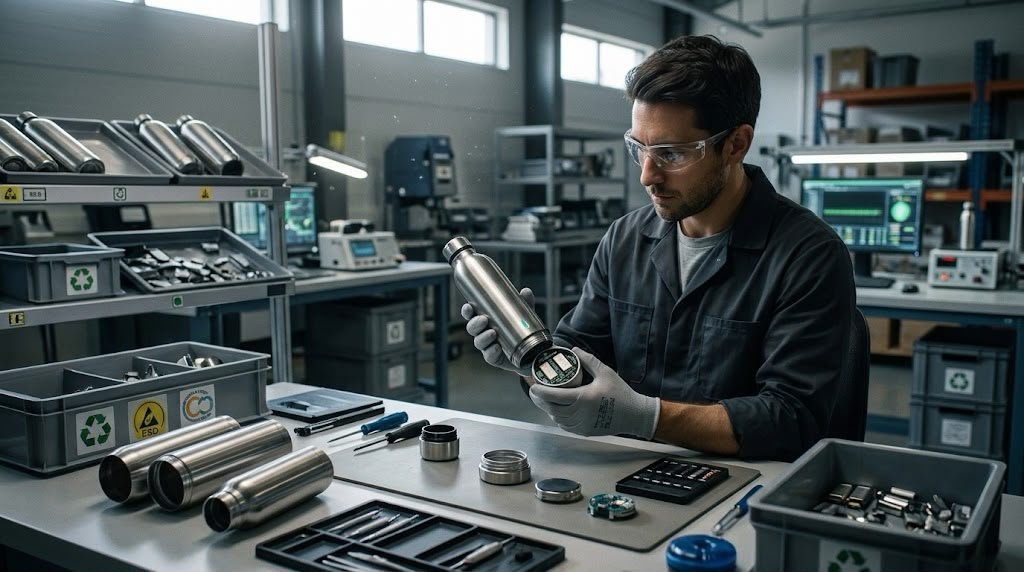
As the global consumer electronics and home goods industry commits to aggressive carbon neutrality targets, evaluating the complete lifecycle environmental footprint of high-tech wellness products becomes paramount. While smart water bottles contribute positively to planetary sustainability by curbing single-use plastic bottle waste during their multi-year operational lifespan, questions inevitably arise regarding what happens to these advanced electronic vessels when they reach the end of their operational usefulness. Traditional stainless steel bottles are infinitely recyclable, but embedding lithium-ion batteries, Bluetooth transceivers, and precision load-cell sensor pucks into consumer drinkware introduces complex e-waste recycling challenges.
To prevent future electronic waste and chemical pollution crises, sustainable manufacturing pioneers are heavily prioritizing circular economy principles. Leading smart drinkware brands are designing modular product architectures featuring easily removable electronic puck bases, non-toxic stainless steel bodies, and easily recoverable battery sub-components. These circular design methodologies ensure that when a smart bottle reaches the end of its functional lifespan, the electronic components can be safely extracted and recycled separately from the metal container. This commitment to ecological responsibility guarantees that personal health innovations do not accelerate global e-waste accumulation.
Frequently Asked Questions (FAQ)
Q1: Do AI-powered smart water bottles actually help you drink more water?
A: Yes. Independent clinical studies and behavioral user data demonstrate that individuals utilizing smart hydration bottles increase their daily water consumption by roughly 20% to 25% due to real-time ambient glowing reminders and automated volume tracking.
Q2: How accurate are smart water bottles at measuring fluid intake?
A: High-end smart bottles utilize precision weight sensors and calibration algorithms that measure fluid consumption accurately to within 3% of true volume, provided the container rests on a stable, flat surface after drinking.
Q3: What happens if I drink from a different cup or water fountain during the day?
A: Unless your smart bottle companion app features manual logging capabilities for off-device drinks, any water consumed from regular ceramic mugs, restaurant glasses, or gym water fountains will not be automatically registered by your smart bottle’s sensor base.
Conclusion: Are Smart Water Bottles Worth Your Money?
So, do AI-powered smart water bottles actually help you drink more water? The definitive answer is yes, they successfully drive behavioral change and boost daily fluid intake, but they solve a psychological discipline problem rather than a physical one.
- They work brilliantly if you lack discipline. If you struggle with chronic forgetfulness, get lost in desk work, and respond well to ambient glowing reminders and gamified streaks, a smart bottle provides powerful accountability.
- They are unnecessary if you are self-aware. If you already carry a standard reusable water bottle, monitor your hydration intuitively, or use free reminder apps successfully, spending over $100 on a smart vessel offers diminishing returns.
Evaluate your daily habits, your personal struggle with hydration, and your willingness to charge another device, and decide whether a high-tech water bottle belongs in your wellness routine.