
Introduction:
For nearly three decades, our digital existence has been tethered to the invisible expanse of the radio frequency (RF) spectrum. From the early days of 802.11b Wi-Fi routers blinking on living room shelves to the pervasive multi-gigabit Wi-Fi 6 and Wi-Fi 7 networks blanketing modern corporate offices, homes, and public spaces, radio waves have served as the undisputed lifeblood of wireless connectivity. We stream ultra-high-definition video, conduct global video conferences, control smart home appliances, and transfer massive enterprise datasets through the airwaves, trusting an invisible, pervasive web of electromagnetic radiation.
Yet, this foundational reliance on radio frequencies faces a compounding, existential bottleneck known as the RF spectrum congestion crisis. The electromagnetic spectrum available for commercial wireless communication is a finite, heavily regulated, and increasingly overcrowded public resource. In dense urban environments, modern apartment buildings, and congested enterprise campuses, multiple Wi-Fi routers broadcasting simultaneously across overlapping 2.4 GHz, 5 GHz, and 6 GHz bands create severe electromagnetic interference. This invisible congestion leads to packet loss, erratic latency spikes, diminished throughput, and sluggish connection speeds precisely when users demand maximum bandwidth. Furthermore, radio waves pass effortlessly through solid walls, making traditional Wi-Fi networks vulnerable to unauthorized interception, signal sniffing, and remote cyber intrusion.
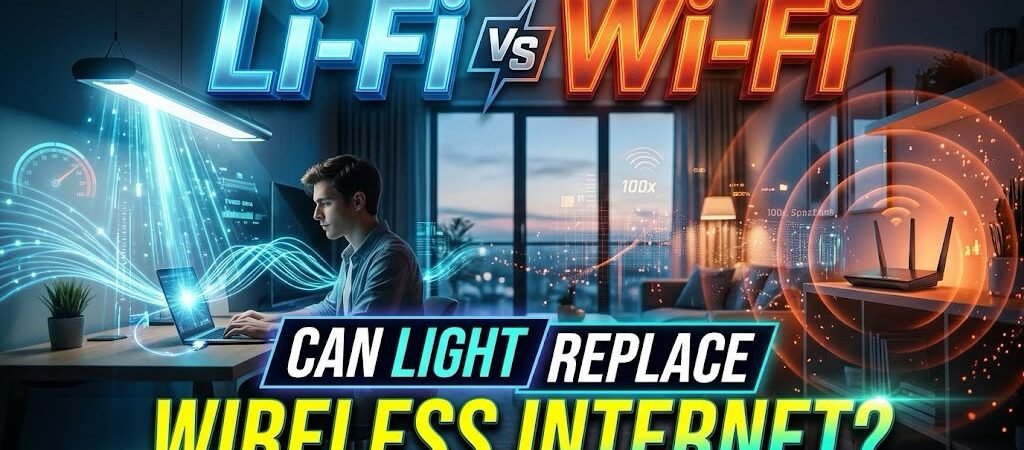
Enter Li-Fi (Light Fidelity), a revolutionary wireless communication technology that bypasses crowded radio frequencies entirely by transmitting high-speed digital data through the visible light, infrared, and ultraviolet spectrums using ordinary LED lighting fixtures. Promising speeds up to 100 times faster than conventional Wi-Fi, absolute physical security, zero electromagnetic interference, and microsecond-level latency, Li-Fi represents one of the most ambitious paradigms shifts in telecommunications history. Can light truly replace wireless internet, or will Li-Fi remain a specialized niche technology operating in the shadow of Wi-Fi? In this comprehensive, in-depth guide, we will deconstruct the physics of visible light communication, compare Li-Fi directly against Wi-Fi 7, analyze security advantages, and evaluate whether light-based data transmission is ready to transform our digital future. For broader industry insights into optical wireless standards and telecommunications trends, you can explore reports via IEEE Communications Society Portal alongside photonics research from Optica Publishing Group Optics Infobase and technical guides at My Tech Hub Connectivity Portal.
1. Introduction to Optical Wireless Communications and the Limitations of Radio Frequencies
To understand why telecommunications engineers are aggressively exploring light-based data transmission, you must first examine the inherent physical limitations governing radio frequency (RF) communications. Radio waves are a form of electromagnetic radiation characterized by relatively long wavelengths and low frequencies, spanning from 3 kHz to 300 GHz. While these long wavelengths allow radio signals to propagate over long distances, bend around physical obstacles, and penetrate solid concrete walls, they carry a catastrophic structural disadvantage: limited bandwidth capacity.
As Shannon’s theorem dictates in information theory, the maximum data transmission capacity of a communication channel is fundamentally proportional to its available frequency bandwidth and signal-to-noise ratio. Because the commercial RF spectrum is heavily partitioned and saturated by television broadcasting, military radar, cellular networks, satellite telemetry, and consumer Wi-Fi, the available channel bandwidth for wireless internet is severely restricted. When millions of devices attempt to communicate simultaneously within a confined geographic area, they crowd into the same limited frequency channels, resulting in severe spectral pollution and degraded network performance.
In stark contrast, the optical light spectrum—encompassing infrared, visible, and ultraviolet light—possesses a frequency bandwidth that is roughly 10,000 times broader than the entire radio frequency spectrum combined. The visible light spectrum alone provides an unimaginably vast, completely unregulated ocean of untapped electromagnetic bandwidth that is entirely immune to RF congestion. By harnessing this underutilized optical frontier, optical wireless communications (OWC) unlock data transmission ceilings that traditional radio frequency technologies can never physically achieve. For further technical analyses on electromagnetic spectrum allocation and channel capacity limits, explore documentation via Federal Communications Commission (FCC) Spectrum Policy Portal or network architecture guides on My Tech Hub Hardware News.
2. Defining Li-Fi (Light Fidelity): How Visible Light Communication Works
While the concept of signaling via light dates back centuries to semaphore towers and optical telegraphs, modern Li-Fi transforms standard indoor illumination fixtures into high-speed digital data access points.
The fundamental operational mechanism of Li-Fi is surprisingly straightforward yet extraordinarily sophisticated in execution. An LED lightbulb is not merely an illumination device; it is a semiconductor diode capable of switching its luminous output on and off at millions of cycles per second. Because these optical switching oscillations occur at speeds far exceeding the flicker fusion threshold of the human eye—typically operating at megahertz or gigahertz frequencies—occupants in a room perceive only steady, continuous illumination while the lightbulb transmits torrents of binary digital data (1s and 0s) invisibly through the air.
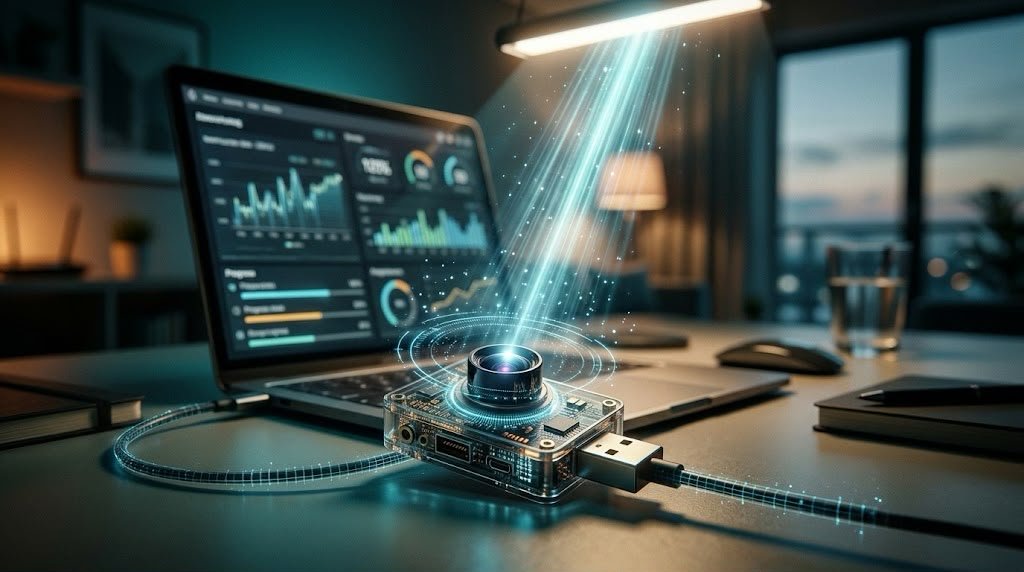
A complete Li-Fi ecosystem comprises three primary architectural components: a data transmitter (an internet-connected LED luminaire equipped with a modulation driver), an unobstructed optical transmission channel (the open air or space between the light source and the client device), and an optical receiver (a sensitive photodetector USB dongle or integrated sensor attached to a laptop, tablet, or smartphone). When data flows from the internet router to the LED fixture, the driver modulates the light intensity at microsecond intervals. The receiving photodetector captures these rapid optical pulses and converts them back into electrical digital data streams, establishing a lightning-fast wireless internet connection.
3. The Physics of Photons vs. Radio Waves: Spectrum Allocation and Bandwidth Capacities
The fundamental divergence between Li-Fi and traditional Wi-Fi rests upon the stark physical differences between radio frequency photons and optical spectrum photons. Radio waves operate at low photon energies and long wavelengths, requiring physical metal antennas of specific resonant lengths to transmit and receive signals. These metal antennas radiate electromagnetic energy omnidirectionally in spherical waves, broadcasting signals through walls, floors, and ceilings. While omnidirectional broadcasting provides wonderful spatial convenience, it creates massive broadcast collisions and spectrum contention when multiple transmitters operate in proximity.
Light waves, conversely, are composed of high-energy photons vibrating at extremely short wavelengths (measured in nanometers). Because optical frequencies operate at hundreds of terahertz, a single optical carrier wave can support astronomical modulation bandwidths. Where a high-end Wi-Fi channel operates on a bandwidth of 160 MHz or 320 MHz, an optical Li-Fi channel can easily leverage optical bandwidths spanning tens or hundreds of gigahertz. This enormous multiplier in raw carrier frequency enables Li-Fi to achieve multi-gigabit data throughput rates that effortlessly dwarf standard Wi-Fi capabilities.
Furthermore, because light photons do not interfere with radio frequency electromagnetic fields, Li-Fi can be deployed freely in sensitive industrial environments—such as hospital operating rooms, commercial aircraft cabins, and petrochemical refineries—where radio frequency transmissions are strictly prohibited due to potential interference with life-critical medical instruments or sensitive avionics navigation systems. For deeper academic insights into optical photonics and carrier frequency physics, read research papers via SPIE Optical Engineering Portal alongside advanced hardware evaluations at My Tech Hub Innovation Portal.
4. Modulation Techniques: From OOK and PPM to Advanced OFDM in Optical Channels
Translating digital binary data into rapid optical light pulses requires advanced signal modulation schemes that maximize data throughput while maintaining signal integrity across noisy optical channels. In the early developmental stages of visible light communication (VLC), engineers relied on basic modulation techniques such as On-Off Keying (OOK) and Pulse Position Modulation (PPM). OOK is the optical equivalent of Morse code: the LED is switched fully on to represent a binary ‘1’ and switched fully off to represent a binary ‘0’. While conceptually simple and easy to implement in basic hardware, OOK suffers from poor spectral efficiency and severe limitations when scaling up to multi-gigabit speeds.
To overcome these throughput bottlenecks, modern high-speed Li-Fi systems employ sophisticated multi-carrier modulation techniques, most notably Optical Orthogonal Frequency-Division Multiplexing (O-OFDM). In an O-OFDM architecture, a wide data stream is split into hundreds of parallel, lower-speed sub-carriers distributed across different optical frequencies. This parallelized transmission approach mitigates inter-symbol interference caused by multipath optical reflections off walls, furniture, and flooring.
Additionally, advanced Li-Fi transceivers utilize high-order modulation formats such as Quadrature Amplitude Modulation (QAM)—including 16-QAM, 64-QAM, and 256-QAM—packing dense clusters of bits into individual optical symbols. By modulating not just the intensity of the light but also leveraging color-shift keying (CSK) across RGB LED arrays, modern Li-Fi transmitters maximize spectral efficiency, achieving multi-gigabit-per-second throughput across standard indoor illumination grids. For further technical analyses on optical modulation mathematics and OFDM signal processing, explore documentation via IEEE Transactions on Communications Portal or software reviews on My Tech Hub Software Directory.
5. Micro-LED Emitters and Phosphor Conversion: The Hardware Engine of Li-Fi Transmitters
The physical performance of any Li-Fi network is fundamentally constrained by the physical characteristics of its light-emitting hardware. Traditional commercial LED lightbulbs found in residential hardware stores are engineered primarily for energy-efficient illumination rather than high-speed data transmission. Standard white LEDs utilize a blue gallium nitride (GaN) semiconductor chip coated with a layer of yellow cerium-doped yttrium aluminum garnet (YAG:Ce) phosphor. The blue light emitted by the semiconductor excites the phosphor coating, which re-emits a broad spectrum of yellow light that blends with residual blue light to produce perceived white illumination.
While phosphor conversion is exceptional for illuminating a room, it creates a severe bottleneck for data transmission: phosphor persistence. The chemical phosphor coating has a natural decay time of several milliseconds—it glows sluggishly for a brief moment after the blue LED chip cuts off. This slow phosphorescent response acts as an optical low-pass filter, restricting modulation bandwidth to a few megahertz and capping data speeds at low levels.
To overcome phosphor persistence, advanced Li-Fi hardware manufacturers deploy specialized Micro-LED arrays and optical filtering techniques. Instead, high-speed Li-Fi transmitters utilize discrete RGB (Red, Green, Blue) micro-LED chips blended electronically to produce clean white light while maintaining blazing-fast optical switching speeds exceeding hundreds of megahertz. Furthermore, specialized optical filters attached to the receiver strip out the slow yellow phosphor luminescence, isolating the rapid blue modulation channel to achieve true multi-gigabit data transmission rates.
6. Photodetectors and Optical Receivers: Transforming Light Pulses Back Into Digital Data
While the Li-Fi transmitter encodes digital data into optical pulses, the receiving end must execute the inverse transformation with extreme sensitivity and speed. The optical receiver in a Li-Fi architecture is typically a compact semiconductor photodetector—such as a Silicon PIN photodiode or an Avalanche Photodiode (APD)—embedded within a USB dongle, laptop chassis, or smartphone sensor array.
When high-speed light pulses strike the active surface of the photodetector, the optical photons transfer their energy to electrons within the semiconductor material, generating a proportional electrical current via the internal photoelectric effect. Because indoor environments are flooded with ambient background light from sunlight streaming through windows, incandescent lamps, and competing electrical fixtures, this raw electrical signal contains massive amounts of optical noise. The receiver’s integrated trans-impedance amplifier (TIA) and analog-to-digital converter (ADC) filter out constant ambient DC light components while amplifying the rapid, high-frequency AC modulation pulses carrying the digital data stream.
Avalanche photodiodes are particularly prized in enterprise Li-Fi receivers because they incorporate internal gain multiplication mechanisms, allowing them to detect faint, distant optical signals bounced off room surfaces even when the receiver is not in direct line-of-sight alignment with the overhead LED fixture. This sensitive optical conversion pipeline ensures robust, error-free data reconstruction across dynamic indoor workspaces. For further technical insights into semiconductor photodetector physics and optical receiver circuit design, read research papers via Journal of Lightwave Technology Portal alongside hardware evaluations at My Tech Hub Hardware News.
7. The Electromagnetic Spectrum Landscape: Why Infrared, Visible, and Ultraviolet Light Offer Massive Advantages
To fully appreciate the architectural superiority of optical wireless communications over radio frequency networks, one must examine the broader electromagnetic spectrum landscape. Radio frequency waves occupy the lowest energy tier of the spectrum, characterized by long wavelengths and broad spatial footprints. Because radio waves pass effortlessly through walls, ceilings, and human bodies, every Wi-Fi router in a neighborhood broadcasts its presence across shared airspace, generating cumulative electromagnetic noise and severe security vulnerabilities.
Optical wireless communications, by contrast, leverage high-frequency, short-wavelength radiation spanning the infrared (IR), visible light (VL), and ultraviolet (UV) tiers. Each of these optical sub-spectra offers unique operational advantages:
- Visible Light Spectrum (380 nm – 750 nm): Dual-purpose infrastructure that provides simultaneous room illumination and high-speed data transmission without requiring additional spectral licensing.
- Infrared Spectrum (750 nm – 1 mm): Completely invisible to the human eye, infrared Li-Fi transmitters can operate at night, in dark conference rooms, or via dedicated optical ceiling transceivers without altering room lighting conditions.
- Ultraviolet Spectrum (100 nm – 380 nm): Highly specialized short-wave UV transmission utilized in extreme non-line-of-sight scattering environments or specialized secure military communications where solar blindness provides natural signal shielding.
By abandoning the congested radio frequency tier and migrating data traffic into these high-energy optical bands, Li-Fi liberates network operators from spectrum licensing fees, regulatory bottlenecks, and crowding constraints.
8. Interference Immunity: How Li-Fi Eliminates Electromagnetic Congestion and RF Dropout
One of the most persistent operational headaches plaguing traditional Wi-Fi networks is electromagnetic interference (EMIR) and radio frequency dropout. Because Wi-Fi routers operate on unlicensed industrial, scientific, and medical (ISM) radio bands—sharing the exact same 2.4 GHz and 5 GHz airwaves with microwave ovens, Bluetooth accessories, baby monitors, cordless phones, radar systems, and neighboring apartment routers—signal degradation is an inevitable daily reality. When multiple devices contend for the same RF channel, latency balloons, video streams buffer, and connection drops occur.
Li-Fi eliminates electromagnetic interference entirely due to a fundamental law of physics: light waves do not interact with radio waves. Light photons travel through space via linear optical propagation without generating or experiencing magnetic coupling with radio frequency electromagnetic fields. You can operate a high-speed Li-Fi network directly inside a heavy industrial manufacturing floor packed with humming electric motors, high-voltage transformers, and radio-emitting machinery without experiencing a single millisecond of signal degradation or packet loss.
This absolute immunity to electromagnetic interference makes Li-Fi uniquely transformative in mission-critical environments where radio frequency communications are unreliable or strictly forbidden. Whether deployed inside hospital intensive care units surrounded by sensitive patient telemetry monitors or within underground mining tunnels packed with heavy electrical equipment, Li-Fi delivers rock-solid, interference-free connectivity that traditional Wi-Fi can never match.
9. Physical Security and Confined Transmission: The Inherent Enclosure Benefits of Light
Perhaps the most compelling commercial and governmental advantage of Li-Fi over Wi-Fi lies in its revolutionary approach to cybersecurity and physical data privacy. Traditional Wi-Fi broadcasts radio waves spherically in all directions. Because radio signals penetrate solid brick walls, glass windows, and concrete floors, an unauthorized hacker sitting in a parked car outside a corporate headquarters or in an apartment next door can easily intercept corporate Wi-Fi traffic, sniff unencrypted packets, or execute brute-force intrusion attacks without ever stepping foot inside the building.
Li-Fi completely neutralizes external eavesdropping through the laws of optical physics: light cannot pass through opaque walls. When an enterprise deploys Li-Fi access points across an office ceiling, the high-speed data stream remains strictly confined within the physical boundaries of that specific room. The moment you close the office door and pull down window blinds, the optical data transmission is hermetically sealed inside the physical space.
An attacker standing outside a closed conference room cannot intercept the Li-Fi signal because no photons escape through the drywall. For financial institutions, defense contractors, government intelligence agencies, and corporate boardrooms handling highly classified intellectual property, Li-Fi provides an impenetrable physical security perimeter that renders remote radio sniffing attacks completely obsolete. For further security analyses on optical containment and physical layer encryption, read reports via National Institute of Standards and Technology (NIST) Cybersecurity Portal alongside security guides on My Tech Hub Security Portal.
10. Latency Performance: Achieving Microsecond-Level Ultra-Reliable Low-Latency Connections
In the modern digital economy, raw download speed is only half the performance equation; latency—the round-trip time it takes for a data packet to travel from a client device to a server and back—dictates the responsiveness of real-time digital applications. While Wi-Fi 6 and Wi-Fi 7 have made remarkable strides in boosting throughput, they still contend with inherent RF protocol overhead, channel contention delays, and queuing latency that cause jitter during peak usage hours.
Li-Fi achieves astonishing microsecond-level latency performance that completely redefines ultra-reliable low-latency communication (URLLC). Because optical channels possess virtually infinite bandwidth capacity and experience zero spectral congestion, data packets are modulated and transmitted instantly across the optical medium without waiting for clear channel assessment (CCA) protocols required in crowded Wi-Fi airwaves.
This near-zero latency performance is transformative for latency-sensitive applications such as cloud-based competitive gaming, remote robotic surgery, autonomous industrial automated guided vehicles (AGVs), and high-frequency financial trading floors where a fraction of a millisecond dictates financial survival. By eliminating RF queuing delays, Li-Fi delivers instantaneous, wire-speed responsiveness over a wireless medium.
11. The Line-of-Sight Hurdle: Navigating Blockages, Shadows, and Reflected Light Paths
Despite its overwhelming superiority in bandwidth, speed, and security, Li-Fi faces one primary physical challenge that has historically limited its standalone deployment: the line-of-sight (LOS) requirement. Unlike radio waves that bend around obstacles and pass through interior walls, light waves travel in straight lines. If a user carrying a Li-Fi enabled laptop stands up, turns around, places their hand over the receiver dongle, or slips the laptop inside a closed backpack, the direct line of sight between the ceiling LED fixture and the photodetector is immediately broken, severing the optical data link.
To prevent frustrating connection drops during natural human movement, modern Li-Fi engineering relies on sophisticated non-line-of-sight (NLOS) optical scattering and diffuse reflections. High-end Li-Fi transmitters are engineered with wide-angle optical lenses that flood an entire room with overlapping light cones. Furthermore, indoor building materials—such as white painted walls, gypsum ceilings, and light-colored flooring—act as diffuse optical reflectors, scattering infrared and visible photons across the room like microscopic mirrors.
Even when direct line-of-sight is temporarily obstructed by a human body or furniture, sensitive avalanche photodiodes on the client device can capture these scattered diffuse reflections off walls and ceilings, maintaining a stable, uninterrupted data connection. Nevertheless, mitigating absolute physical blockages remains an active area of photonics research.
12. Hybrid Networks: Marrying Li-Fi and Wi-Fi 7 for Seamless Indoor Mobility
Recognizing that both Li-Fi and Wi-Fi possess complementary strengths and weaknesses, telecommunications architects and standards bodies are abandoning the notion of an exclusive “either/or” replacement war. Instead, the future of enterprise and residential networking lies in seamless hybrid wireless networks that marry the hyper-fast bandwidth and absolute security of Li-Fi with the ubiquitous wall-penetrating mobility of Wi-Fi 7.
In a modern hybrid network architecture, static devices and high-bandwidth workstations—such as executive desktop computers, high-definition streaming displays, trading terminals, and conference room tables—are anchored to lightning-fast Li-Fi cells positioned directly overhead. These stationary or semi-stationary devices enjoy multi-gigabit throughput and impenetrable physical security without experiencing RF interference.
Concurrently, highly mobile devices—such as smartphones carried by roaming employees walking down corridors, tablets moving between rooms, and wearable IoT sensors—rely on Wi-Fi 7 or 5G cellular connectivity when transitioning through non-illuminated spaces or behind closed doors. Intelligent software-defined networking (SDN) controllers manage the handoff between optical and radio frequency layers invisibly in the background, ensuring that users experience uninterrupted, best-path connectivity regardless of their physical location within a building. For further software integration insights, explore documentation via Wi-Fi Alliance Technical Library or tutorials on My Tech Hub Productivity Portal.
13. Infrastructure Retrofitting: Power Line Communication (PLC) and PoE Integration for Li-Fi Bulbs
Deploying a new networking technology across existing enterprise real estate requires evaluating the financial and physical friction of infrastructure retrofitting. Running dedicated Category 6 or fiber-optic data cables to every single ceiling light fixture in a fifty-story commercial skyscraper would incur prohibitive labor costs and structural disruption. Fortunately, Li-Fi deployment leverages existing commercial electrical and lighting infrastructures through ingenious engineering integrations.
The two primary deployment methodologies utilized for commercial Li-Fi retrofitting are Power Line Communication (PLC) and Power over Ethernet (PoE):
- Power Line Communication (PLC): Modulates high-speed digital data signals directly onto existing building AC electrical wiring. Standard electrical power lines carry both 120V/240V power and high-frequency data signals to the ceiling LED fixture without requiring new data cables.
- Power over Ethernet (PoE): Increasingly common in modern smart buildings, PoE delivers both electrical power and high-speed Ethernet data packets over a single standard twisted-pair copper cable directly to smart LED luminaires equipped with integrated Li-Fi transceivers.
By piggybacking data transmission onto existing building power grids or Ethernet drops, commercial property owners can upgrade standard office lighting into high-speed Li-Fi access points during routine lighting maintenance cycles, drastically minimizing capital expenditure and installation downtime.
14. Standardization and IEEE 802.11bb: The Milestone Toward Global Commercial Interoperability
For any emerging wireless technology to transition from isolated laboratory prototypes into widespread global commercial adoption, it must achieve rigorous international standardization. Without universal standards, competing proprietary hardware systems from different manufacturers cannot interoperate, stalling consumer adoption and freezing enterprise procurement departments. For years, Li-Fi suffered from a lack of unified industry standards, creating a fragmented marketplace of incompatible vendor ecosystems.
That historic barrier was decisively dismantled with the official ratification of IEEE 802.11bb, the global standard for light communications released by the Institute of Electrical and Electronics Engineers. Developed in close collaboration with the IEEE 802.11 working group—the exact same administrative body responsible for standardizing Wi-Fi—IEEE 802.11bb establishes a universal global framework for optical wireless local area networks.
By integrating optical physical layer (PHY) and medium access control (MAC) specifications directly into the existing IEEE 802.11 Wi-Fi protocol architecture, IEEE 802.11bb enables Li-Fi to utilize the exact same software drivers, security protocols (such as WPA3), and networking stacks as traditional Wi-Fi. This monumental standardization milestone means that microchips supporting both Wi-Fi and Li-Fi can be manufactured on standard silicon wafers at scale, paving the way for seamless hardware integration into mainstream smartphones, laptops, and IoT devices.

15. Enterprise, Industrial, and Healthcare Applications: Secure Environments Driving Li-Fi Adoption
While residential consumers may view Li-Fi as an exotic alternative to home Wi-Fi, enterprise, industrial, and healthcare sectors represent the primary commercial engines driving aggressive Li-Fi adoption. In these high-stakes professional environments, the operational advantages of light-based networking solve critical, expensive pain points that traditional radio frequency technologies cannot address.
- Healthcare and Operating Rooms: Modern hospitals are saturated with sensitive life-support machinery, patient telemetry monitors, and MRI machines that are highly susceptible to radio frequency electromagnetic interference. Wi-Fi signals can occasionally cause erratic sensor readings or equipment jitter. Li-Fi utilizes safe, interference-free light, allowing doctors and nurses to stream high-resolution surgical feeds and patient health records wirelessly inside sterile operating theaters without risking equipment interference.
- Smart Manufacturing and Industry 4.0: Factory floors packed with robotic assembly lines, automated guided vehicles (AGVs), and heavy electrical machinery experience severe Wi-Fi multipath fading and latency spikes. Li-Fi provides deterministic, microsecond-level latency and absolute EMIR immunity, ensuring flawless real-time industrial robotics coordination.
For further industrial automation case studies, read reports via Industrial Internet Consortium Research Desk alongside business strategy guides at My Tech Hub Business Portal.
16. Avionics, Defense, and Secure Government Deployments: Eliminating RF Signature Vulnerabilities
In military defense, aerospace engineering, and classified government intelligence operations, communication security is a matter of national survival. Traditional military and commercial aircraft rely on complex webs of heavy copper wiring and radio frequency transceivers to transmit data throughout the cabin and cockpit. These RF systems generate massive electromagnetic signatures that can be detected by hostile radar or intercepted by electronic warfare units, exposing aircraft positions and leaking tactical communications.
Li-Fi offers a revolutionary paradigm shift in avionics and defense communications through RF-silent cabin architectures. By replacing heavy copper wire harnesses and radio frequency antennas with lightweight fiber-optic networks and invisible infrared Li-Fi transceivers embedded within aircraft ceiling panels, military transport planes and commercial airliners can distribute gigabit-per-speed entertainment, flight telemetry, and cockpit communications entirely within a confined optical bubble.
Because infrared and visible light photons cannot penetrate the metallic hull of an aircraft or escape through exterior windows into open airspace, hostile ground-based interceptors cannot detect an aircraft’s internal data transmissions. This absolute elimination of RF emission signatures provides an impenetrable tactical advantage in hostile electronic warfare environments.
17. Underwater Communications and Hazardous Environments: Where Radio Waves Fail Entirely
Exploring the vast expanse of Earth’s oceans and operating within hazardous industrial environments presents severe telecommunications challenges where traditional radio frequency technologies fail entirely due to fundamental laws of physics. Radio waves cannot propagate effectively through water; high-frequency radio waves are heavily absorbed by water molecules, while low-frequency radio waves require massive, impractical antenna arrays and offer agonizingly slow data transfer speeds (measured in mere bits per second). Consequently, submarines, remotely operated underwater vehicles (ROVs), and marine research divers have historically relied on clumsy tethered acoustic modems that suffer from severe latency and acoustic reverberation.
Light, however, can propagate through clear water across specific optical wavelength windows, particularly within the blue-green spectrum (around 450 nm to 500 nm), which experiences minimum attenuation in aquatic environments. Underwater Li-Fi leverages blue-green LED transmitters and sensitive optical receivers to establish high-speed wireless data links between submerged submersibles, autonomous underwater drones, and fixed ocean-floor sensor grids.
Submarine crews and marine researchers can stream high-definition video, download massive bathymetric scan data, and coordinate underwater robotic maintenance operations in real time without being physically tethered to surface ships. Similarly, in hazardous petrochemical refineries or underground explosive gas pipelines where a single stray radio frequency spark could trigger a catastrophic explosion, intrinsically safe optical Li-Fi transmitters eliminate electrical ignition risks entirely.
18. Power Consumption and Energy Efficiency: Balancing Illumination with Data Transmission
In an era defined by aggressive global climate sustainability mandates and rising corporate energy costs, evaluating the power consumption footprint of networking infrastructure is paramount. Traditional Wi-Fi routers and enterprise access points consume continuous electrical power to maintain active radio frequency carrier waves, drawing substantial wattage whether heavy data is being transmitted or the office building is completely empty at midnight.
Li-Fi introduces a brilliant energy-efficiency synergy by dual-purposing existing lighting infrastructure. In commercial office buildings, architectural lighting accounts for a massive percentage of total electricity consumption. By upgrading standard commercial LED illumination fixtures into smart Li-Fi luminaires, property owners combine room lighting and data transmission into a single unified electrical load. Furthermore, advanced Li-Fi protocols leverage dimming capabilities: even when an LED lightbulb is dimmed down to a subtle 10% illumination level for ambient mood lighting, the microsecond-level optical switching speed remains fully operational, transmitting high-speed data streams without requiring full-brightness electrical power.
Additionally, because optical receivers on client devices require minimal electrical bias compared to power-hungry RF transceiver chip-sets, Li-Fi dongles consume significantly less battery power on smartphones and laptops, extending mobile device battery longevity during intensive remote work sessions.
19. Eye Safety Regulations and Photobiological Safety Standards (IEC 62471)
Whenever a new consumer or enterprise technology introduces artificial light emission sources into human-occupied spaces, strict regulatory compliance regarding biological safety is mandatory. Critics unfamiliar with photonics engineering occasionally voice concerns regarding whether high-speed optical data transmission using LEDs or infrared lasers could cause retinal damage or long-term ocular fatigue over extended exposure periods.
To eliminate any risk of biological harm, commercial Li-Fi systems are strictly engineered to comply with rigorous international photobiological safety standards, most notably IEC 62471 (Photobiological safety of lamps and lamp systems) and relevant FDA laser safety regulations. These global standards establish strict exposure limits for optical radiation across human eyes and skin.
In a certified Li-Fi system, the optical power density emitted by ceiling luminaires is carefully regulated to fall well within safe, continuous-viewing limits—comparable to or even lower than standard high-efficiency office LED ceiling tiles. The high-speed modulation pulses occur at intensities that are completely imperceptible to human photoreceptors, ensuring zero eye strain, thermal heating, or photochemical retinal hazards, even when occupants stare directly upward toward lighting fixtures for twelve hours a day.
20. Cost Economics and Manufacturing Scalability: Transitioning from Niche Lab to Mass Market
Like any emerging high-tech innovation migrating from academic research laboratories into commercial reality, Li-Fi must navigate the formidable economic hurdles of manufacturing scalability and component cost parity. Historically, specialized optical modulators, avalanche photodiodes, and custom Li-Fi transceivers were manufactured in low-volume specialty semiconductor foundries, driving unit costs to prohibitive levels that restricted deployment strictly to high-budget military, aerospace, and elite enterprise testing facilities.
However, the modern economic trajectory of Li-Fi is experiencing a dramatic cost-reduction curve driven by the mass-market proliferation of Gallium Nitride (GaN) micro-LEDs and silicon photonics manufacturing. Because micro-LED emitters share identical semiconductor fabrication processes with modern display screens and high-efficiency lighting chips, manufacturing yields are scaling rapidly across global semiconductor foundries.
Furthermore, the official ratification of the IEEE 802.11bb standard allows semiconductor manufacturers to embed standardized Wi-Fi/Li-Fi dual-mode silicon chip-sets directly onto motherboards at scale. As production volumes climb into millions of units, component pricing is plummeting toward parity with traditional Wi-Fi transceivers, transforming Li-Fi from an expensive niche luxury into an economically viable commercial upgrade for mainstream commercial real estate.
Comprehensive Li-Fi vs. Wi-Fi 7 Technical Comparison Matrix
To help you evaluate how Li-Fi stacks up directly against traditional wireless technology, review the comprehensive comparison matrix below:
| Technical Parameter | Wi-Fi 7 (802.11be) | Li-Fi (IEEE 802.11bb) | Winner |
| Carrier Medium | Radio Frequency Waves (2.4, 5, 6 GHz) | Optical Light Spectrum (Infrared, Visible, UV) | Li-Fi (Bandwidth) |
| Max Theoretical Speed | Up to 46 Gbps | Over 100 Gbps (Laboratory tested) | Li-Fi (Speed) |
| Electromagnetic Interference | Susceptible to RF noise and congestion | Absolute immunity to EMI and RF dropout | Li-Fi (Stability) |
| Physical Security | Penetrates walls; vulnerable to remote sniffing | Confined to physical room; blocked by walls | Li-Fi (Security) |
| Spatial Coverage Range | Broad range (~10–30 meters through walls) | Line-of-sight & room-confined (~3–10 meters) | Wi-Fi (Coverage) |
| Infrastructure Deployment | Standard wireless routers and APs | Requires smart LED lighting and optical transceivers | Wi-Fi (Simplicity) |
21. Intellectual Property, Patent Landscapes, and Global Corporate Rivalries in Optical Wireless
The rapid commercial maturation of Li-Fi, micro-LED optical modulators, and IEEE 802.11bb transceiver hardware has triggered an intense, multi-billion-dollar corporate race for global intellectual property dominance. Major telecommunications equipment vendors, lighting manufacturing conglomerates, and specialized deep-tech photonics startups are fiercely patenting every conceivable breakthrough in optical orthogonal frequency-division multiplexing, avalanche photodiode sensitivity, hybrid Wi-Fi/Li-Fi handoff algorithms, and Power Line Communication (PLC) integration. Securing foundational patents in this nascent industry dictates which corporations will control global supply chains, manufacturing licensing frameworks, and commercial distribution channels across the upcoming optical networking era.
This high-stakes corporate rivalry has transformed university photonics research laboratories and advanced semiconductor spin-offs into prime acquisition targets. Venture capital firms, telecommunications venture funds, and major lighting manufacturers are pouring massive capital injections into optical engineering teams capable of solving manufacturing yield hurdles associated with sub-millimeter micro-LED integration and wide-angle optical lens design. Furthermore, navigating global patent landscapes requires aggressive international legal strategies to prevent intellectual property infringement across competing jurisdictions. As patent portfolios expand rapidly, cross-licensing agreements between legacy lighting giants and cutting-edge wireless pioneers are beginning to emerge, laying the legal foundation for standardized commercial production. For comprehensive analyses on photonics patent filings and intellectual property trends in optical wireless communications, explore reports via World Intellectual Property Organization (WIPO) Analytics Portal alongside market strategy guides at My Tech Hub Business Portal.
22. The Societal and Urban Impact of Ambient Data Illumination in Smart Cities
The widespread architectural transition toward optical wireless communications and ambient data illumination introduces profound urban, societal, and environmental considerations. For decades, municipal lighting infrastructure—ranging from streetlamps and highway tunnels to urban plaza illumination—served a singular, passive purpose: providing nighttime visibility to enhance public safety. Today, as municipal governments enact smart city master plans and IoT sensor grids, urban planners face an urgent imperative to transform passive municipal lighting into active, high-speed data transmission backbones.
This regulatory and environmental shift elevates ambient Li-Fi harvesting from an optional green marketing luxury into an essential component of urban digital resilience. However, it also raises important questions concerning socioeconomic equity and equitable access to high-speed optical micro-generation technology. If high-performance Li-Fi street lighting and public square access points remain concentrated exclusively in affluent corporate downtown districts, digital divide disparities may widen, leaving older urban infrastructure and lower-income communities dependent on aging cellular and Wi-Fi networks. Ensuring equitable manufacturing cost reductions and accessible municipal deployment programs for optical street lighting retrofits represents a critical societal challenge in the just transition toward smart, interconnected cities. For deeper ethical explorations into urban connectivity and digital equity, read papers via Urban Land Institute Sustainability Desk alongside smart city guides at My Tech Hub Innovation Portal.
23. Neurological Adaptation and Human Interaction with Invisible Light Data Networks
When architects and lighting designers integrate high-speed Li-Fi transceivers into residential homes, hospitals, and corporate office spaces, the psychological comfort, biological compatibility, and subjective well-being of human occupants working under those light fixtures are just as critical as raw network throughput calculations. For generations, lighting was selected primarily for its color temperature, lumen output, and aesthetic harmony. However, introducing microscopic optical modulation frequencies—even when occurring far beyond the human visual flicker threshold—raises fascinating questions regarding human neurological adaptation.
Extensive photobiological safety studies demonstrate that certified commercial Li-Fi systems operate with zero adverse neurological side effects. Because human photoreceptor cells and visual cortex processing pathways cannot register light intensity fluctuations operating in the megahertz and gigahertz bands, occupants experience zero visual flickering, eye strain, or neurological fatigue. Furthermore, intelligent lighting management systems synchronize Li-Fi illumination schedules with natural human circadian rhythms, modulating color temperatures dynamically throughout the day to support alertness during morning work hours and melatonin production during evening hours. This harmonious integration ensures that high-speed data transmission enhances rather than disrupts human biological health.
24. Environmental Sustainability, Circular Economics, and E-Waste Considerations in Optical Hardware
As the global electronics and lighting manufacturing industry commits to aggressive carbon neutrality targets, evaluating the complete lifecycle environmental footprint of high-tech networking equipment becomes paramount. While Li-Fi systems contribute positively to planetary sustainability by dual-purposing existing energy-efficient LED lighting infrastructure and reducing power consumption compared to continuous RF transceivers, questions inevitably arise regarding what happens to these advanced optical transceivers and photodetector dongles when they reach the end of their operational usefulness. Traditional networking hardware is notoriously difficult to recycle, and embedding semiconductor micro-LEDs, silicon photodiodes, and printed circuit boards into consumer devices introduces complex e-waste challenges.
To prevent future electronic waste and material pollution crises, sustainable manufacturing pioneers are heavily prioritizing circular economy principles. Leading optical transceiver manufacturers are designing modular product architectures featuring easily separable structural housings, non-toxic recyclable aluminum frames, and easily recoverable semiconductor sub-components. These circular design methodologies ensure that when a Li-Fi access point or client dongle reaches the end of its functional lifespan, the optical and electronic components can be safely extracted and recycled separately from the housing shell. This commitment to ecological responsibility guarantees that personal health and networking innovations do not accelerate global e-waste accumulation.

25. The Ultimate Decision Framework: Evaluating Enterprise and Residential Readiness for Li-Fi Deployment
As corporate IT directors, enterprise facility managers, network architects, and tech-savvy homeowners stand at this historic crossroads between traditional radio frequency Wi-Fi and emerging optical wireless communications, evaluating network readiness requires disciplined strategic planning. Rushing out to install bleeding-edge Li-Fi infrastructure without analyzing physical room layouts, direct line-of-sight constraints, mobile device roaming requirements, and hybrid networking compatibility can lead to operational inefficiencies and unjustified capital expenditures.
To determine whether integrating Li-Fi makes financial and technical sense for your organization today, evaluate three core pillars: security classification requirements, environmental RF interference density, and bandwidth throughput demands. If you manage a classified government boardroom, a sensitive hospital operating room, an automated smart factory floor, or a high-density corporate trading desk where Wi-Fi security vulnerabilities and RF congestion cripple operations, deploying a hybrid Li-Fi / Wi-Fi 7 architecture delivers immediate, transformative security and performance value. Evaluate your architectural blueprint, balance upfront capital investment against long-term security and speed dividends, and decide whether your facility is ready to embrace the optical wireless revolution.
Frequently Asked Questions (FAQ)
Q1: Can Li-Fi completely replace Wi-Fi in homes and offices?
A: Not entirely in the immediate future. While Li-Fi offers vastly superior speed, zero interference, and impenetrable security within a single room, its inability to penetrate solid walls means it cannot match the wall-penetrating spatial mobility of Wi-Fi. The future points toward hybrid networks where Li-Fi handles high-bandwidth stationary desks and Wi-Fi handles roaming mobile devices.
Q2: Does Li-Fi work when the room lights are turned off?
A: Yes. Modern Li-Fi transmitters can operate using invisible infrared light spectra rather than visible light, or they can transmit data while visible LED bulbs are dimmed down to subtle ambient levels where data modulation remains fully functional without blinding room occupants.
Q3: Is Li-Fi harmful to human eyes or skin?
A: No. Certified commercial Li-Fi systems comply strictly with international photobiological safety standards (such as IEC 62471), emitting optical radiation levels well within safe continuous-viewing limits that cause zero thermal or photochemical hazard to human eyes.
Conclusion: Can Light Replace Wireless Internet?
So, can light replace wireless internet? The definitive answer is no, light will not entirely replace Wi-Fi as a universal consumer standard, but it is poised to dominate high-security, ultra-high-speed enterprise, industrial, and specialized environments.
- The performance advantages are undeniable. Li-Fi delivers multi-gigabit speeds, absolute immunity to electromagnetic interference, microsecond-level latency, and physical security that radio waves cannot touch.
- The physics of light dictate its niche. Because photons cannot bend around walls or travel through opaque barriers, Li-Fi excels as a confined room-level powerhouse, while Wi-Fi retains its crown for whole-home spatial roaming.
Evaluate your security requirements, your bandwidth demands, and your physical workspace constraints, and consider whether stepping into the lightning-fast, secure world of optical wireless networking belongs in your technological roadmap.