
Introduction:
For decades, mobile communication has relied on a foundational geographic constraint: cellular connectivity stops wherever a terrestrial telecommunications tower fails to reach. Whether driving through remote mountain ranges, hiking across dense forests, sailing across the open ocean, or weathering natural disasters that shatter ground-based infrastructure, billions of smartphone users experience the universal frustration of seeing “No Service” displayed across their screens. Traditional cellular architecture requires dense networks of physical towers connected via fiber-optic backhauls, making it economically unfeasible to provide coverage across vast rural deserts, oceans, and wilderness areas.
Yet, a revolutionary technological convergence is permanently erasing these geographical dead zones. We have entered the era of direct-to-cell satellite connectivity, a breakthrough telecommunications paradigm that allows ordinary, unmodified commercial smartphones to link directly with satellites orbiting hundreds of miles above the Earth.
How does direct-to-cell satellite connectivity work on standard smartphones, what complex physics govern space-based cellular links, and how are aerospace engineers overcoming massive Doppler shifts and signal delays? In this comprehensive, exhaustive guide, we will deconstruct Low Earth Orbit constellations, 3GPP Non-Terrestrial Network standards, spectrum sharing, and the corporate partnerships reshaping global mobility.
1. The Fundamental Paradigm Shift: Connecting Unmodified Smartphones to Space
To understand the magnitude of direct-to-cell satellite technology, one must first recognize why traditional satellite communication was historically restricted to expensive, specialized satellite phones (such as Iridium or Thuraya handsets). Legacy satellite phones required bulky, high-gain directional antennas, massive battery packs, and specialized radio transceivers capable of punching through atmospheric attenuation to reach Geostationary Earth Orbit (GEO) satellites stationed 22,300 miles above the equator.
An ordinary consumer smartphone, by contrast, is designed for localized terrestrial communication. It contains a compact, low-power internal antenna optimized to communicate with cell towers located a few miles away, transmitting at relatively low wattage to preserve battery life. Bridging the astronomical chasm between a pocket-sized smartphone and a satellite moving at thousands of miles per hour without any hardware modification represents one of the most formidable engineering triumphs in telecommunications history.
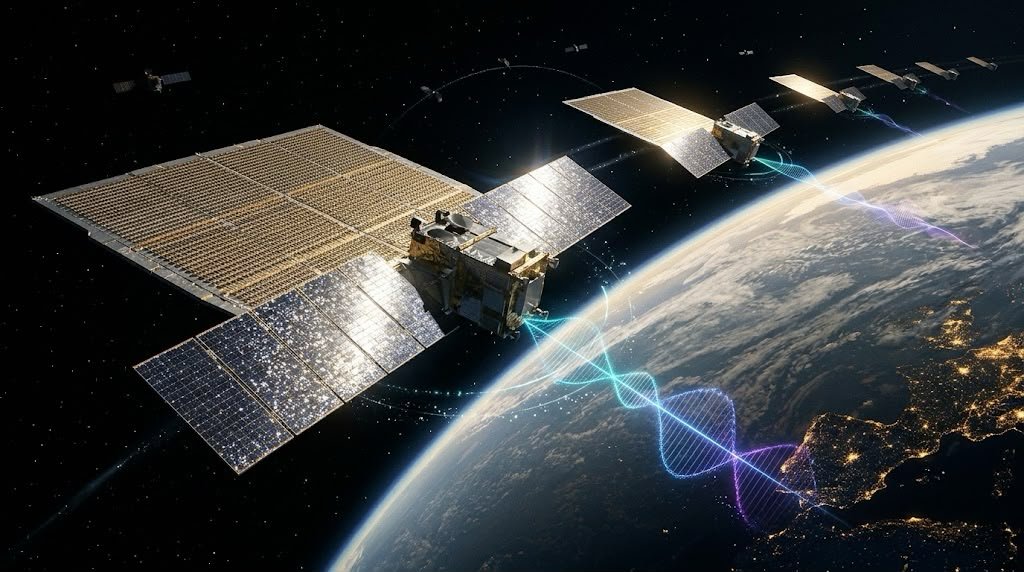
Direct-to-cell technology flips the traditional dynamic on its head. Instead of forcing consumers to carry specialized space hardware, satellite operators deploy colossal, highly sensitive phased-array antennas into space. These orbiting cell towers act as hyper-sensitive receivers and powerful transmitters capable of closing the link budget with ordinary mobile handsets using standard LTE and 5G cellular frequencies.
2. The Mechanics of Low Earth Orbit (LEO) Constellations vs. Geostationary Satellites
The feasibility of direct-to-cell smartphone connectivity depends almost entirely on the orbital altitude of the satellite constellation. For decades, satellite communications relied heavily on Geostationary Earth Orbit (GEO) satellites. While GEO satellites offer the immense advantage of appearing stationary relative to a fixed point on the Earth’s surface—requiring simple, fixed satellite dishes on the ground—their extreme altitude (35,786 kilometers or 22,300 miles) introduces catastrophic latency and extreme path loss. A round-trip data packet traveling to a GEO satellite incurs a physical propagation delay of over 600 milliseconds, rendering real-time cellular conversations and data browsing practically unusable.
In stark contrast, modern direct-to-cell networks utilize Low Earth Orbit (LEO) constellations orbiting at altitudes ranging from 400 to 2,000 kilometers (250 to 1,200 miles) above the Earth. At this close proximity, round-trip latency drops dramatically to between 20 and 50 milliseconds—comparable to terrestrial cellular networks.
However, LEO satellites introduce a new set of engineering challenges: they move at blistering orbital velocities (approximately 27,000 kilometers per hour or 17,000 miles per hour), completing a full orbit around the Earth in roughly 90 minutes. This means a LEO satellite passes across a smartphone’s overhead sky in a matter of minutes, requiring sophisticated handoff algorithms, continuous beam-steering, and dynamic network routing.
3. Overcoming Massive Path Loss and Extreme Distance Constraints
The most immediate physical hurdle facing direct-to-cell satellite communications is free-space path loss (FSPL). When a radio frequency signal travels from a cellular tower to a smartphone a few miles away, the signal attenuates naturally according to the inverse-square law. When that same signal must travel 500 to 1,000 kilometers through the atmosphere from a LEO satellite to a smartphone, the path loss becomes astronomical.
Compounding this challenge is the fact that standard smartphones emit very low radio frequency power (typically restricted to 200 milliwatts to 2 watts) through omnidirectional internal antennas that radiate energy in all directions rather than focusing it tightly toward the sky.
To overcome this severe energy deficit, satellite operators deploy massive, highly sophisticated phased-array antennas in space. These orbital antennas span dozens of meters when unfurled in orbit, comprising thousands of tiny individual antenna elements that cooperate via digital beamforming. By dynamically phasing the signals emitted from each element, the satellite constructs razor-sharp, high-gain directional beams focused precisely onto individual smartphone users on the ground, amplifying incoming and outgoing signals enough to close the extreme link budget without draining the phone’s battery.
4. Mitigating High-Velocity Doppler Shifts Caused by Orbital Motion
Because LEO satellites streak across the sky at orbital speeds exceeding 7 kilometers per second relative to the Earth’s surface, communications links are subjected to severe Doppler effect frequency shifts. The Doppler effect—the same acoustic phenomenon that causes the pitch of a siren to drop as an ambulance speeds past an observer—alters the carrier frequency of radio waves transmitted between a fast-moving satellite and a stationary smartphone.
As a LEO satellite approaches a smartphone on the ground, the radio frequency is compressed toward a higher frequency shift; as the satellite reaches zenith and recedes over the horizon, the frequency stretches downward. In traditional cellular networks, Doppler shifts caused by moving vehicles are negligible. In direct-to-cell satellite architectures, however, the frequency shift can span tens of kilohertz—enough to throw the receiver entirely out of channel synchronization and corrupt data packets.
To combat this, modern direct-to-cell systems incorporate advanced pre-compensation and dynamic Doppler tracking algorithms implemented at both the satellite ground station and the orbital payload. The satellite predicts its exact ephemeris (orbital trajectory) relative to the smartphone’s GPS-derived geographic location and pre-shifts its transmission frequency dynamically, ensuring that the signal arrives at the user’s handset precisely centered within the allocated cellular channel.

5. Managing Extended Propagation Delays and Modified 3GPP Timing Advance Protocols
Cellular telecommunications protocols rely on strict time synchronization between base stations and client devices to coordinate data packet transmission windows and prevent signal collisions. In terrestrial LTE and 5G networks, cell towers assume maximum distances of 20 to 30 kilometers, utilizing a mechanism called Timing Advance (TA) to measure and compensate for microscopic propagation delays caused by distance.
When communicating with a LEO satellite orbiting 600 kilometers overhead, the physical propagation delay increases by orders of magnitude. Radio waves travel at the speed of light, but covering hundreds of miles introduces millisecond-scale delays that shatter standard terrestrial cellular timing windows. If uncorrected, these extended delays cause the smartphone’s transmissions to collide with framing slots allocated for other users, resulting in complete radio link failure.
To resolve this, telecommunications standards bodies and satellite engineers implemented specialized modifications to the 3GPP timing architecture. Satellites and modified ground base stations broadcast extended timing windows and specialized Random Access Channel (RACH) preambles, allowing the network to dynamically adjust the Timing Advance parameter to account for hundreds of kilometers of space propagation delay without requiring any modifications to the consumer’s smartphone firmware.
6. Spectrum Sharing and Terrestrial-Satellite Frequency Harmonization
One of the most fiercely contested and legally complex dimensions of direct-to-cell satellite connectivity is radio frequency spectrum management. Cellular mobile network operators (MNOs) pay national governments billions of dollars for exclusive national licenses to operate on specific terrestrial frequency bands—such as cellular 1.9 GHz (PCS band) or 850 MHz blocks.
Direct-to-cell connectivity leverages Supplemental Coverage from Space (SCS) by allowing satellite operators (such as SpaceX or AST SpaceMobile) to partner with terrestrial MNOs (such as T-Mobile, AT&T, or global carriers) and transmit over the exact same licensed terrestrial mid-band or low-band frequencies. Instead of requiring new dedicated satellite spectrum allocations, the satellite essentially acts as a floating cell tower utilizing the identical cellular frequencies your phone already uses every day.
However, this spectrum sharing introduces severe regulatory risks regarding terrestrial interference. If an orbiting satellite broadcasts powerful radio signals down to earth using the same frequencies deployed by ground-based cell towers, it can cause catastrophic co-channel interference that deafens terrestrial towers and disrupts local mobile users. Regulatory bodies like the Federal Communications Commission (FCC) enforce rigorous power flux density (PFD) limits and orbital coordination agreements to ensure that space-based cellular beams coexist harmoniously with ground networks. For further regulatory analyses on spectrum allocation and international coordination, explore documentation via Federal Communications Commission (FCC) Spectrum Portal or industry guides on My Tech Hub Hardware News.
7. The Role of Non-Terrestrial Networks (NTN) and 3GPP Standards (Release 17 and Beyond)
The commercial viability of direct-to-cell technology transitioned from experimental proprietary science into a standardized global telecom framework with the formal introduction of Non-Terrestrial Networks (NTN) within 3GPP (3rd Generation Partnership Project) Release 17 and subsequent Release 18 specifications.
Prior to 3GPP NTN standardization, every satellite-to-phone initiative relied on proprietary, closed-loop waveforms and custom protocols that required specialized modem chipsets. Release 17 marked a historic milestone by establishing native support for satellite communications directly within standard 5G New Radio (5G NR) and LTE specifications.
By standardizing NTN protocols, 3GPP enabled silicon manufacturers—such as Qualcomm, MediaTek, and Apple—to bake native satellite protocol stacks directly into standard mobile baseband modem chipsets. This means any modern smartphone equipped with a Release 17-compliant 5G modem possesses the foundational firmware required to interpret satellite broadcast signals, handle extended Doppler shifts, and synchronize with orbital ephemeris data without requiring custom carrier software overlays.
8. Mobile Network Operator (MNO) and Satellite Operator Partnerships
Direct-to-cell connectivity is not built on a competitive model where satellite companies bypass traditional mobile carriers; rather, it is anchored entirely on strategic symbioses between satellite operators and terrestrial MNOs. Because satellite operators do not own terrestrial spectrum licenses, and mobile carriers do not own rocket fleets or LEO constellations, commercial success requires deep structural integration.
The industry ecosystem is defined by major multi-billion-dollar partnerships:
- SpaceX Starlink & T-Mobile: Utilizing SpaceX’s growing fleet of Direct-to-Cell enabled LEO satellites to blanket rural North America with supplemental LTE coverage utilizing T-Mobile’s PCS spectrum.
- AST SpaceMobile & AT&T / Verizon: Deploying massive commercial unfolding satellite arrays (BlueBird) designed to deliver direct cellular broadband speeds straight to standard smartphones over partner carrier spectrum blocks.
- Apple & Globalstar: Pioneering consumer satellite messaging through a dedicated capital partnership funded by Apple, utilizing Globalstar’s LEO constellation to deliver emergency SOS and roadside assistance via satellite.
These partnerships allow MNOs to market 100% geographic coverage as part of their standard cellular subscription plans, transforming remote wilderness blackouts into seamless nationwide connectivity.
9. Direct-to-Cell Satellite Connectivity vs Traditional Cellular Networks
| Feature | Direct-to-Cell Satellite Connectivity | Traditional Cellular Network |
|---|---|---|
| Technology | Connects compatible smartphones directly to satellites in orbit | Connects smartphones to terrestrial cell towers |
| Network Coverage | Can provide connectivity in remote areas beyond cellular tower coverage | Primarily depends on the availability of nearby cell towers |
| Signal Transmission | Signals travel between the smartphone and an orbiting satellite | Signals travel between the smartphone and a nearby cell tower |
| Device Compatibility | Requires a compatible smartphone and supported satellite service | Works with most cellular-compatible smartphones |
| Internet Connectivity | May support messaging, limited data, and other services depending on the provider | Supports voice calls, messaging, and high-speed mobile internet |
| Availability | Depends on satellite coverage, service provider, and regional regulations | Depends on cellular network coverage and infrastructure |
| Speed and Latency | Generally has higher latency and may offer limited data speeds | Usually provides lower latency and faster data speeds |
| Pricing | May be included in mobile plans or offered as a separate paid service | Often included in standard mobile plans or charged separately |
| Main Advantage | Provides connectivity in areas without traditional cellular coverage | Offers reliable, high-speed connectivity in covered areas |
| Main Limitation | Requires a clear view of the sky and may have limited functionality | Cannot provide service in areas without cellular infrastructure |
10. Direct-to-Cell Satellite Connectivity Pricing
The cost of direct-to-cell satellite connectivity depends on the service provider, mobile carrier, subscription plan, and supported features. Some providers include satellite connectivity in premium mobile plans, while others offer it as a separate monthly subscription.
| Satellite Service | Pricing (USD) | Billing Type | Included Features |
|---|---|---|---|
| Apple Emergency Satellite Services | $0 | Free (eligible iPhones) | Emergency SOS, satellite messaging, and location sharing where supported |
| T-Mobile T-Satellite | $10/month | Monthly subscription | Satellite messaging and access to selected satellite-ready apps |
| T-Mobile Premium Plan | Included | Included with eligible plans | Satellite connectivity without an additional subscription fee |
| AST SpaceMobile | Varies by carrier | Day pass or monthly plan | Satellite-based voice, messaging, and broadband services, depending on availability |
| Dedicated Satellite Phone Plans | $30–$100+/month | Monthly subscription | Satellite voice calls, messaging, and selected data services |
11. From Emergency SOS to Continuous Broadband: The Evolution of Use Cases
The rollout of direct-to-cell satellite capabilities follows an evolutionary roadmap defined by technological maturity and bandwidth capacity:
- Phase 1: Emergency Messaging & SOS (2022–2024): The pioneering era focused exclusively on life-saving narrowband communications. Users stranded in remote areas could transmit short, compressed text packets to emergency dispatchers, sharing exact GPS coordinates and distress details.
- Phase 2: Two-Way Texting & Data Messaging (2024–2026): Expansion into consumer-grade SMS text messaging, group chats, and automated location sharing with family members when outside terrestrial coverage.
- Phase 3: High-Speed Cellular Broadband & Voice (2026 and Beyond): The current frontier, where massive second-generation LEO constellations deliver multi-megabit data throughput, supporting full voice calls, mobile web browsing, and streaming applications directly on unmodified smartphones.
This steady climb up the bandwidth ladder transforms satellite connectivity from an occasional emergency parachute into a reliable, everyday extension of mobile broadband.
12. AST SpaceMobile and BlueWalker/BlueBird Cellular Broadband Constellations
Another formidable pioneer in space-based cellular broadband is AST SpaceMobile, whose technological approach focuses on deploying gargantuan commercial satellite constellations featuring the largest commercial phased-array antennas ever deployed in low Earth orbit.
While other constellations are designed primarily for low-bandwidth text messaging and IoT data, AST SpaceMobile’s “BlueBird” satellites are engineered to deliver full cellular broadband capabilities—matching the performance of terrestrial 4G LTE and 5G cell towers. Each satellite features an unfolding antenna array spanning hundreds of square meters, capturing faint radio frequency signals from standard smartphones with unprecedented sensitivity.
By partnering with global telecommunications titans like AT&T, Vodafone, and Rakuten, AST SpaceMobile aims to eliminate global cellular dead zones entirely, enabling continuous video streaming, web browsing, and voice calls from the middle of oceans, deserts, and remote mountain ranges without requiring specialized user handsets.
13. Apple, Globalstar, and the Pioneer Era of Consumer Satellite Messaging
While SpaceX and AST SpaceMobile focused on building massive cellular-in-space constellations, Apple initiated the consumer revolution in satellite connectivity by partnering with Globalstar to launch Emergency SOS via satellite on the iPhone 14 lineup.
Apple’s implementation represented a masterclass in consumer hardware and software integration. Because early satellite data links possessed extremely narrow bandwidths and required precise line-of-sight alignment, Apple designed an intuitive graphical user interface that guides the user’s hand, instructing them to point their iPhone directly at an overhead Globalstar satellite using real-time directional on-screen prompts.
The system compresses emergency questionnaires into micro-sized data packets—reducing file sizes to a fraction of a kilobyte—allowing distress signals to be successfully transmitted through the atmosphere within seconds. This pioneering consumer feature saved hundreds of lives during wilderness accidents within its first year of operation, establishing consumer expectations that satellite connectivity should be a native, default feature on every premium smartphone.
14. Narrowband IoT (NB-IoT) vs. Broadband LTE/5G Direct-to-Cell Protocols
When examining the underlying radio protocols utilized in space-based communications, engineers generally divide architectures into two distinct technical categories: Narrowband IoT (NB-IoT) and Broadband LTE/5G.
- Narrowband IoT (NB-IoT): Utilizes extremely narrow frequency channels (typically 180 kHz) optimized for low-power, intermittent data transmission. NB-IoT satellite systems (such as those deployed by Skylo or Lynk Global) are exceptionally robust against path loss and signal attenuation, making them ideal for emergency SOS text messaging, asset tracking, and smart utility metering. However, their low data throughput cannot support voice calls or web browsing.
- Broadband LTE/5G: Leverages wider standard cellular channel bandwidths (1.4 MHz to 20 MHz) to deliver multi-megabit data throughput. While far more complex to engineer due to severe power constraints and Doppler degradation, broadband direct-to-cell constellations enable full mobile internet access, messaging apps, and voice connectivity on standard smartphones.
15. Power Management and Battery Consumption Optimization During Satellite Transmissions
Maintaining a radio frequency link with a satellite orbiting 600 kilometers away places an immense electrical load on a smartphone’s internal power amplifier and battery management system. If a smartphone attempted to broadcast a continuous high-power radio signal toward space using standard idle transmission parameters, its lithium-ion battery would drain completely within a matter of minutes.
To prevent catastrophic battery depletion, direct-to-cell operating systems and baseband modems implement aggressive power management and duty-cycling protocols:
- Burst Transmission Modes: Data is compressed into micro-bursts and transmitted during highly optimized temporal windows rather than streaming continuously.
- Dynamic Power Scaling: The modem communicates with the satellite to establish the minimum required transmission power level necessary to close the link budget, scaling down wattage when signal conditions are favorable.
- Aggressive Sleep States: Between scheduled satellite overpass windows, the modem shuts down its satellite radio transceiver circuits completely.
These power-saving optimizations ensure that using satellite SOS or emergency messaging does not leave a stranded user with a dead battery.
16. Line-of-Sight Requirements, Terrain Obstructions, and Open-Sky Positioning
Despite the engineering wizardry of digital beamforming and high-gain orbital antennas, direct-to-cell satellite connectivity remains bound by an immutable law of physics: radio frequency signals in the LEO and mid-bands require an unobstructed line of sight (LOS) to the sky.
Unlike terrestrial Wi-Fi or low-frequency cellular signals that bounce off interior walls and penetrate building materials, satellite signals operating in space-to-ground configurations struggle heavily indoors or beneath dense urban canyons.
- The Indoor Barrier: Dense concrete, metal roofing, brick walls, and thick double-pane glass attenuate satellite signals beyond recognition.
- Vegetation and Terrain: Walking beneath a dense forest canopy or standing inside a deep, narrow mountain gorge can temporarily obstruct the direct path between the smartphone and the moving LEO satellite.
Consequently, successful direct-to-cell transmission requires users to step outdoors and maintain an open view of the horizon, guided by on-screen software compasses that point toward the exact coordinates of the passing satellite.
17. Regulatory Frameworks, ITU Coordination, and Terrestrial Interference Management
Deploying thousands of low Earth orbit satellites that broadcast cellular frequencies down to Earth requires unprecedented international regulatory coordination governed by the International Telecommunication Union (ITU) and national regulatory agencies such as the FCC, European Communications Office (ECO), and national telecom ministries.
The primary regulatory dilemma centers on harmful interference. If orbital satellite operators flood terrestrial airwaves with uncontrolled radio frequency energy, they risk paralyzing ground-based cellular networks operated by competing telecommunications companies.
Regulatory frameworks mandate strict compliance with Equivalent Isotropically Radiated Power (EIRP) limits, dynamic power control algorithms, and geographic exclusion zones near sensitive radio astronomy observatories and military installations. Navigating these complex international treaties and securing multi-national spectrum landing rights represents one of the most difficult non-technical hurdles in the commercial deployment of global space networks.
18. National Security, Defense Resilience, and Emergency Disaster Communications
In the domains of national security, military defense, and civil disaster response, robust communications resilience is a matter of absolute survival. Terrestrial telecommunications infrastructure—including fiber-optic cables, cellular towers, and regional data centers—is highly vulnerable to physical destruction during geopolitical conflicts, cyberattacks, and natural disasters such as massive earthquakes, hurricanes, and tsunamis.
When ground-based cell towers collapse during a natural disaster, first responders, emergency management agencies, and affected civilians are frequently cut off from the outside world precisely when communication is most critical. Direct-to-cell satellite connectivity provides an indestructible, space-borne communications safety net that bypasses terrestrial destruction entirely.
Because LEO satellite constellations operate independently of ground infrastructure, emergency alerts can be broadcast directly to millions of citizens’ smartphones in a disaster zone, and first responders can coordinate rescue operations using standard mobile handsets without missing a beat.
19. Enterprise Logistics and Supply Chain Transparency: Global Tracking via Space
While mainstream commercial marketing frequently highlights direct-to-cell satellite connectivity as a sleek consumer emergency feature for weekend hikers and international travelers, its most vital industrial and macroeconomic function may ultimately lie in global logistics supply chains and asset transparency. Modern international commerce relies on complex, multi-modal supply chains where high-value cargo containers, pharmaceutical shipments, aerospace components, and industrial freight traverse oceans, deserts, and international borders continuously.
Tracking these remote assets requires deploying ruggedized cellular IoT asset trackers equipped with GPS sensors and cellular modems. When a shipping container moves from a port in Shanghai through maritime shipping lanes to a distribution warehouse in Frankfurt, it crosses multiple national borders and switches between dozens of regional cellular network operators. Traditional physical SIM cards locked to a single domestic carrier would result in catastrophic roaming blackout zones or exorbitant international data fees. Industrial multi-IMSI and eSIM-enabled asset trackers solve this logistics bottleneck by storing pre-provisioned profiles from global roaming alliances. As the cargo container crosses international borders, the device communicates with local cellular towers via dynamically selected profile agreements, ensuring uninterrupted, real-time location telemetry and environmental monitoring across the entire global supply chain journey. For further logistics analytics and enterprise IoT case studies, read reports via TechCrunch Enterprise Mobility Desk alongside supply chain guides on My Tech Hub Business Portal.

Frequently Asked Questions (FAQ)
Q1: Do I need a special satellite phone to use direct-to-cell connectivity?
A: No. That is the core breakthrough of direct-to-cell technology. You can use an ordinary, unmodified commercial smartphone (such as recent iPhone and Android flagship models) without purchasing extra hardware, special attachments, or satellite dishes.
Q2: How do satellites communicate with my phone when cell towers are miles away?
A: Satellite operators deploy massive, highly sensitive phased-array antennas into Low Earth Orbit (LEO). These orbital payloads act as space-based cell towers, using digital beamforming to concentrate high-gain radio signals directly onto your smartphone using standard LTE or 5G cellular frequencies.
Q3: Can I stream videos and make phone calls right now using direct-to-cell satellite?
A: It depends on the current phase of rollout. Initial deployments (such as emergency SOS and basic messaging) focus primarily on low-bandwidth text packets and emergency data. However, second-generation constellations and broadband-focused operators are actively rolling out high-speed data and voice capabilities for standard smartphones.
Conclusion: Is Satellite Connectivity the End of Cellular Dead Zones?
So, how does direct-to-cell satellite connectivity work on smartphones, and is it truly the end of cellular dead zones? The definitive answer is yes, the technological convergence of Low Earth Orbit constellations, 3GPP NTN standards, and high-gain space antennas has permanently bridged the gap between space and terrestrial mobile networks.
- The paradigm shift is absolute. By turning orbiting satellites into space-borne cell towers, the telecommunications industry has eliminated the geographic constraint of physical ground towers.
- The future of mobility is borderless. As broadband constellations scale and carrier partnerships expand, “No Service” will soon become a relic of telecommunications history, replacing wilderness isolation with ubiquitous global connectivity.
Evaluate your travel habits, your emergency preparedness needs, and your mobile carrier plan, and consider embracing the seamless digital freedom of direct-to-cell satellite connectivity for your mobile lifestyle.