
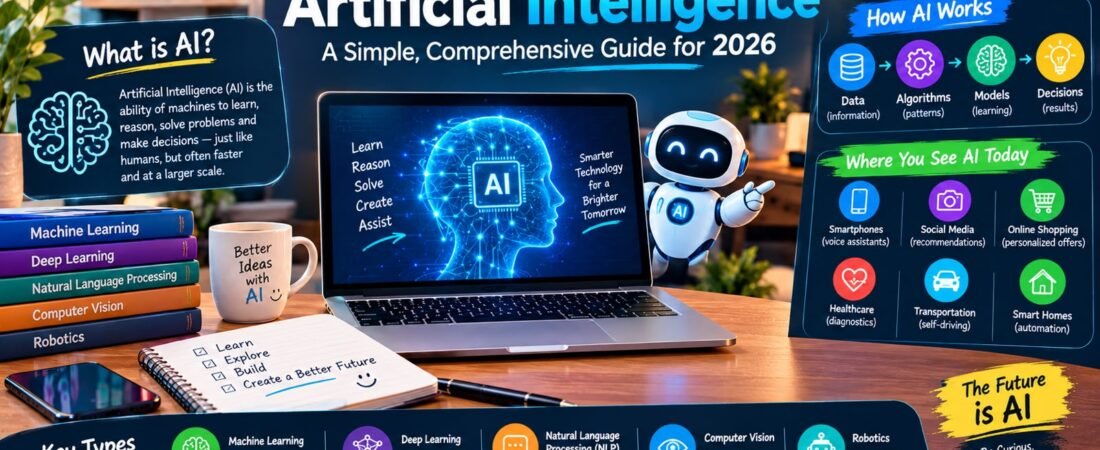
Introduction: The Invisible Engine Transforming Our Modern World
Artificial Intelligence (AI) has rapidly transitioned from the esoteric realm of science fiction and academic computer science laboratories into the beating heart of our daily digital existence. Just a decade ago, mentioning AI conjured cinematic images of autonomous androids or supercomputers plotting global domination. Today, artificial intelligence is far more mundane, yet exponentially more powerful: it is the invisible, tireless engine powering the smartphone in your pocket, optimizing the electrical grid in your city, diagnosing rare medical conditions before symptoms manifest, and reshaping how businesses operate across every conceivable industry.
We are currently living through a monumental technological revolution. From generative language models and deep neural networks to automated logistics routing and real-time computer vision, AI touches nearly every aspect of modern commerce, education, entertainment, and communication. Yet, despite its ubiquitous presence, artificial intelligence remains deeply misunderstood by the general public. Many view it with starry-eyed utopian optimism, while others harbor dystopian anxieties about job displacement and algorithmic control.
To navigate this rapidly evolving technological landscape intelligently, we must look past the sensationalized headlines and examine what AI actually is, how it operates under the hood, where it is actively deployed today, and what the future holds for human-machine collaboration. In this comprehensive, in-depth guide, we will break down the fundamentals of artificial intelligence, explore its real-world applications across healthcare, agriculture, and transportation, analyze the looming ethical challenges, and examine why digital literacy is non-negotiable in 2026. For broader perspectives on artificial intelligence trends, semiconductor manufacturing, and machine learning research, you can explore reports via MIT Technology Review alongside global tech insights from The Verge AI Desk and expert digital primers at My Tech Hub Innovation Blog.
1. What Is Artificial Intelligence? Defining Machine Cognition
Artificial Intelligence (AI) can be defined as imitation, duplication, and imitation of human intelligence processes through computers, software programs, and digital machinery. Whereas conventional computer programs mainly work according to pre-defined codes, AI systems are based on the ability to sense their surrounding, learn from steady information inputs, make logical decisions, and act independently and autonomously toward some goals.
How Machines “Think” and Learn
To understand AI, it helps to break down its foundational sub-disciplines:
- Machine Learning (ML): Machine Learning, relates directly to AI as it requires vast amounts of historical data as training input. For instance, machine learning algorithms can perform their tasks without direction by analyzing the statistical correlation presented in the given data.
- Deep Learning (DL): An advanced branch of machine learning inspired by the biological structure of the human brain. Deep learning utilizes multi-layered artificial neural networks to process incredibly complex inputs, such as raw audio waveforms, high-definition video feeds, and intricate natural language text.
- Natural Language Processing (NLP): The technology that enables machines to read, parse, interpret, and generate human language in a way that feels natural and conversational.
These systems power everything from voice-activated virtual assistants like Siri, Alexa, and Google Assistant to sophisticated product recommendation engines on e-commerce platforms. For deeper technical explorations into neural network architecture, read documentation via OpenAI Research Lab or technical breakdowns on Google DeepMind Portal.
2. Real-World Applications of AI in Everyday Life
Artificial intelligence is no longer confined to experimental laboratory environments; it is actively embedded in the critical infrastructure of our daily lives and professional industries.

Healthcare and Medical Diagnostics
In the medical sector, AI is transforming patient care by accelerating diagnostic accuracy and drug discovery. Machine learning models trained on millions of historical radiological scans (such as X-rays, MRIs, and CT scans) can detect early-stage tumors, microscopic fractures, and cardiovascular abnormalities with a precision that frequently matches or exceeds human specialists. Furthermore, AI models simulate molecular interactions to slash the time required to discover life-saving pharmaceutical drugs from decades down to mere months.
Precision Agriculture and Food Security
Agriculture is experiencing a high-tech renaissance driven by artificial intelligence. Agricultural robots using artificial intelligence, such as computerized drones and fully automated tractors which allow for the analysis of crops in real-time help the farmers to reduce the attempts to check for pest presence in crops, monitor the condition of plantations, and distribute water and fertilizers as precisely as possible.
Autonomous Transportation and Logistics
The automotive and shipping industries rely heavily on AI to power self-driving vehicle technology, advanced driver-assistance systems (ADAS), and global supply chain routing. Computer vision algorithms process real-time sensor feeds from LiDAR, radar, and cameras to navigate complex urban traffic safely, while predictive AI models optimize freight shipping routes to minimize fuel consumption and delivery delays.
3. Mechanics of Machine Learning: Training Data and Algorithms
Ever wonder how a machine actually learns to recognize a cat in a photograph or translate Spanish text into English? It all boils down to training data and iterative mathematical optimization.
The Training Loop Explained
- Data Collection: The neural network gets millions of labeled samples from engineers (for example hundreds of thousands of visuals of “cat” or “dog”).
- Pattern Recognition: The algorithm analyzes pixel weights and feature boundaries, forming statistical hypotheses.
- Error Correction (Backpropagation): Once the machine makes an error (for example a dog is identified as a cat), it computes its error and recalibrates its weights.
- Validation: This process repeats billions of times across high-performance GPU server clusters until the model achieves near-perfect predictive accuracy.
Without clean, unbiased, and massive datasets, even the most advanced AI architecture remains useless. Data quality is the true currency of the artificial intelligence era. For more tips on data management and machine learning pipelines, check out My Tech Hub Software Directory or read developer tutorials via GitHub AI Hub.
4. Artificial Narrow Intelligence (ANI) vs. Artificial General Intelligence (AGI)
When discussing the future of AI, it is crucial to distinguish between current technological capabilities and theoretical milestones.
- Artificial Narrow Intelligence (ANI): Also known as Weak AI, ANI refers to systems designed and trained to execute a single, highly specific task. A chess-playing supercomputer like DeepBlue or a facial recognition algorithm is an example of ANI; it cannot write poetry, drive a car, or diagnose illnesses. Every single commercial AI application existing today falls strictly under ANI.
- Artificial General Intelligence (AGI): Also known as Strong AI, AGI represents a hypothetical future milestone where a machine possesses the cognitive ability to understand, learn, and apply knowledge across any intellectual domain just like a human being. While tech visionaries debate when or if AGI will ever be achieved, mainstream computer scientists agree that true AGI remains a distant theoretical horizon.
5. The Dark Side of AI: Bias, Ethics, and Misinformation
While the productivity benefits of artificial intelligence are undeniable, rapid technological scaling has introduced severe societal, ethical, and security challenges that demand urgent regulatory oversight.
Algorithmic Bias and Fairness
AI models are trained on historical human data. If the training data contains systemic human prejudices, socio-economic biases, or racial inequalities, the AI model will mathematically codify, amplify, and automate those biases. Biased AI algorithms deployed in criminal justice risk assessments, mortgage lending approvals, and corporate hiring pipelines can perpetuate discrimination under the false veneer of objective mathematical neutrality.
Deepfakes, Synthetic Media, and Misinformation
Generative AI tools capable of synthesizing hyper-realistic human voices, photorealistic fake imagery, and deceptive video deepfakes have democratized digital forgery. Bad actors can now generate convincing audio impersonations of public figures or fabricate breaking news events in seconds, threatening democratic election integrity, corporate security, and personal digital privacy. Establishing cryptographic provenance and media authentication standards is one of the defining cybersecurity battles of our decade.
6. Artificial Intelligence and the Future of the Global Workforce
Few topics provoke as much economic anxiety as the impact of artificial intelligence on human employment. Will robots take all our jobs?
The Shift in Human Labor
Economic history demonstrates that major technological revolutions—from the steam engine to personal computing—destroy certain routine job categories while simultaneously creating entirely new industries. AI is no exception.
- Displaced Tasks: Routine, repetitive administrative tasks, data entry, basic customer service routing, and foundational code writing are increasingly being automated by generative AI models.
- New Human Roles: Conversely, demand is exploding for AI ethics officers, prompt engineers, machine learning data curators, cybersecurity auditors, and hybrid professionals who know how to leverage AI tools to amplify their own creative and operational output.
The goal of AI integration should not be human obsolescence, but rather human augmentation—freeing workers from mind-numbing administrative toil to focus on higher-order strategic thinking, empathy, and creative problem-solving.
7. The Environmental Toll: Energy Consumption and Data Centers
The dazzling speed and conversational fluency of advanced AI models mask a staggering physical reality: artificial intelligence is exceptionally energy-intensive.
Powering the Neural Grid
Training frontier large language models and operating global cloud inference data centers requires massive arrays of specialized graphics processing units (GPUs) running twenty-four hours a day. These server facilities consume staggering amounts of electricity and millions of gallons of fresh water for liquid cooling systems.
As artificial intelligence scales globally, tech conglomerates are being forced to rethink their energy infrastructure, investing heavily in renewable solar, wind, and next-generation nuclear energy to prevent AI server expansion from derailing global carbon-reduction commitments.
8. The Future of Artificial Intelligence: What Lies Ahead?
As we look toward the horizon, the trajectory of artificial intelligence points toward deeper ambient integration, edge-computing intelligence, and multi-modal sensory understanding.

Multimodal AI and Edge Computing
Future AI models will seamlessly process text, audio, video, spatial depth, and biometric data simultaneously in real-time, mirroring human sensory perception. Furthermore, as semiconductor manufacturing advances, powerful neural processing chips are shrinking down to run locally on smartphones, smartwatches, and household appliances without requiring constant cloud connectivity, enhancing user privacy and offline responsiveness.
Understanding artificial intelligence is no longer optional reserved for computer scientists; it is an essential pillar of modern digital literacy.
Comprehensive AI Technology Reference Matrix
To help you categorize the primary domains, mechanisms, and real-world uses of artificial intelligence, review the reference table below:
| AI Sub-Field | Core Mechanism | Primary Real-World Application | Major Ethical Concern |
|---|---|---|---|
| Machine Learning (ML) | Statistical pattern recognition from historical data | E-commerce product recommendations & credit scoring | Algorithmic bias and feedback loops |
| Deep Learning (DL) | Multi-layered artificial neural networks | Medical tumor detection & autonomous vehicle vision | Massive energy consumption and carbon footprint |
| Natural Language Processing | Parsing and generating human conversational syntax | Virtual assistants, live translation, and chatbots | Automated misinformation and deepfakes |
| Computer Vision | Digital pixel analysis and spatial object tracking | Facial recognition security and satellite crop monitoring | Surveillance state expansion and privacy loss |
Frequently Asked Questions (FAQ)
Q1: Is artificial intelligence going to replace human programmers entirely?
A: No. While AI code assistants (like GitHub Copilot) can write boilerplate code, debug scripts, and accelerate development workflows, they lack systemic architectural vision, business context, and emotional intelligence. Programmers are shifting from writing syntax line-by-line to orchestrating high-level software engineering solutions.
Q2: How can I protect myself from AI-generated deepfakes and scams?
A: Maintain healthy skepticism toward unsolicited audio or video calls asking for emergency financial transfers. Establish secret family verification passphrases, rely on multi-factor authentication, and verify breaking news through reputable, independent journalistic outlets.
Q3: Do I need a background in advanced mathematics to understand AI?
A: Not necessarily. While building frontier AI models requires advanced linear algebra, calculus, and probability theory, understanding how AI impacts society, business, and daily productivity requires conceptual digital literacy rather than calculus equations.
Worth Bookmarking: Essential AI Resources for Lifelong Learners
Artificial intelligence is evolving at a breathtaking pace, and keeping your finger on the pulse of technological innovation requires reliable, authoritative information sources. Whether you are a student, an entrepreneur, or a curious professional wanting to stay informed, bookmarking trusted educational platforms ensures you won’t get left behind in a technology-driven world.
Take time to explore open-source learning repositories, ethical AI research groups, and industry publications. Embracing continuous digital education is the single best investment you can make to ensure you remain empowered, informed, and competitive in the age of artificial intelligence.