
By My Tech Hub | Tech, Made Simple
Introduction
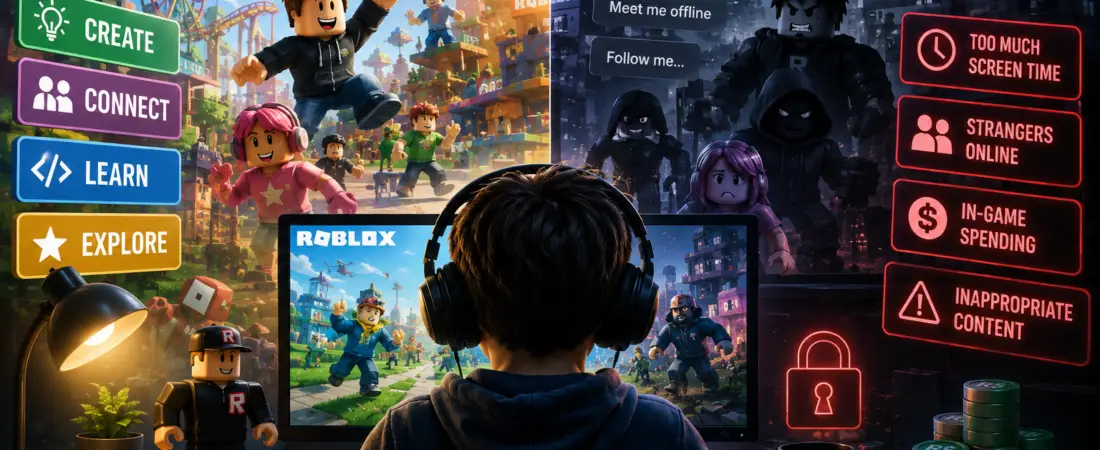
Ask a ten-year-old what they did after school, and there’s a decent chance the answer involves building a house, running a business, hosting a party, or narrowly escaping a monster — all without leaving their bedroom. That’s Roblox in a sentence: not one game, but millions of them, built by users themselves, layered with chat, currency, friendships, and a version of social life that didn’t exist for any previous generation of children.
By 2026, Roblox counts well over 150 million people logging in daily, and a substantial share of them are under 13. For many kids, it isn’t something they play occasionally — it’s closer to a shared social space, the digital equivalent of a neighborhood where friends gather, hang out, build things, and sometimes get into trouble.
That scale raises a genuinely difficult question, one that doesn’t have a tidy answer. Is Roblox simply the modern version of kids playing together after school — trading a backyard for a browser? Or is something more fundamental shifting: how children socialize, spend money, form identities, and understand the difference between a stranger and a friend?
This article won’t rush to answer that. Instead, it walks through what Roblox actually is, why it captured this much of a generation’s attention, what the platform genuinely offers, where the real risks lie, and what parents, educators, and anyone curious about the future of childhood should understand before forming an opinion.
Table of Contents
- What Exactly Is Roblox?
- Why Is Roblox So Popular With Children?
- The Good: How Roblox Can Benefit Children
- Roblox as a Creative Platform
- The Bad: Where the Concerns Begin
- The Robux Economy: When Play Becomes Spending
- Is Roblox Addictive?
- Roblox and Child Safety
- What Parents Should Know
- Roblox vs. the Real World
- The Bigger Picture: Is Roblox Changing Childhood?
- The Future of Roblox and Children
What Exactly Is Roblox?
If you’ve never opened it, Roblox is easy to misunderstand. It isn’t a single game with one set of rules, characters, or objectives — it’s a platform, more like an app store than a game console. Inside it live tens of millions of individual “experiences” (Roblox’s word for games), created not by one studio, but by ordinary users, professional studios, teenagers, and everyone in between.
A few core concepts make Roblox function the way it does:
- Experiences — the individual games or spaces users enter. These range from obstacle courses and racing games to elaborate roleplay towns, tycoon-building simulators, and social hangout spaces that barely resemble a “game” at all.
- Avatars — customizable digital characters that represent each user across every experience. Avatar customization (clothing, accessories, animations) is a major part of the platform’s appeal and its economy.
- Robux — the platform’s virtual currency, purchasable with real money and usable to buy avatar items, access premium experiences, or unlock in-game advantages.
- Roblox Studio — the free creation tool that lets users build their own experiences, including scripting logic, designing 3D environments, and publishing them for others to play.
- Chat and social features — communication tools that let users message friends or, depending on their account type and age verification status, other players within an experience.
The clearest way to understand why Roblox feels different from a traditional video game: a normal game gives you a fixed world someone else designed. Roblox gives you a platform where you might play a racing game at 4 p.m., visit a friend’s virtual house at 4:15, and be actively building your own obstacle course by 5. It blends playing, socializing, and creating into a single continuous session, which is part of why it’s genuinely difficult to describe in one sentence.
Why Is Roblox So Popular With Children?
No single factor explains Roblox’s dominance among children — it’s a combination of design choices that reinforce each other.
Endless variety. With tens of millions of experiences available, there’s effectively no ceiling on novelty. Bored of one game? There’s always another one trending among friends.
Social gravity. Roblox thrives on network effects. If a child’s friends are playing a specific experience, that experience becomes the thing to do — not because of its individual quality, but because of who’s there.
Personalization. Avatars let children express identity in a low-stakes, endlessly tweakable way, similar to how earlier generations personalized a locker or a bedroom wall.
Progression and rewards. Many Roblox experiences use game-design techniques — badges, levels, in-game currency, daily login rewards — that are common across the wider gaming and app industry, designed to encourage users to return.
Creator-driven trends. YouTube and TikTok creators who specialize in Roblox content act as a constant discovery engine, surfacing new experiences to millions of young viewers and effectively marketing the platform on Roblox’s behalf, often without any formal partnership.
Put together, these factors make Roblox difficult for anything else — homework, dinner, or another app — to compete with for a child’s attention in any given moment. That’s not necessarily evidence of manipulation; it’s evidence of effective design, the same kind that makes any successful platform successful. Whether that’s a good thing depends heavily on how it’s used, which is where the more complicated part of this conversation begins.
The Good: How Roblox Can Benefit Children
It’s tempting, especially for a publication that leans technical, to focus purely on risk. But dismissing Roblox’s genuine upsides would be inaccurate and unfair to the millions of kids who use it constructively.
Potential benefits include:
- Creative expression. Building an obstacle course, designing a virtual home, or scripting a simple game mechanic requires actual creative problem-solving, not passive consumption.
- Collaboration. Many popular experiences are built by teams of young creators working together remotely — an early, informal introduction to collaborative digital work.
- Communication skills. Coordinating with friends inside an experience, whether through voice chat, text, or in-game actions, requires real-time social coordination.
- Digital literacy. Simply navigating menus, account settings, permissions, and in-platform tools builds a baseline comfort with digital systems that increasingly matters in adult life.
- Early exposure to coding concepts. Roblox Studio uses Lua, a real scripting language. Children building anything beyond the simplest experience are, in effect, writing basic code.
- Introduction to entrepreneurship. Some young creators genuinely earn Robux (convertible to real money through Roblox’s developer payout program) from experiences they’ve built, offering an early, real-world lesson in how digital products generate income.
It’s important to be precise here: these are potential benefits, not guaranteed outcomes. A child who spends hours passively wandering low-effort social hangout spaces isn’t building the same skills as one actively designing and scripting their own experience. The platform enables both, and the difference between them matters enormously.
Roblox as a Creative Platform
Roblox Studio deserves its own section because it’s arguably the most defensible part of the platform on educational grounds. It’s a genuine, free, professional-adjacent 3D creation tool — not a simplified toy version of one.
Inside Studio, users work with:
- 3D modeling and environment design — placing, scaling, and texturing objects to build a space from scratch.
- Scripting in Lua — writing logic that controls how objects behave, how currency is awarded, or how a game mode functions.
- Monetization tools — setting up game passes, developer products, and other mechanisms that let creators earn Robux directly from players.
- Publishing and iteration — releasing an experience publicly, gathering feedback through play counts and comments, and updating it over time.
Some of the platform’s most successful creators started as teenagers and turned Roblox development into legitimate income, occasionally leading to careers in game development or software engineering. That said, this is the exception rather than the rule — most young Roblox users are players, not creators, and even among those who try Studio, few build anything approaching commercial success. The opportunity is real, but it shouldn’t be oversold as a typical outcome.
The Bad: Where the Concerns Begin
This is where the conversation gets more difficult, and where it’s important to be precise rather than alarmist.
Screen time and difficulty stopping. Many parents report that children find it hard to disengage from Roblox sessions, particularly when friends are online or an experience has active progression systems. This is a common pattern across many types of engaging digital media, not unique to Roblox specifically.
Exposure to inappropriate content. Because millions of experiences are user-generated, moderation at that scale is genuinely difficult. Despite Roblox’s content review systems, instances of inappropriate or poorly moderated content have been reported and covered in the press, and this remains an acknowledged challenge rather than a solved problem.
Contact with strangers. Roblox’s chat and social features have, in a number of documented cases covered by news outlets and referenced in ongoing lawsuits, been used by adults attempting to contact children inappropriately. This is a serious, well-documented concern that has driven significant regulatory and platform-level changes through 2026 (detailed further in the safety section below).
Cyberbullying and social pressure. As with any platform where children interact socially, exclusion, harassment, and peer pressure around spending or status can and do occur.
Spending pressure. The Robux economy, avatar customization culture, and social status tied to owning certain items can create real pressure — particularly among children who feel excluded for not having premium items their friends have.
Algorithmic and creator-driven discovery. Trending experiences promoted by outside creators aren’t necessarily vetted for age-appropriateness, meaning children can be steered toward content their parents haven’t reviewed.
None of this means Roblox is “dangerous” as a blanket statement — the vast majority of daily sessions involve no safety incident whatsoever. But it also means the “it’s just a kids’ game” framing understates what the platform actually is: a large-scale social network with a game layer attached, and it deserves the same level of parental attention as any social platform would.
The Robux Economy: When Play Becomes Spending
Robux is Roblox’s virtual currency, purchasable with real money through the app or website, and usable to buy avatar cosmetics, access premium experiences, or purchase in-experience advantages set up by individual creators (game passes and developer products).
According to Roblox’s own financial disclosures, the platform generated close to $4.9 billion in revenue for full-year 2025, with total Robux “bookings” (the amount of virtual currency purchased) reaching around $6.8 billion — both up sharply year-over-year, driven substantially by younger users’ spending alongside a growing base of adult users.
A few dynamics worth understanding:
- Status and social pressure. Because avatars are visible to friends, rare or premium items can function similarly to physical status symbols — a dynamic familiar from decades of children’s fashion and toy trends, just moved into a digital space.
- Microtransactions add up quickly. Individual purchases often feel small (a few dollars’ worth of Robux), but frequent small purchases can accumulate into significant spending over time, especially without a spending limit in place.
- Children may not fully grasp real-world value. Robux acts as an abstraction layer between a purchase and actual currency, which can make spending feel less consequential to a child than handing over physical cash would.
Practical steps parents can take include linking a parent account to manage and monitor spending, setting spending limits directly through Roblox’s parental controls, avoiding stored payment methods on a child’s device, and having direct conversations about how Robux purchases connect to real money — treating it the same way you’d teach a child about an allowance.
Is Roblox Addictive?
This is a section where precision matters more than anywhere else in this article.
Roblox is not classified as an “addictive product” by any major medical or scientific body, and it would be inaccurate to describe it that way. What does exist, recognized by the World Health Organization in its ICD-11 classification, is Gaming Disorder — a specific clinical condition defined by a persistent pattern of impaired control over gaming, increasing priority given to gaming over other life activities, and continuation despite negative consequences, typically evident over a period of at least 12 months.
That’s an important distinction. A child who plays Roblox frequently, even for long stretches, is not automatically exhibiting clinical addiction. Most heavy engagement with any enjoyable activity — reading, sports, video games generally — doesn’t meet that clinical bar.
What Roblox does share with many digital platforms is a set of design features that make disengagement harder than it might otherwise be:
- Reward loops — daily login bonuses, item drops, and progression systems that create a sense of missing out if a child stops playing.
- Social pressure — if friends are online and active in a shared experience, leaving can feel like being excluded from something happening in real time.
- Endless content — because new experiences constantly emerge, there’s no natural “end point” the way a traditional game with a finished campaign might have.
The more useful question for most parents isn’t “is Roblox addictive” but “is my child’s Roblox use interfering with sleep, schoolwork, offline relationships, or mood regulation.” That’s a practical, observable standard that doesn’t require a clinical diagnosis to act on.
Roblox and Child Safety
Safety is the area where Roblox has changed the most substantially, largely in response to significant legal and regulatory pressure. Through 2025 and into 2026, the company faced multiple lawsuits and government scrutiny — including a full platform block in Turkey and a ban in Egypt — tied to concerns about predatory contact with children and harmful content.
In response, Roblox rolled out a series of major safety changes during 2026:
- Mandatory age checks for chat. Since January 2026, any user wanting to use chat features must complete an age check, typically through facial age estimation technology (a short video processed by a third-party provider, which Roblox states is deleted after processing) or, alternatively, government ID verification.
- Age-segmented accounts. Starting in mid-2026, Roblox rolled out globally segmented account types — Roblox Kids (strictest settings, chat disabled by default for users under 9), Roblox Select (for older kids and younger teens, with chat gradually unlocking under parental oversight), and standard Roblox accounts for verified users 16 and older.
- A revamped Parental Insights dashboard, allowing parents to see which experiences a child is spending time in, monitor their friends list, and set time limits directly, rather than relying on a shared four-digit PIN system as in earlier years.
- AI-assisted chat moderation, which as of March 2026 began rephrasing messages containing flagged language rather than simply blocking them outright, aiming to keep conversation readable while filtering inappropriate content.
These changes represent a genuine, substantial shift toward a more security-conscious platform architecture. It’s worth being clear-eyed, though: no age-verification or chat-moderation system is perfect. Facial age estimation is an estimate, not a certainty, and some safety advocates and legal experts involved in ongoing litigation against Roblox have raised valid concerns about how thoroughly these systems close existing gaps versus how much responsibility they still leave with individual families.
The honest framing is that online child safety is a shared responsibility split across the platform, parents, the children themselves, and regulators — no single layer of protection, including Roblox’s newest tools, eliminates the need for parental involvement.
What Parents Should Know
Rather than treating Roblox as something to simply ban or fully trust, a more practical approach involves active, ongoing engagement:
- Understand what your child is actually doing. Use Roblox’s Parental Insights dashboard to see which experiences they’re spending time in and who they’re interacting with, rather than assuming “Roblox” means one uniform activity.
- Set the account type correctly for their age. Make sure your child is on the appropriate Roblox Kids or Select account tier, and don’t override age-appropriate chat restrictions without a clear reason.
- Talk about strangers online, specifically. General “don’t talk to strangers” advice doesn’t always translate intuitively to online chat, where a stranger can seem friendly and familiar within minutes. Explicit conversations about not sharing personal information or moving conversations to other apps matter here.
- Set spending boundaries in advance. Use built-in spending limits, avoid saved payment methods on a child’s device, and treat Robux purchases as a conversation about money, not just a tap on a screen.
- Establish screen-time boundaries collaboratively, not just punitively. Children are more likely to respect limits they understood the reasoning behind, rather than limits that feel arbitrary.
- Keep communication open rather than defaulting to a full ban. Outright banning a platform this socially central to a child’s peer group can push engagement underground (using a friend’s device, for example) rather than eliminating it, and can damage the trust needed for a child to come to a parent if something goes wrong.
None of this is a substitute for professional guidance if a specific concern arises — this is general practical advice, not clinical direction.
Roblox vs. the Real World
Here’s a genuinely open question worth sitting with: is the core issue Roblox itself, or is it the broader amount of time children now spend in digital environments generally?
Compare Roblox to earlier forms of play. Physical toys and outdoor play offered unstructured creativity and physical activity, but limited social reach beyond a child’s immediate neighborhood. Traditional video games offered structured, finite entertainment, with clear start and end points, but far less social or creative dimension. Social media offers broad social connection, but comparatively little creative or constructive output. Roblox sits at an unusual intersection of all three — creative tool, game platform, and social network simultaneously.
That hybrid nature is precisely what makes it hard to categorize, and hard to regulate using rules designed for any single one of those older categories. A screen-time guideline built for “video games” doesn’t necessarily account for the social stakes of being excluded from a friend group’s shared Roblox space. A guideline built for “social media” doesn’t account for the genuine creative and technical skill-building available in Roblox Studio.
The more honest comparison isn’t Roblox versus outdoor play, as if children face a binary choice. It’s a question of balance — whether digital and offline activities are both present in a child’s life in reasonable proportion, rather than one entirely displacing the other.
The Bigger Picture: Is Roblox Changing Childhood?
Pulling the threads together: Roblox represents a genuine departure from how previous generations played, socialized, and formed peer identity, but it’s not a clean story of decline or improvement.
It has created an entirely new category of creator economy accessible to children, something no prior form of play offered at this scale. It has also created a new category of risk — persistent chat with unknown users, real-money spending pressure, and content moderation challenges — that didn’t exist in the same form for previous generations either.
It has changed what “playing with friends” looks like, from a physical backyard to a shared digital space that can include children a continent away. It has also changed what “spending time with friends” costs, introducing a virtual economy into peer relationships in a way earlier playground culture never quite did, even if trading cards and toys carried some of the same social dynamics in miniature.
Whether this amounts to childhood being “changed” for better or worse likely depends less on Roblox itself and more on the specific conditions surrounding an individual child’s use of it: how much time, what content, which social connections, how much parental awareness, and how effectively the platform’s safety tools are actually applied in that household. Two children with identical Roblox usage hours can have completely different experiences depending on those variables.
The Future of Roblox and Children
Looking ahead, several trends are worth watching, though these should be read as informed speculation rather than confirmed developments:
- AI-generated content and NPCs. The broader gaming industry is actively exploring AI tools that could let users generate game elements or interact with more lifelike non-player characters. Roblox has signaled interest in AI-assisted creation tools, though the extent of future implementation isn’t fully confirmed.
- Continued regulatory pressure. Given the pattern of lawsuits, government scrutiny, and platform bans already seen through 2025 and 2026, further regulation targeting large child-facing platforms — Roblox included — seems likely to continue, though the specific form it takes remains uncertain.
- Deeper age-segmentation. Building on the Roblox Kids and Select account rollout, further refinement of age-based content and social boundaries is a reasonable expectation, though not something Roblox has detailed beyond current plans.
- Growing adult user base. Roblox’s own reporting shows a rising share of users aged 18 and over, suggesting the platform’s future audience may look less exclusively child-focused than its reputation currently suggests.
What’s clear is that Roblox, or something functionally similar to it, isn’t a passing trend — it represents a durable shift in how a generation understands play, creativity, and social connection online. What remains genuinely uncertain is how well platform safety measures, parental engagement, and regulatory oversight will keep pace with a user base this large and this young.
Final Verdict
Is Roblox changing childhood? Yes — but not in a single direction, and not in a way that makes it simple to label good or bad.
It has given millions of children a genuine creative outlet, a low-barrier introduction to coding and digital design, and a social space that connects them with friends in ways earlier generations couldn’t access. It has also introduced real risks: exposure to inappropriate content, contact with strangers, spending pressure tied to a real virtual economy, and design patterns that make disengagement genuinely difficult for some children.
The platform itself is not the deciding factor — how it’s used is. A child actively building experiences in Roblox Studio, playing in appropriately age-gated spaces, with parents aware of their spending and social connections, has a meaningfully different relationship with the platform than one passively consuming unmoderated content for hours with no oversight. Roblox’s 2026 safety overhaul — age verification, segmented accounts, and expanded parental tools — genuinely improved the baseline, but no system of controls replaces active parental engagement.
Childhood has always adapted to whatever tools a given era makes available, from television to home video game consoles to smartphones. Roblox is simply the current chapter of that ongoing story — not a departure from how childhood evolves, but a particularly vivid example of it happening in real time.
Frequently Asked Questions
1. Is Roblox safe for children? Roblox has implemented significant safety measures as of 2026, including mandatory age verification for chat and segmented account types by age. However, no platform of this scale, with millions of user-generated experiences, can guarantee complete safety — active parental oversight remains important.
2. What age is Roblox appropriate for? Roblox itself doesn’t set a single minimum age, but its 2026 account structure (Roblox Kids, Select, and standard accounts) is designed to match content and chat access to a user’s verified age, with the strictest settings applied to the youngest users.
3. Can children talk to strangers on Roblox? It depends on account type and age-verification status. Since January 2026, chat features require an age check, and younger users are placed in more restrictive chat settings by default, though parents can adjust some settings directly.
4. Can children spend real money on Roblox? Yes, through purchasing Robux with real currency, which can then be spent on avatar items, game passes, and in-experience content. Parents can set spending limits through Roblox’s parental control tools.
5. What is Robux? Robux is Roblox’s virtual currency, purchasable with real money and usable across the platform to buy avatar customization items, access certain experiences, or purchase in-game advantages set up by individual creators.
6. Is Roblox educational? It can be, particularly through Roblox Studio, which involves real coding (in Lua), 3D design, and basic game-development logic. However, most time spent on the platform is playing rather than creating, so educational value depends heavily on how a child engages with it.
7. Does Roblox cause addiction? Roblox is not classified as an addictive product by medical or scientific authorities. The World Health Organization does recognize “Gaming Disorder” as a clinical condition, but it requires a persistent, long-term pattern of impaired control over gaming with significant life impact — most frequent Roblox use doesn’t meet that threshold.
8. How much Roblox should a child play? There’s no universal number that applies to every child. A more practical approach is watching whether play is interfering with sleep, schoolwork, or offline relationships, rather than fixating on a specific hourly limit.
9. Can parents control Roblox? Yes. Roblox’s parental control system, expanded significantly in 2025 and 2026, allows parents to link accounts, set spending and time limits, view a child’s play history and friends list, and adjust chat and content settings depending on account type.
10. Is Roblox better or worse than traditional video games? Neither framing fits well. Roblox combines gaming, social networking, and creative tools in a way traditional video games don’t, which brings different benefits (creativity, social connection) and different risks (spending pressure, stranger contact) than a typical single-player or multiplayer game.
11. Why did Roblox add facial age verification? Following multiple lawsuits and government scrutiny — including platform restrictions in countries like Turkey and Egypt — Roblox introduced facial age estimation and ID verification in 2026 to more reliably sort users into age-appropriate chat and content tiers.
12. Is Roblox popular with adults too? Yes, and increasingly so. Roblox’s own financial disclosures show a growing share of users aged 18 and older, meaning the platform’s audience is broader than its reputation as a “kids’ app” might suggest.