
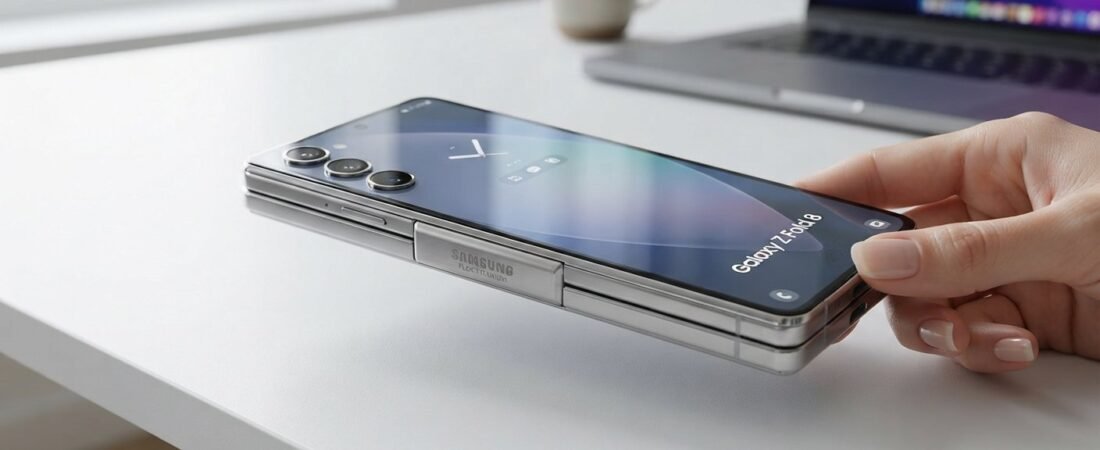
Samsung just broke its own foldable formula. After seven years of tall, narrow book-style phones, the Galaxy Z Fold 8 ditches that shape entirely for a shorter, wider design that looks — and feels — like nothing Samsung has shipped before. If you’re deciding whether this is the foldable to buy in 2026, here’s everything you need to know before you spend $1,899.
Table of Contents
- Quick Verdict on the Z Fold 8
- Release Date and Price
- Design: Z Fold 8 A Completely New Shape
- Display
- Performance
- Cameras
- Battery and Charging
- Galaxy AI Features
- What’s Missing
- Galaxy Z Fold 8 vs. Galaxy Z Fold 7: Should You Upgrade?
- Pros and Cons
- Frequently Asked Questions
- Final Thoughts
Quick Verdict on the Z Fold 8
The Galaxy Z Fold 8 is the most usable, most pocketable foldable Samsung has ever made — but it isn’t a straight upgrade over the Z Fold 7. It trades the telephoto camera and S Pen support (features the pricier Z Fold 8 Ultra keeps) for a lighter body, a wider screen built for real multitasking, and meaningfully faster charging. It’s less “Fold 7 successor” and more a brand-new product line aimed at buyers who want a foldable that behaves like a normal phone first.
Release Date and Price
Samsung unveiled the Z Fold 8 alongside the Z Fold 8 Ultra and Z Flip 8 at Galaxy Unpacked in London on July 22, 2026. Pre-orders opened the same day, with general availability starting in early August 2026.
Pricing starts at:
- $1,899 – 256GB storage, 8GB RAM
- Higher tiers with 512GB and 1TB storage and up to 16GB RAM are also available at a premium
That undercuts the Z Fold 8 Ultra by roughly $200, which lands closer to $2,099.
Design: Z Fold 8 A Completely New Shape
This is the headline change. Every previous Z Fold opened into a tall, almost-square inner display and folded into a narrow “candy bar” shape. The Z Fold 8 flips that formula:
- Inner display: 7.6 inches, with a wider 4:3 aspect ratio instead of the old near-square shape
- Cover display: 5.5 inches, noticeably wider than past Fold cover screens
- Folded dimensions: 123.9 x 81.9 x 9.7mm
- Weight: 201g — the lightest Z Fold to date
Closed, it resembles a passport rather than a phone. Early hands-on impressions have been positive: the wider cover screen makes typing and browsing far less cramped when the phone is folded shut, which was always the biggest usability complaint with older Z Fold models.
Samsung also redesigned the hinge to reduce crease visibility, and added an anti-reflective coating that Samsung claims cuts glare and reflections by up to 50% compared to the Z Fold 7.
Display
- 7.6″ inner display, 4:3 aspect ratio, up to 120Hz refresh rate
- 5.5″ cover display for quick tasks without unfolding
- Peak brightness rated for strong outdoor visibility
- New hinge geometry designed to minimize the visible crease
The wider inner aspect ratio is built for split-screen multitasking and video — Samsung is clearly positioning this as a productivity and media device first.
Performance
The Z Fold 8 runs on the Snapdragon 8 Elite Gen 5 for Galaxy, the same chip family powering this year’s flagship Galaxy S lineup, paired with up to 12GB of RAM and storage options up to 1TB. Performance won’t be a bottleneck for multitasking, gaming, or on-device AI features.
Software-wise, it ships with One UI 9 on Android 17, backed by Samsung’s commitment to seven years of software updates — a meaningful long-term value point if you plan to hold onto the phone for years.
Cameras
- 50MP main sensor
- 50MP ultrawide sensor
- 10MP dual front cameras (cover and inner)
- No telephoto lens
This is the biggest trade-off compared to both the Z Fold 7 and the Z Fold 8 Ultra. Samsung dropped the telephoto camera entirely on the standard Z Fold 8, positioning it as a step down in camera versatility even though the main and ultrawide sensors themselves are solid performers. If zoom photography matters to you, this is the spec to pay attention to before buying.
Battery and Charging
Battery life has historically been one of the Z Fold line’s weakest points, and Samsung made real gains here:
- 4,800mAh silicon-carbon (Si-C) battery — about 9% larger than the Z Fold 7’s cell
- 45W wired charging, up from just 25W on the Z Fold 7
- Roughly 63% charge in 30 minutes
- 20W wireless charging (Qi2)
- Up to a claimed 26 hours of video playback
The jump to silicon-carbon battery chemistry lets Samsung pack more capacity into a slimmer, lighter body than older lithium-ion cells would allow. Early testers report comfortable all-day battery life, something previous Z Fold generations couldn’t always guarantee.
One thing worth knowing for long-term ownership: Si-C batteries in this generation are rated around 1,200 charge cycles, somewhat lower than the 1,500+ cycle rating typical of Samsung’s S-series batteries. At one charge per day, that works out to roughly three years before capacity noticeably declines — worth factoring in if you’re weighing Samsung Care+ or a battery replacement plan.
Galaxy AI Features
The Z Fold 8 leans heavily into Samsung’s expanding Galaxy AI suite, including:
- Call Brief – automatic call summaries
- My FanCam – AI-assisted photo/video curation
- Now Nudge – contextual suggestions that prompt multitasking, like surfacing Multi Window when it detects you’re switching between related tasks
These features build on the multitasking-friendly wider display, nudging users toward using the Z Fold 8 as a genuine productivity device rather than just a novelty form factor.
What’s Missing
Two notable omissions separate the standard Z Fold 8 from the Ultra model:
- No S Pen support — neither the Z Fold 8 nor the Z Fold 8 Ultra support S Pen input this generation, continuing a long-running gap in Samsung’s foldable lineup for stylus users.
- No telephoto camera — a step back from the Z Fold 7, which did include one.
If either of these is a dealbreaker, it’s worth comparing against the Z Fold 8 Ultra, which adds a 200MP main camera (shared with the Galaxy S26 Ultra), a larger 5,000mAh battery, and a titanium-reinforced display — for about $200 more.
Galaxy Z Fold 8 vs. Galaxy Z Fold 7: Should You Upgrade?
| Galaxy Z Fold 8 | Galaxy Z Fold 7 | |
|---|---|---|
| Shape | Wide, 4:3 inner display | Tall, near-square inner display |
| Weight | 201g | Heavier, narrower body |
| Cameras | 50MP + 50MP (no telephoto) | Includes telephoto |
| Charging | 45W wired | 25W wired |
| Battery | 4,800mAh Si-C | 4,400mAh |
If you liked the Z Fold 7’s shape and camera versatility, the Z Fold 8 Ultra is the more direct successor. The standard Z Fold 8 is a sideways move for camera quality but a clear upgrade in comfort, charging speed, and battery life — worth it primarily if the new wide-screen format and lighter weight matter more to you than zoom photography.
Pros and Cons
Pros:
- Genuinely new, more pocketable form factor
- Lightest Z Fold ever at 201g
- Significantly faster 45W charging
- Larger battery with strong real-world endurance
- Seven years of promised software updates
- Reduced hinge crease
Cons:
- No telephoto camera, a downgrade from the Z Fold 7
- No S Pen support
- $1,899 starting price is still a major investment
- New form factor means learning a different way of using a foldable
Frequently Asked Questions
Is the Galaxy Z Fold 8 worth buying in 2026? It’s worth it if you want the most pocketable, comfortable-to-hold foldable Samsung has made and don’t rely heavily on zoom photography or S Pen input. If those features matter, look at the Z Fold 8 Ultra instead.
Does the Galaxy Z Fold 8 support the S Pen? No. Neither the Z Fold 8 nor the Z Fold 8 Ultra support S Pen input in this generation.
How much does the Galaxy Z Fold 8 cost? It starts at $1,899 for the 256GB/8GB RAM configuration, with higher storage tiers available at additional cost.
What’s the difference between the Z Fold 8 and Z Fold 8 Ultra? The Ultra keeps the Z Fold 7’s tall, narrow shape and adds a 200MP camera with telephoto, a larger 5,000mAh battery, and a titanium-reinforced near-crease-free display, for about $200 more. The standard Z Fold 8 is a new wider, lighter form factor without a telephoto lens.
Final Thoughts
The Galaxy Z Fold 8 isn’t a simple spec bump — it’s Samsung testing a new shape for what a foldable phone can be. For buyers frustrated by how narrow and top-heavy past Z Folds felt, this is the most natural-feeling Fold yet. Just go in knowing you’re trading some camera versatility for that comfort, and weigh whether the Ultra’s extra $200 is worth it for the camera and battery upgrades before you check out.