
By My Tech Hub Editorial Team
Tech, Made Simple.
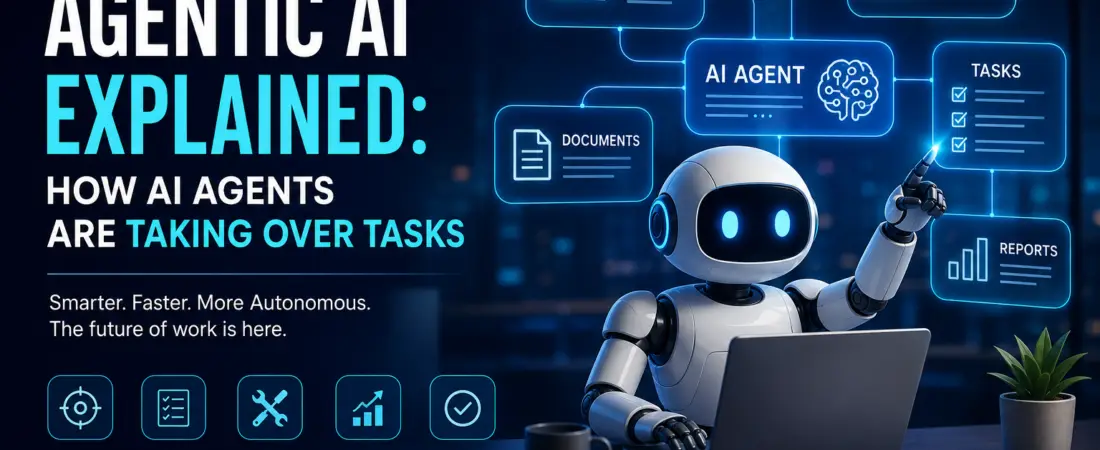
Agentic AI : Introduction
Artificial intelligence has already changed how we search the web, write emails, generate images, and answer questions. But the next major shift isn’t simply AI that responds when you ask—it’s AI that takes initiative.
Imagine assigning a digital assistant a goal like “plan my business trip,” and instead of answering with suggestions, it researches flights, compares hotels, books reservations after approval, schedules meetings, updates your calendar, and reminds you about your passport. That’s the promise of Agentic AI.
This emerging branch of artificial intelligence is moving beyond chatbots into systems capable of planning, reasoning, making decisions, and executing complex tasks with minimal human supervision. Major technology companies, startups, and enterprise software providers are investing heavily in AI agents because they could fundamentally reshape knowledge work over the next decade.
In this guide, you’ll learn what Agentic AI really means, how AI agents work behind the scenes, why they’re attracting so much attention, where they’re already being used, their limitations, the challenges they present, and what the future may hold for businesses and everyday users alike.
Table of Contents
- What Is Agentic AI?
- Understanding AI Agents
- How Agentic AI Works
- The Evolution from Chatbots to Autonomous Agents
- Why Agentic AI Is Becoming So Important
- Real-World Applications
- Advantages of Agentic AI
- Limitations and Challenges
- Common Misconceptions
- Agentic AI vs Traditional AI
- Leading Agentic AI Platforms
- Who Should Use Agentic AI?
- Best Practices for Using AI Agents
- What the Future Looks Like
- Frequently Asked Questions
- Final Verdict
What Is Agentic AI?
Agentic AI refers to artificial intelligence systems that can independently pursue goals instead of simply responding to individual prompts.
Traditional AI waits for instructions.
Agentic AI can:
- Break complex goals into smaller tasks
- Decide the best sequence of actions
- Use external tools
- Gather information
- Learn from previous attempts
- Adapt when circumstances change
- Continue working until objectives are completed
Think of the difference between a calculator and a personal assistant.
A calculator performs one operation.
A personal assistant understands your objective and completes multiple steps to achieve it.
That’s the core idea behind Agentic AI.
Understanding AI Agents
An AI agent is software designed to observe its environment, make decisions, and perform actions to achieve specific goals.
Instead of answering one question at a time, agents operate in cycles.
For example:
Goal: Organize a company meeting.
An AI agent might:
- Check participants’ calendars.
- Find available meeting slots.
- Book a conference room.
- Send invitations.
- Prepare an agenda.
- Follow up with attendees.
- Reschedule if conflicts arise.
This process happens through reasoning rather than simple prompt-response interactions.
How Agentic AI Works
Although implementations vary, most AI agents follow a similar workflow.
Step 1: Understand the Goal
The agent interprets what success looks like.
Instead of focusing on one instruction, it identifies the broader objective.
Step 2: Create a Plan
The AI decomposes large objectives into manageable tasks.
Example:
Goal:
Launch a marketing campaign.
Possible plan:
- Research competitors
- Identify target audience
- Write campaign copy
- Generate graphics
- Schedule posts
- Analyze performance
Step 3: Gather Information
Agents retrieve information from:
- Search engines
- Internal databases
- APIs
- Documents
- Company software
- Emails
- Calendars
The more context available, the better the decisions.
Step 4: Execute Actions
Unlike ordinary chatbots, agents interact with tools.
They may:
- Create spreadsheets
- Send emails
- Generate reports
- Update CRM systems
- Book appointments
- Run code
- Query databases
Step 5: Evaluate Results
Here’s where things get interesting.
Good AI agents don’t simply execute.
They evaluate whether the outcome achieved the objective.
If not, they revise the plan and try again.
This feedback loop makes Agentic AI far more capable than traditional automation.
The Evolution from Chatbots to Autonomous Agents
AI has progressed through several major stages.
| Generation | Capabilities |
|---|---|
| Rule-Based Systems | Follow predefined logic |
| Machine Learning | Learn from data |
| Generative AI | Create text, images, and code |
| AI Assistants | Answer questions conversationally |
| Agentic AI | Plan, reason, and execute tasks autonomously |
Each stage added more flexibility.
Agentic AI combines many previous breakthroughs into systems that can complete multi-step objectives.
Why Agentic AI Is Becoming So Important
Several factors are driving rapid adoption.
Better Language Models
Modern large language models can reason more effectively than previous generations.
Improved Tool Integration
AI can now interact with:
- Browsers
- Databases
- Email systems
- Business software
- APIs
- Cloud services
This dramatically expands what AI can accomplish.
Enterprise Demand
Businesses want automation beyond repetitive workflows.
Instead of automating one task, organizations want entire business processes automated.
Falling Costs
Cloud computing and AI infrastructure have become more accessible, making advanced AI agents practical for companies of all sizes.
Real-World Applications of Agentic AI
Customer Support
AI agents can:
- Resolve tickets
- Access customer history
- Issue refunds
- Escalate complex issues
- Follow up automatically
Software Development
Developers increasingly use AI agents to:
- Write code
- Debug applications
- Review pull requests
- Generate documentation
- Run tests
Healthcare Administration
Administrative AI agents help:
- Schedule appointments
- Process insurance forms
- Organize medical records
- Draft clinical documentation
Human oversight remains essential for medical decisions.
Finance
Financial institutions use AI agents for:
- Fraud monitoring
- Compliance checks
- Risk assessment
- Report generation
- Workflow automation
Marketing
Marketing teams automate:
- Keyword research
- SEO audits
- Content planning
- Campaign analysis
- Email personalization
Human Resources
AI agents assist with:
- Resume screening
- Interview scheduling
- Employee onboarding
- Benefits administration
- Internal knowledge searches
Personal Productivity
Individual users employ AI agents to:
- Plan travel
- Organize calendars
- Manage tasks
- Summarize meetings
- Research purchases
- Prepare presentations
Advantages of Agentic AI
Increased Productivity
Agents eliminate repetitive administrative work.
Faster Decision Making
They can process large amounts of information within minutes.
24/7 Availability
Unlike human workers, AI agents never need breaks.
Better Scalability
One organization can deploy hundreds of AI agents simultaneously.
Reduced Human Error
When properly configured, agents consistently follow procedures.
Cost Savings
Businesses can reduce operational costs while allowing employees to focus on higher-value work.
But There’s a Catch: Limitations and Challenges
Agentic AI is powerful, but it’s far from perfect.
Hallucinations
AI may confidently produce incorrect information.
Poor Judgment
Agents lack human intuition.
They can make technically logical yet practically flawed decisions.
Security Risks
Giving AI access to emails, databases, and financial systems creates new cybersecurity challenges.
Privacy Concerns
Sensitive company or customer information must be handled carefully.
Organizations need strong governance and access controls.
Regulatory Compliance
Industries such as finance and healthcare face strict legal requirements for AI deployment.
High Infrastructure Costs
Large-scale autonomous systems require significant computing resources.
Common Misconceptions
“AI Agents Think Like Humans”
No.
They simulate reasoning through statistical models and structured planning.
“Agentic AI Replaces Every Job”
No.
Most organizations are using AI to augment employees rather than replace them entirely.
“Agents Always Make Correct Decisions”
False.
Human supervision remains critical.
“Every Chatbot Is an AI Agent”
Not necessarily.
Many chatbots only generate responses without planning or taking actions.
Agentic AI vs Traditional AI
| Feature | Traditional AI | Agentic AI |
|---|---|---|
| Responds to prompts | ✔ | ✔ |
| Plans tasks | ✘ | ✔ |
| Uses external tools | Limited | Extensive |
| Executes workflows | Limited | Yes |
| Learns from outcomes | Basic | More adaptive |
| Multi-step reasoning | Limited | Advanced |
| Goal-oriented | No | Yes |
Leading Agentic AI Platforms
Several technology companies are actively building AI agent ecosystems.
| Platform | Primary Focus | Best For |
|---|---|---|
| OpenAI | General-purpose AI agents | Productivity, coding, research |
| Anthropic | Enterprise reasoning | Business workflows |
| Workspace automation | Productivity and search | |
| Microsoft | Business AI integration | Microsoft 365 users |
| Salesforce | CRM automation | Sales and customer service |
The market is evolving rapidly, with new tools and specialized agents appearing every month.
Who Should Use Agentic AI?
Best For
- Businesses automating workflows
- Software developers
- Content creators
- Researchers
- Marketing professionals
- Customer support teams
- Consultants
- Project managers
Who Should Be Cautious?
- Organizations handling highly sensitive data without proper safeguards
- Industries requiring human judgment for legal or ethical decisions
- Businesses without governance policies for AI use
Best Practices for Using AI Agents
If you’re considering Agentic AI, keep these recommendations in mind:
- Start with low-risk tasks.
- Keep humans involved for critical decisions.
- Monitor outputs regularly.
- Limit permissions to necessary systems.
- Protect sensitive information.
- Test thoroughly before large-scale deployment.
- Document AI actions for accountability.
- Continuously update and improve workflows.
What Does the Future Look Like?
Many experts believe Agentic AI represents the next major evolution of artificial intelligence.
Future agents may:
- Coordinate with other AI agents
- Manage entire business operations
- Perform scientific research
- Design software independently
- Operate autonomous robots
- Deliver highly personalized digital assistance
At the same time, governments and industry groups are working on standards for transparency, safety, accountability, and responsible deployment. The future is likely to involve increasingly capable AI agents working alongside people rather than replacing them entirely.
Frequently Asked Questions
1. What is Agentic AI in simple terms?
Agentic AI refers to AI systems that can plan, make decisions, use tools, and complete multi-step tasks with minimal human guidance.
2. How is Agentic AI different from ChatGPT?
A conversational AI primarily responds to prompts, while an AI agent can pursue goals over multiple steps, interact with external systems, and adapt its approach as it works.
3. Can AI agents make decisions on their own?
Yes, within the boundaries defined by their developers or users. They can choose actions, but they should still be monitored for high-impact decisions.
4. Will Agentic AI replace human workers?
It is more likely to automate repetitive work and enhance productivity than replace all jobs. Human oversight, creativity, and judgment remain essential.
5. Which industries benefit most from Agentic AI?
Software development, customer service, finance, healthcare administration, marketing, logistics, and human resources are among the sectors seeing the fastest adoption.
6. Is Agentic AI safe?
It can be safe when paired with appropriate safeguards, including access controls, monitoring, audit logs, and human review for sensitive actions.
7. Does Agentic AI require coding knowledge?
Not always. Many modern platforms provide no-code or low-code interfaces, though technical expertise can unlock more advanced capabilities.
8. Can small businesses use Agentic AI?
Yes. Cloud-based AI services make agentic capabilities increasingly affordable for startups and small businesses, especially for customer support, scheduling, and marketing tasks.
9. What are the biggest risks of Agentic AI?
The main risks include inaccurate outputs, security vulnerabilities, privacy concerns, overreliance on automation, and unintended actions if permissions are too broad.
10. What skills should I learn to work with Agentic AI?
Prompt design, workflow automation, API fundamentals, data literacy, AI governance, and critical thinking are valuable skills for building and supervising AI agents.
Final Verdict
Agentic AI marks a significant step beyond traditional chatbots and content generators. Instead of simply answering questions, AI agents can understand objectives, create plans, use digital tools, and carry out complex workflows with increasing independence. That shift has the potential to transform how businesses operate and how individuals manage everyday tasks.
However, greater autonomy also brings greater responsibility. Organizations must balance the productivity gains of AI agents with strong governance, cybersecurity practices, privacy protections, and human oversight. The most successful implementations will be those that treat AI as a capable collaborator rather than an infallible replacement for human judgment.
For professionals, now is an excellent time to learn how agentic systems work and where they fit into existing workflows. For businesses, starting with carefully selected, low-risk use cases can deliver immediate value while building confidence in the technology. As the ecosystem continues to mature, Agentic AI is poised to become a foundational layer of modern software—quietly handling routine work so people can focus on creativity, strategy, and decision-making.