
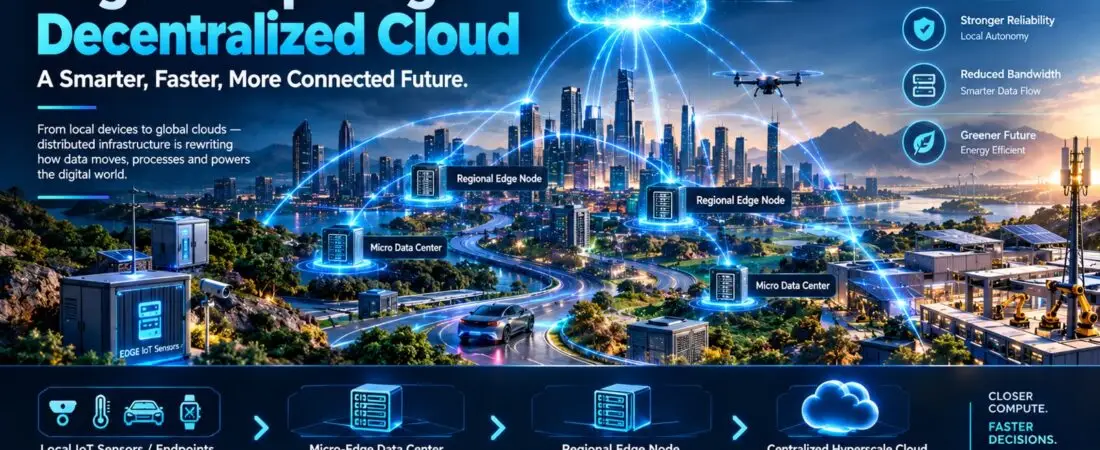
For the entire foundational era of cloud computing, the rule was simple and absolute: data travels to the server. Whether you uploaded a high-resolution video file, queried an enterprise database, or streamed an interactive gaming session, your local device acted as a lightweight endpoint. It captured your input, packaged it across standard internet protocols, and shipped it thousands of miles away to massive centralized hyperscale data centers. There, banks of high-powered servers processed the heavy lifting, compressed the result, and fired it back down the line.
While this centralized model built the modern internet, it has run into a severe physical speed limit: the speed of light and network congestion. As billions of internet-connected sensors, autonomous vehicles, industrial IoT devices, and real-time AI inference engines demand sub-millisecond response times, routing every single packet through centralized cloud hubs introduces unacceptable latency.
The antidote to this bottleneck is the mass decentralization of computing power. We are witnessing a monumental shift toward edge computing and cloud-native micro-data centers, where data processing happens right where data is generated. Let us examine how edge infrastructure works, why centralized clouds are shifting their approach, and what this decentralized revolution means for the future of digital connectivity.
The Latency Wall: Why Centralized Cloud Infrastructure Is Reaching Its Limits
To understand why edge computing has become an operational necessity rather than a supplementary trend, we must look at the mechanical constraints of long-haul data transit.
- The Physics of Round-Trip Time: Even over high-speed fiber-optic lines, data cannot travel faster than the speed of light. When cloud clusters sit hundreds or thousands of miles away, baseline round-trip latency often spikes past 50 to 100 milliseconds.
- The Bandwidth Crisis: Streaming raw, uncompressed 4K video feeds from thousands of industrial cameras back to a central cloud server overwhelms local network infrastructure and inflates bandwidth costs astronomically.
- The Mission-Critical Fail-Safe: Autonomous vehicles, smart power grids, and remote medical devices cannot afford to lose connection or experience network lag during a cloud routing failure. Local autonomy is mandatory for safety.
Architectural Anatomy: The Three-Tier Edge Ecosystem
Edge computing is not a monolith; it is structured as a hierarchical continuum bridging local devices and massive centralized cloud hubs.
[ Local IoT Sensors / Endpoints ] ──> [ Micro-Edge Data Center ]
                                             │
[ Centralized Hyperscale Cloud ] <── [ Regional Edge Node ]
- The Extreme Edge: Micro-controllers, local gateways, and on-device NPUs that handle immediate, life-critical telemetry and local sensory processing.
- The Regional Edge: Telecom cellular towers, localized fiber hubs, and modular micro-data centers deployed inside metropolitan areas to serve regional user bases with single-digit millisecond latency.
- The Central Hyperscaler: Massive long-term data repositories, deep model training clusters, and global analytics engines that synchronize data asynchronously from distributed edge nodes.
Kubernetes at the Edge: Managing Distributed Micro-Clusters
Deploying, monitoring, and updating software across thousands of remote, unattended micro-data centers introduces monumental administrative hurdles. Traditional IT deployment models—where engineers manually SSH into servers to push updates—are entirely impossible at edge scale.
- Lightweight Orchestration: Cloud-native software engineers rely on ultra-lightweight, resource-efficient Kubernetes distributions designed specifically to run seamlessly on small-footprint edge hardware.
- Declarative Remote Management: Using GitOps pipelines, platform engineers update thousands of distributed edge clusters simultaneously by pushing configuration manifests to a central repository, leaving automated controllers to reconcile remote nodes safely.
- Autonomous Resilience: Edge nodes are programmed to maintain full functional autonomy. If wide-area network (WAN) connectivity drops, the local micro-cluster continues processing workloads locally until network links are restored.
Real-World Verticals: Where Edge Architecture Shines
The migration toward decentralized cloud computing unlocks transformative capabilities across diverse industrial and consumer sectors.
- Autonomous Logistics and Transportation: Self-driving fleets require instant reaction times to handle dynamic road hazards, processing spatial sensor data locally before uploading anonymized analytics to the cloud.
- Smart Manufacturing and Industrial IoT: Industrial assembly lines utilize low-latency edge nodes to inspect products via computer vision in real time, stopping defective manufacturing loops within milliseconds.
- Immersive Extended Reality (XR): High-definition spatial computing headsets offload heavy rendering pipelines to nearby regional edge servers, ensuring smooth frame rates and eliminating motion sickness caused by network lag.
Infrastructure Bottlenecks: Physical Security, Power, and Cooling
Building decentralized micro-data centers outside of secure, temperature-controlled hyperscale warehouses introduces unique engineering and logistical vulnerabilities.
- Physical Vulnerability: Edge nodes often sit in unprotected locations—strapped to cellular masts, installed in factory basements, or housed in street-side utility boxes—requiring robust hardware-level encryption and tamper resistance.
- Unpredictable Thermal Environments: Unlike pristine enterprise server rooms, edge nodes must operate reliably across extreme outdoor temperature swings, demanding passive cooling innovations and ruggedized semiconductor packaging.
- Power Grid Reliability: Maintaining continuous uptime during local electrical grid fluctuations requires localized battery backups and intelligent power-saving operational profiles.
Common Misconceptions About Edge Computing
This is where many people get confused.
A widespread myth across tech forums suggests that edge computing is designed to completely replace centralized cloud data centers. Critics often assume that because processing moves closer to the user, hyperscalers will become obsolete.
In reality, edge computing and centralized cloud architecture operate in a symbiotic partnership. While the edge handles low-latency execution, real-time filtering, and local decision-making, centralized cloud servers remain indispensable for heavy model training, historical data warehousing, and global fleet management.
Frequently Asked Questions
1. What is edge computing? It is a distributed computing paradigm that brings data processing and storage closer to the physical location where it is gathered, minimizing latency and bandwidth consumption.
2. Why is edge computing replacing centralized cloud for certain tasks? Tasks requiring instant decision-making—like autonomous driving or real-time industrial automation—cannot tolerate the latency of sending data to distant data centers.
3. Does edge computing eliminate the need for centralized cloud data centers? No. Centralized clouds continue to handle massive data storage, deep AI model training, and long-term analytics, while edge nodes handle real-time execution.
4. How do engineers manage thousands of remote edge servers? They use lightweight, cloud-native orchestration tools and declarative GitOps pipelines to automate updates and monitor remote clusters without manual intervention.
5. What are the main physical challenges of edge hardware? Edge nodes face harsh environmental conditions, temperature fluctuations, physical security risks, and unreliable local power supplies.
6. What is a micro-data center? It is a small-footprint, self-contained data center module deployed in metropolitan areas or industrial sites to deliver regional low-latency cloud services.
7. How does 5G connectivity support edge computing? High-bandwidth, ultra-low-latency 5G cellular networks connect mobile devices and industrial IoT sensors directly to regional edge computing nodes efficiently.
Final Verdict: Building the Distributed Digital Fabric
The rapid evolution of edge computing and decentralized cloud infrastructure represents a fundamental maturing of global networking. By breaking free from the strict constraints of centralized hyperscalers and pushing computing intelligence out to the physical fringes of the network, modern systems are unlocking unprecedented responsiveness and operational resilience.
Navigating this decentralized future demands rigorous architectural discipline. Success belongs to organizations that master remote fleet orchestration, secure distributed topologies, and build hybrid systems where the edge and the cloud operate as a seamless, unified digital fabric.