Introduction: The Hidden Gems of the World Wide Web
The modern internet has transformed into a heavily monetized landscape. Everywhere you look, platforms are pushing recurring subscription walls, pop-up paywalls, aggressive tracking cookies, and premium tiers designed to squeeze every last dollar out of casual users. It is easy to feel like the golden age of open internet sharing is dead.
However, beneath the commercial noise, the web still houses an enormous amount of genuinely useful, completely legitimate digital resources that most everyday internet users have never heard of. Some of these platforms provide tools or access that feel like they should cost a fortune. Others feel so powerful that using them makes you feel like you are getting away with something. None of them are illegal — they are simply hidden in plain sight, funded by grants, non-profit archives, or freemium business models that prioritize massive user accessibility over immediate profit.
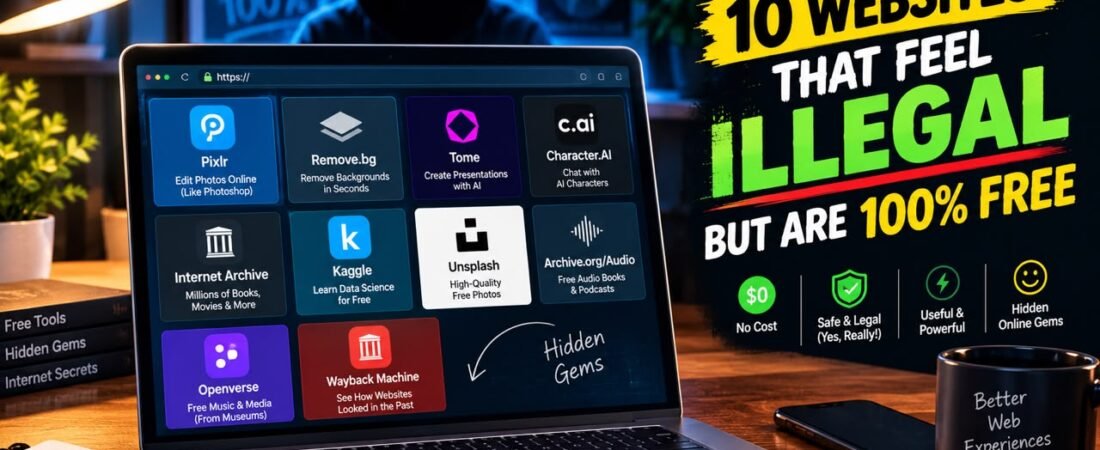
If you know where to look, you can access Ivy League course materials, professional-grade design software, digital libraries containing millions of historical texts, and high-performance translation engines without ever opening your wallet. In this comprehensive guide, we will explore ten incredible websites that feel like they shouldn’t be free, detailing what makes each one extraordinary and how you can leverage them to upgrade your daily digital workflow. For broader perspectives on digital tools and internet innovations, you can explore resources via The Verge Tech Desk alongside internet archiving studies at Electronic Frontier Foundation (EFF) and expert digital utility roundups at My Tech Hub Software Directory.
1. Archive.org — The Ultimate Digital Memory Bank
The Internet Archive is a non-profit digital library that has been quietly preserving the collective history of the web since 1996. For anyone who loves history, research, or digital preservation, it is arguably the most valuable website on earth.
Why It Feels Illegal and How It Empowers Research
- The Wayback Machine: This legendary tool lets you plug in any web URL and travel backward in time to see what that website looked like at almost any point in its history. You can view archived snapshots of early Google, ancient news pages from the year 2000, or your own childhood blog. This capability is frequently used by researchers, journalists, and legal investigators to track corporate changes, recover lost digital content, and audit historical web data.
- Massive Digital Lending Library: Beyond web pages, the archive houses millions of free public domain books, historical audio recordings, vintage software programs, live concert bootlegs, and classic films. You can borrow digital books from their virtual library for free using a standard user account, utilizing controlled digital lending protocols to ensure copyright compliance while maximizing global public access.
2. Unsplash and Pexels — Professional Photography With Zero Strings Attached
If you have ever needed clean, high-resolution imagery for a blog post, social media graphic, presentation, or business website, you know how predatory stock photo agencies can be—often charging exorbitant fees for single licenses. Unsplash and Pexels completely shatter that archaic model.
Uncompromising Visual Quality and Commercial Freedom
Both platforms offer massive libraries of breathtaking, professional-grade photography that you can download and use entirely for free, including for commercial projects, without requiring attribution or author credit.
- Unsplash skews heavily toward artistic, moody, minimalist, and editorial aesthetics, making it a favorite for conceptual web design.
- Pexels offers a broader range of everyday lifestyle, business, travel, and tech imagery, alongside a fantastic collection of free high-definition stock video clips that rival expensive paid production assets.
Using these sites will genuinely ruin traditional paid stock photography websites for you forever. For more tips on sourcing visual assets, check out My Tech Hub Innovation Blog or design resources via Smashing Magazine Design Lab.
3. Coursera Audit Option — Free Access to Ivy League Lectures
Higher education tuition costs are astronomical, leading many to believe that elite academic knowledge is locked behind heavy university paywalls. However, platforms like Coursera offer a massive loophole through their audit feature.
Unlocking World-Class Education for Free
Most people do not realize that Coursera allows users to audit the vast majority of its online courses completely free of charge. This includes structured courses offered by legendary institutions like Yale, Stanford, Johns Hopkins, Google, and IBM.
- What You Get: While you do not receive a verified certificate or graded assignments unless you pay the subscription fee, you get complete, unhindered access to all video lectures, reading materials, and self-assessment quizzes.
- Since, for instance, anyone wishing to take Yale University’s well-known Science of Well-Being course is free to access it online without paying tuition, this makes up the opportunity for self-sufficient students who want to improve their education to learn the same information as that acquired by Yale students for no cost, without having to pay off their loans.
4. Canva Free Tier — Professional Graphic Design Without a Designer
Graphic design used to require expensive desktop publishing software like Adobe Photoshop or Illustrator, combined with years of specialized training. Canva completely democratized visual design by moving powerful tools directly into the browser.
Exceptional Creative Power for Zero Cost
Canva’s free tier is astonishingly capable. It grants users access to thousands of professionally designed templates for Instagram posts, business presentations, YouTube thumbnails, flyers, resumes, and invoices.
- Drag-and-Drop Simplicity: Combined with a massive built-in library of free fonts, graphics, illustrations, and background removal tools, the free plan easily satisfies 90% of daily graphic design needs for individuals, students, and small business owners without ever forcing you to upgrade to Canva Pro. Its intuitive web interface ensures that anyone can produce publication-ready marketing assets within minutes.
5. Project Gutenberg — The World’s Greatest Classic Free Library
If you love reading classic literature, philosophy, historical texts, and poetry, Project Gutenberg is an absolute treasure chest that feels like it belongs in a utopian future.
Decades of Literature at Your Fingertips
Project Gutenberg offers over 70,000 free ebooks. Its guiding principle is simple: every book whose copyright has expired enters the public domain and is digitized for free public access. This covers virtually all classic literature written before the mid-20th century, including works by Jane Austen, Charles Dickens, Mark Twain, Shakespeare, and Arthur Conan Doyle.
- The books are available for download in every major ebook format (EPUB, Kindle MOBI, plain text), making them instantly readable on e-readers, tablets, and smartphones, thereby democratizing access to human philosophy and narrative history.
6. Open Access Journals and PubMed Central — Legitimate Academic Research
Academic research papers are notoriously locked behind expensive institutional journal subscriptions that can cost upwards of $35 per individual paper. Fortunately, the movement toward open-access science has opened up incredible legal avenues for researchers and curious minds.
Unlocking Scientific Knowledge Legally
- PubMed Central (PMC): A free full-text archive of biomedical and life sciences journal literature maintained by the National Institutes of Health (NIH), containing millions of peer-reviewed research papers available to read and download for free.
- Unpaywall: A fantastic free browser extension that automatically scans the web for legal, open-access copies of locked academic papers whenever you hit a journal paywall.
- SSRN (Social Science Research Network): Hosts a massive repository of free working papers across economics, law, political science, and social sciences, allowing independent scholars to stay at the cutting edge of global research.
7. Figma Free Tier — Industry-Standard UI/UX Design Software
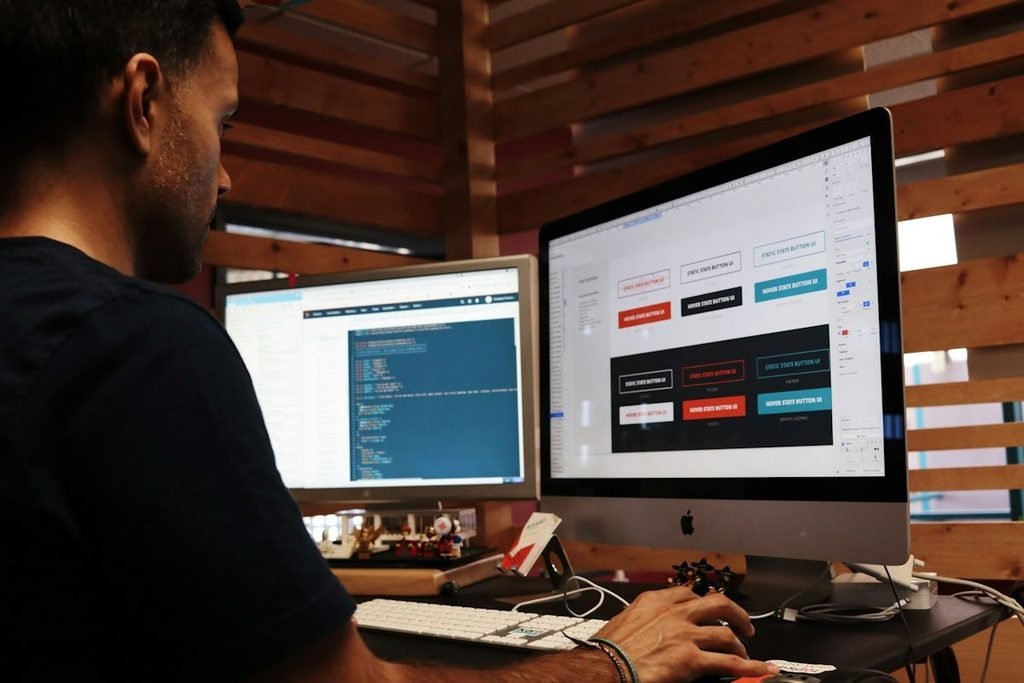
Ask any professional digital product designer, web developer, or user experience (UX) architect what software they use daily, and the universal answer is Figma. Used by design teams at Airbnb, Uber, Microsoft, and Netflix, Figma is the undisputed king of collaborative interface design.
Enterprise-Grade Power for Individuals
Astonishingly, Figma offers a robust free tier that allows individual users to create up to three active projects with full real-time collaboration tools. For students, freelance web designers, and aspiring developers, having free access to an industry-standard professional suite is an incredible privilege that would have been unimaginable just a decade ago. For deeper insights into modern web design tooling, check out resources via Smashing Magazine Design Lab or tutorials on My Tech Hub Software Directory.
8. Wolfram Alpha — The Computational Answer Engine
Standard search engines like Google are designed to find web pages and articles matching your keyword queries. Wolfram Alpha, by contrast, is designed to compute direct answers.
The Ultimate Problem Solver
Launched in 2009, Wolfram Alpha is a computational knowledge engine. Instead of giving you a list of links, it processes data using sophisticated algorithms and curated knowledge bases.
- What It Can Do: You can type in complex calculus equations, chemical balancing formulas, nutritional comparisons between two foods, historical date timelines, or precise unit conversions. Wolfram Alpha computes the exact answer step-by-step and displays its working logic. The free tier handles the vast majority of everyday student and professional queries without requiring a subscription.
9. DeepL — Neural Translation That Outsmarts Google Translate
Language translation tools have existed for decades, but they have historically suffered from stiff, unnatural syntax, awkward phrasing, and humorous translation errors. DeepL changed the industry standard entirely.
Human-Quality Neural Translation
DeepL’s proprietary translation engine consistently outperforms traditional competitors like Google Translate, producing remarkably natural-sounding, context-aware output—particularly across European and global languages.
- The free tier allows users to translate up to 500,000 characters per month and even upload entire Word or PowerPoint documents for instant file translation. If you have ever cringed at the robotic sound of automated translation software, DeepL reads like a bilingual human actually wrote it.
10. Remove.bg — Instant Artificial Intelligence Background Removal
Isolating a subject from its background used to require a skilled graphic designer spending twenty minutes painstakingly tracing hair and edges using the Lasso tool inside Adobe Photoshop. Remove.bg turns that tedious chore into a three-second automated process.
Magic Powered by Computer Vision
You simply drag and drop any photograph onto the website, and its advanced artificial intelligence instantly detects the primary subject (whether it is a person, car, product, or animal), surgically cuts it out, and returns a clean PNG file with a transparent background. While the free tier applies minor resolution limits, it is completely adequate for quick personal projects, profile pictures, and e-commerce listings.

Comprehensive Price & Utility Reference Guide
To help you categorize these incredible free web platforms by their primary function, review the reference table below:
| Website Name | Primary Function | Cost Model | Best Suited For |
|---|---|---|---|
| Archive.org | Web history & digital library | Free / Non-Profit | Researchers, historians, and book lovers |
| Unsplash / Pexels | Free stock photography | Free / Open Use | Bloggers, designers, and content creators |
| Coursera (Audit) | Ivy League online education | Free to Audit | Lifelong learners and students |
| Canva (Free) | Graphic design templates | Freemium (Robust Free) | Social media creators and small business owners |
| Project Gutenberg | Classic ebook library | Free / Public Domain | Literature enthusiasts and students |
| Figma | UI/UX product design | Freemium (Generous Free) | Web designers, developers, and students |
| Wolfram Alpha | Computational math & science | Free Tier Available | Students, engineers, and researchers |
| DeepL | Advanced neural translation | Free Tier Available | Translators, travelers, and international businesses |
| Remove.bg | AI background removal | Free (Res Limited) | E-commerce sellers and graphic editors |
Frequently Asked Questions (FAQ)
Q1: Are these websites genuinely 100% free with no hidden traps?
A: Yes. Platforms like Archive.org, Project Gutenberg, and Wolfram Alpha operate on non-profit, grant-funded, or freemium business models where the core tools remain permanently free for public use without requiring credit cards.
Q2: Can I use images from Unsplash and Pexels for commercial business projects?
A: Absolutely. Both platforms operate under permissive license terms that permit free commercial and non-commercial use of their media libraries without requiring mandatory attribution.
Q3: How does auditing a Coursera course differ from paying for it?
A: Auditing grants you free access to all video lectures, readings, and practice quizzes. Paying for the course unlocks graded assignments, peer-reviewed projects, and an official verified certificate of completion upon finishing.
Worth Bookmarking: Securing Your Digital Toolkit
Most internet users rely on a handful of familiar websites every day, assuming the web has exhausted its utility and that solving specialized problems always requires paying for expensive software licenses. These ten incredible platforms are a powerful reminder that there are brilliant, highly functional tools out there waiting to be discovered—tools that make complex tasks faster, easier, and entirely free.
Take a moment to bookmark the websites that align with your daily creative, professional, or academic pursuits. Integrating these digital powerhouses into your routine will save you time, eliminate unnecessary software subscription costs, and completely transform how you navigate the modern internet.