
By My Tech Hub Editorial Team
AI Healthcare: How Technology Is Saving Lives and Reshaping Modern Medicine
Healthcare has always relied on two things: human expertise and scientific progress. Today, artificial intelligence (AI) is becoming the bridge between them, helping doctors diagnose diseases faster, researchers discover new treatments, and hospitals operate more efficiently than ever before.
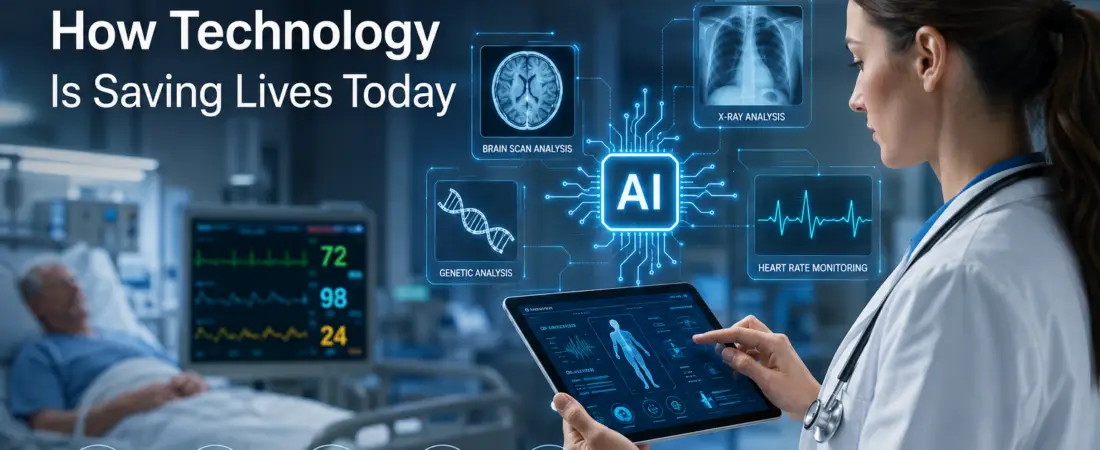
Not long ago, AI in healthcare sounded like science fiction. Today, it’s helping radiologists detect cancer earlier, enabling surgeons to perform highly precise robotic procedures, predicting patient deterioration before symptoms become critical, and accelerating the development of life-saving drugs. These aren’t experimental concepts hidden inside research labs—they’re increasingly part of everyday healthcare around the world.
Yet AI isn’t replacing doctors, despite what headlines often suggest. Instead, it’s becoming a powerful assistant that processes enormous amounts of medical information far faster than any human could, allowing healthcare professionals to make better-informed decisions.
In this guide, we’ll explore how AI is transforming healthcare, how the technology actually works, where it’s already making a measurable difference, its biggest advantages and limitations, ethical concerns, and what the future of AI-powered medicine may look like. Whether you’re simply curious or wondering how these technologies could affect your own healthcare, you’ll gain a practical understanding of one of the most important technological shifts of our time.
Table of Contents
- What Is AI in Healthcare?
- How Artificial Intelligence Works in Medicine
- A Brief History of AI in Healthcare
- Why AI Has Become So Important
- Major Applications of AI in Healthcare
- Benefits of AI for Patients and Medical Professionals
- Challenges and Limitations
- AI vs Traditional Healthcare Methods
- Common Misconceptions About AI Healthcare
- The Future of AI in Medicine
- Frequently Asked Questions
- Final Verdict
What Is AI in Healthcare?
Artificial intelligence in healthcare refers to computer systems that can analyze medical data, recognize patterns, assist with decision-making, and perform tasks that traditionally required human intelligence.
Unlike conventional software that follows fixed rules, AI systems learn from enormous datasets. They improve their performance by identifying relationships between symptoms, diagnoses, treatments, medical images, laboratory results, and patient histories.
Healthcare AI can assist with:
- Diagnosing diseases
- Predicting health risks
- Reading X-rays and MRI scans
- Recommending treatments
- Managing hospital operations
- Monitoring patients remotely
- Accelerating drug discovery
- Supporting medical research
The key point is simple: AI helps healthcare professionals make faster and often more informed decisions—not independent medical decisions.
How Artificial Intelligence Works in Medicine
Understanding AI becomes much easier when you think of it as a highly trained pattern-recognition engine.
Instead of “thinking” like a doctor, AI analyzes millions of examples to recognize similarities.
Machine Learning
Machine learning allows systems to learn from historical medical data.
For example:
- Thousands of chest X-rays
- Millions of patient records
- Blood test results
- Treatment outcomes
Over time, the system becomes increasingly accurate at identifying patterns associated with specific diseases.
Deep Learning
Deep learning uses neural networks inspired by the human brain.
This approach excels at:
- Medical imaging
- Cancer detection
- Eye disease screening
- Skin lesion classification
- Brain scans
Deep learning models often detect subtle abnormalities that may be difficult for humans to notice immediately.
Natural Language Processing (NLP)
Doctors generate enormous amounts of written information every day.
Natural language processing enables AI to understand:
- Clinical notes
- Medical literature
- Research papers
- Patient records
- Insurance documentation
This dramatically reduces administrative work while making valuable information easier to access.
Predictive Analytics
Predictive AI estimates future outcomes using historical trends.
Hospitals use predictive analytics to identify:
- Patients at risk of sepsis
- Heart failure complications
- Readmission likelihood
- ICU deterioration
- Medication complications
Here’s where things get interesting: predicting illness before symptoms become severe often saves more lives than treating disease after it progresses.
A Brief History of AI in Healthcare
Although AI seems like a recent breakthrough, its medical roots stretch back decades.
| Year | Milestone |
|---|---|
| 1950s | Early AI concepts introduced |
| 1970s | Expert medical diagnosis systems developed |
| 1990s | Computer-assisted radiology improves |
| 2010s | Deep learning transforms medical imaging |
| 2020s | Generative AI and large language models begin supporting clinical workflows |
Several factors accelerated AI adoption:
- Digital health records
- Affordable cloud computing
- Faster GPUs
- Massive healthcare datasets
- Improved AI algorithms
Without these developments, modern healthcare AI simply wouldn’t exist.
Why AI Has Become So Important
Healthcare systems worldwide face common challenges:
- Growing populations
- Aging societies
- Doctor shortages
- Rising healthcare costs
- Increasing chronic diseases
- Administrative overload
AI helps address many of these issues by improving efficiency rather than replacing healthcare professionals.
Consider a radiologist reviewing hundreds of scans daily. AI can automatically highlight suspicious regions, allowing the specialist to focus attention where it’s needed most.
The result isn’t replacing expertise—it’s amplifying it.
Major Applications of AI in Healthcare
1. Medical Imaging
Medical imaging is arguably AI’s greatest success story.
AI now assists with:
- X-rays
- CT scans
- MRI scans
- Mammograms
- Ultrasounds
- Retinal scans
It can identify abnormalities that warrant closer review while helping specialists prioritize urgent cases.
Common Uses
- Lung cancer detection
- Breast cancer screening
- Brain hemorrhage identification
- Bone fracture analysis
- Diabetic eye disease detection
2. Early Disease Detection
Earlier diagnosis often means better outcomes.
AI helps identify diseases before obvious symptoms appear.
Examples include:
- Alzheimer’s disease
- Parkinson’s disease
- Heart disease
- Diabetes
- Certain cancers
- Kidney disease
Early intervention frequently reduces treatment complexity and improves survival rates.
3. Drug Discovery
Developing a new medication traditionally takes many years.
AI dramatically accelerates several stages by:
- Identifying promising molecules
- Predicting protein interactions
- Simulating chemical behavior
- Prioritizing drug candidates
- Reducing laboratory trial requirements
While clinical testing remains essential, AI helps researchers focus on the most promising options sooner.
4. Personalized Medicine
Every patient is different.
AI combines information from:
- Genetics
- Medical history
- Lifestyle
- Lab tests
- Current medications
Doctors can then develop treatment plans better tailored to individual patients rather than relying solely on broad population averages.
5. Robotic Surgery
Robotic surgical systems do not operate independently.
Instead, surgeons control sophisticated robotic instruments that enhance precision.
Advantages include:
- Smaller incisions
- Reduced blood loss
- Greater precision
- Faster recovery
- Lower infection risk
AI can also assist by providing real-time guidance and identifying anatomical structures.
6. Virtual Health Assistants
Healthcare chatbots and virtual assistants help patients:
- Schedule appointments
- Answer basic medical questions
- Remind users about medications
- Monitor chronic conditions
- Provide post-surgery guidance
These systems reduce pressure on healthcare staff while improving accessibility.
7. Remote Patient Monitoring
Wearable technology has become increasingly sophisticated.
Devices continuously monitor:
- Heart rate
- Blood oxygen
- Sleep quality
- Blood glucose
- Blood pressure
- Physical activity
AI analyzes these data streams and alerts healthcare providers when concerning trends emerge.
8. Hospital Management
Not every AI application directly treats patients.
Hospitals use AI for:
- Staff scheduling
- Bed management
- Supply chain optimization
- Billing
- Predicting patient demand
- Reducing waiting times
Better operational efficiency ultimately benefits patients.
9. Medical Research
Researchers face an overwhelming volume of scientific literature.
AI can rapidly:
- Summarize studies
- Identify research trends
- Compare clinical trials
- Discover hidden relationships
- Generate research hypotheses
This allows scientists to spend more time validating discoveries rather than searching for information.
Benefits of AI for Patients and Medical Professionals
For Patients
- Faster diagnoses
- Earlier disease detection
- More personalized treatment
- Reduced medical errors
- Improved access to healthcare
- Better chronic disease monitoring
- More convenient virtual care
For Doctors
- Decision support
- Reduced paperwork
- Faster image analysis
- Improved workflow
- Better access to research
- Enhanced treatment planning
For Healthcare Systems
- Lower operational costs
- Better resource allocation
- Increased efficiency
- Reduced hospital overcrowding
- Improved patient outcomes
AI vs Traditional Healthcare Methods
| Feature | Traditional Healthcare | AI-Assisted Healthcare |
|---|---|---|
| Diagnosis | Human expertise only | Human expertise supported by AI analysis |
| Image Review | Manual | Automated assistance plus human review |
| Drug Discovery | Mostly laboratory-based | AI-assisted candidate identification |
| Patient Monitoring | Periodic visits | Continuous remote monitoring |
| Administrative Tasks | Mostly manual | Largely automated |
| Treatment Planning | Standard guidelines | Increasingly personalized recommendations |
AI does not replace traditional medicine—it enhances it.
Challenges and Limitations
AI healthcare isn’t perfect.
Privacy Concerns
Medical data is among the most sensitive personal information.
Hospitals must ensure:
- Strong encryption
- Secure storage
- Limited access
- Regulatory compliance
Protecting patient privacy remains a top priority.
Bias in AI Models
AI systems learn from existing datasets.
If those datasets underrepresent certain populations, performance may vary across different demographic groups.
Developers are increasingly working to improve dataset diversity and fairness.
Lack of Human Judgment
Medicine involves empathy, ethics, and nuanced decision-making.
AI cannot:
- Comfort anxious patients
- Understand every personal circumstance
- Replace physician experience
- Make ethical decisions independently
Human oversight remains essential.
Regulatory Challenges
Healthcare AI must undergo rigorous testing before clinical deployment.
Governments and regulatory agencies continue developing frameworks to evaluate:
- Safety
- Reliability
- Transparency
- Accountability
Cost of Implementation
Large hospitals may have the resources to deploy advanced AI systems, but smaller clinics can face challenges such as:
- Infrastructure upgrades
- Staff training
- Software licensing
- Data integration
Over time, cloud-based AI services may reduce these barriers.
Common Misconceptions About AI Healthcare
“AI Will Replace Doctors”
This is perhaps the biggest myth.
Doctors bring clinical judgment, communication, ethics, and compassion—qualities AI cannot replicate.
AI serves as an intelligent assistant.
“AI Is Always Correct”
AI systems can make mistakes.
Errors may occur because of:
- Poor-quality data
- Rare diseases
- Unusual cases
- Incomplete patient information
Healthcare professionals must always validate AI recommendations.
“AI Only Benefits Large Hospitals”
Many AI-powered tools are now available through cloud platforms, smartphones, and telemedicine services, making advanced capabilities increasingly accessible.
“AI Can Cure Every Disease”
AI accelerates research and improves diagnosis, but it does not eliminate biological complexity.
Medicine remains an evolving science.
Practical Considerations Before Trusting AI Healthcare
Patients should remember:
- AI complements professional medical advice.
- Ask your doctor how AI supports your diagnosis.
- Continue regular health screenings.
- Protect your personal medical data.
- Use reputable healthcare providers and approved digital health tools.
Being informed helps patients benefit from AI while maintaining realistic expectations.
Who Benefits Most from AI Healthcare?
AI delivers value across the healthcare ecosystem.
Patients
Best for:
- Chronic disease management
- Preventive care
- Remote monitoring
- Faster diagnostics
Doctors
Best for:
- Medical imaging
- Clinical decision support
- Documentation
- Research assistance
Hospitals
Best for:
- Resource optimization
- Operational efficiency
- Predictive planning
- Administrative automation
Researchers
Best for:
- Drug discovery
- Data analysis
- Clinical trial optimization
What Does the Future of AI in Healthcare Look Like?
Healthcare is moving toward increasingly intelligent, connected systems.
Emerging developments include:
- AI-powered digital twins for personalized treatment simulations
- More capable wearable health devices
- Faster drug discovery using advanced generative AI
- AI-assisted precision oncology
- Predictive public health surveillance
- Better integration of genomics into everyday care
- Smarter clinical documentation tools
- Expanded telemedicine with AI support
The real question is not whether AI will become part of healthcare—it already has. The more important question is how responsibly we develop, regulate, and use it.
The most successful healthcare systems will likely combine advanced technology with human expertise rather than treating them as competitors.
Frequently Asked Questions
1. What is AI in healthcare?
AI in healthcare refers to technologies that analyze medical data, assist clinicians, automate administrative tasks, support diagnosis, and improve patient care using machine learning and related techniques.
2. Can AI diagnose diseases?
AI can assist in identifying patterns associated with disease, particularly in medical imaging and predictive analytics, but diagnoses should be confirmed by qualified healthcare professionals.
3. Is AI replacing doctors?
No. AI is designed to support doctors by improving efficiency and providing additional insights, not replace their expertise, judgment, or patient relationships.
4. How does AI improve medical imaging?
AI can rapidly analyze scans, highlight suspicious findings, prioritize urgent cases, and reduce the time specialists spend reviewing routine images.
5. Is patient data safe with AI?
It can be, provided healthcare organizations implement strong cybersecurity measures, comply with privacy regulations, and use AI systems responsibly.
6. What diseases can AI help detect?
AI has shown promise in supporting the detection of various conditions, including certain cancers, diabetic eye disease, heart conditions, neurological disorders, and lung diseases.
7. Can AI create new medicines?
AI helps researchers identify promising drug candidates and optimize early stages of drug discovery, but laboratory research and clinical trials remain essential.
8. Are AI-powered healthcare tools expensive?
Costs vary widely. Large hospital systems often make significant investments, while cloud-based AI services and consumer health apps are making many tools more affordable.
9. What are the biggest risks of AI in medicine?
Key concerns include data privacy, algorithmic bias, lack of transparency, overreliance on AI recommendations, and ensuring appropriate human oversight.
10. What skills will healthcare professionals need in an AI-driven future?
Healthcare workers will increasingly benefit from understanding data literacy, AI-assisted decision-making, digital health tools, cybersecurity awareness, and ethical use of technology alongside traditional clinical expertise.
Final Verdict
Artificial intelligence is no longer a futuristic concept in healthcare—it’s becoming a practical tool that improves diagnosis, accelerates research, streamlines hospital operations, and supports better patient outcomes. From identifying diseases earlier to helping researchers develop new treatments, AI is expanding what modern medicine can achieve while allowing healthcare professionals to focus more on the human side of care.
At the same time, AI is not a substitute for doctors, nurses, or medical specialists. Successful healthcare depends on combining advanced technology with human expertise, empathy, and sound clinical judgment. Challenges such as privacy, fairness, regulation, and transparency still require careful attention, and responsible adoption will determine how much value AI ultimately delivers.
For patients, AI promises more personalized and proactive care. For clinicians, it offers powerful decision-support tools that can reduce workload and improve accuracy. And for healthcare systems, it represents an opportunity to make limited resources go further without compromising quality.
As AI continues to evolve, the healthcare organizations that embrace it thoughtfully—while keeping people at the center of every decision—will be best positioned to deliver safer, smarter, and more accessible care. The future of medicine isn’t human versus machine; it’s human expertise strengthened by intelligent technology.