
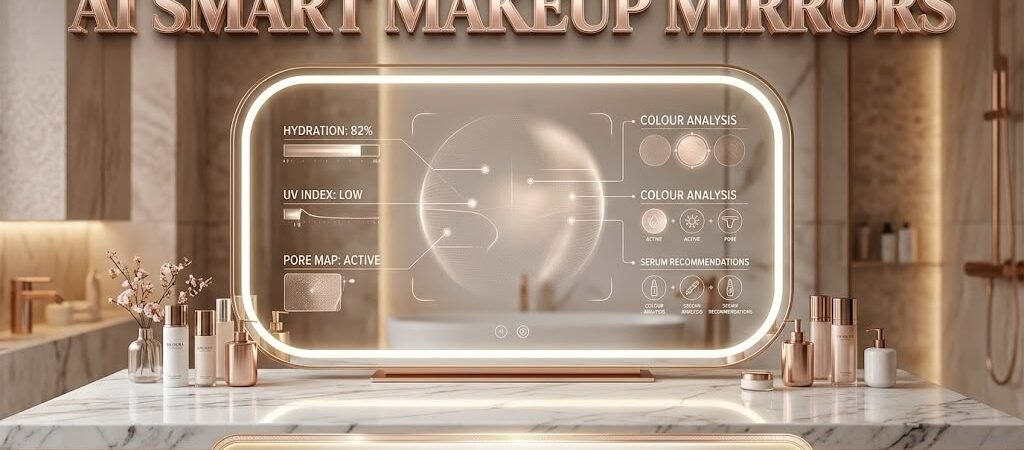
Introduction: The Convergence of Dermatology and Edge Artificial Intelligence in Modern Vanities
For generations, the morning skincare and makeup routine has been an intuitive, highly subjective daily ritual. We stood in front of traditional glass mirrors bathed in uneven bathroom lighting, squinting at our reflections, guessing whether a sudden breakout was caused by stress, humidity, or a poor dietary choice, and blindly applying moisturizers, serums, and foundations recommended by generalized beauty magazines or social media influencers. While skincare is a multi-billion-dollar global industry, the consumer approach to treating skin has historically relied on trial and error—purchasing expensive products, hoping for visible results, and lacking any objective scientific metrics to track whether a specific serum is actually repairing dermal barriers or simply sitting on the surface.
Today, rapid breakthroughs in multispectral imaging, computer vision, edge computing, and generative artificial intelligence are permanently transforming the household vanity into an advanced dermatological clinic. We have entered the era of the AI-powered smart makeup mirror—sophisticated, mirror-embedded computer systems equipped with high-resolution cameras, specialized ultraviolet and polarized lighting arrays, and localized neural processors capable of scanning your skin in real-time, diagnosing micro-imperfections invisible to the naked eye, and dynamically prescribing personalized skincare routines.
Can AI-powered smart makeup mirrors really recommend skincare routines in real-time, or are they an over-engineered luxury gadget capitalizing on consumer insecurity? In this comprehensive, exhaustive guide, we will deconstruct the multispectral hardware architecture, analyze computer vision biometric mapping, explore real-time recommendation engines, and evaluate whether smart mirrors are ready to revolutionize personal skincare. For broader industry insights into beauty technology and consumer electronics trends, you can explore reports via Allure Beauty Technology Desk alongside dermatological imaging studies from Journal of Investigative Dermatology Portal and technical guides at My Tech Hub AI Research Portal.
1. Defining the AI Smart Makeup Mirror: Hardware Architecture and Multispectral Imaging
To understand how a smart mirror evaluates skin health, you must first examine the sophisticated hardware architecture hidden beneath its reflective surface. A traditional mirror is a passive sheet of glass coated with a reflective silver backing; an AI smart makeup mirror, by contrast, is an active, multi-layered Internet of Things (IoT) computer system encased in an elegant bathroom-ready or vanity-ready frame.
At the core of a smart mirror’s hardware stack is a seamless integration of optical glass, high-density LED lighting strips, miniature high-resolution RGB and infrared cameras, and local edge computing microprocessors. When a user sits before the mirror, the device does not merely capture a standard visible-light photograph. Instead, it deploys a rapid succession of specialized lighting wavelengths—including cross-polarized light, parallel-polarized light, and ultraviolet (UV) illumination—to capture multiple distinct exposures of the user’s facial topography.
These specialized light waves penetrate beneath the stratum corneum (the outermost layer of skin), allowing the mirror’s optical sensors to photograph subsurface phenomena that are completely invisible in normal daylight, such as deep-set melanin pigmentation, sub-surface vascular redness, Propionibacterium acnes bacterial accumulation, and microscopic dehydration fissures. This advanced multispectral capture capability transforms an ordinary household mirror into a powerful diagnostic imaging tool.
2. Multispectral Skin Analysis: How Cameras and LEDs Capture Subsurface Dermal Data
The secret weapon enabling smart mirrors to perform clinical-grade skin assessments is multispectral imaging technology. Human skin is translucent; visible light striking the face does not bounce immediately off the surface. Instead, light penetrates several layers into the epidermis and dermis, scattering, absorbing, and reflecting back to create the unique optical signature of human skin.
Traditional smartphone cameras captured under standard indoor lighting capture only surface reflections, obscuring crucial diagnostic data hidden beneath the skin. Smart mirrors solve this by sequencing specialized LED arrays during a brief, multi-second scanning routine:
- Cross-Polarized Lighting: Cancels out surface specular glare, allowing the optical sensor to capture subsurface vascular conditions, broken capillaries, erythema, and inflammatory acne lesions hidden beneath the skin.
- Parallel-Polarized Lighting: Highlights surface topography, capturing fine lines, micro-wrinkles, skin texture roughness, and pore dilation with extreme fidelity.
- Ultraviolet (UV) Imaging: Stimulates natural skin fluorophores, revealing invisible sun damage, photoaging, hidden melasma spots, and bacterial porphyrins secreted by acne-causing microbes in clogged pores.
By combining these disparate optical layers into a unified digital composite, the smart mirror captures a comprehensive biometric fingerprint of your skin’s exact physiological condition.
3. Computer Vision and Facial Biometrics: Mapping Wrinkles, Pores, and Melanin Distribution
Once the smart mirror’s camera array captures high-resolution multispectral imagery, raw pixel data must be translated into actionable clinical metrics. This is where advanced computer vision and facial biometric algorithms take over.
Utilizing deep convolutional neural networks (CNNs) trained on millions of annotated dermatological photographs, the mirror’s on-board processor executes real-time facial landmark detection to align the user’s face precisely within the optical frame. Once aligned, the computer vision pipeline segments the face into distinct anatomical zones (forehead, cheeks, nose, periorbital eye region, chin) and analyzes specific dermatological parameters:
- Pore Segmentation: Quantifying the total count, depth, and dilation diameter of pores across the T-zone and cheeks.
- Wrinkle and Fine Line Mapping: Measuring the shadow depth, length, and directional orientation of expression lines around the eyes (crow’s feet) and mouth.
- Pigmentation Analysis: Detecting localized concentrations of melanin to score sun spots, age spots, and uneven skin tone distribution.
This automated biometric mapping eliminates human subjectivity, providing consistent, repeatable scoring across standardized dermatological indexes.
4. Edge Processing vs. Cloud Computing: Privacy and Latency in Vanity Smart Devices
A fundamental architectural decision facing manufacturers of smart home beauty devices is determining where computational workloads occur: on local edge hardware inside the mirror or on remote cloud servers. Because smart mirrors capture highly sensitive biometric facial imagery, this architectural choice carries profound privacy and performance implications.
- Cloud-Based Processing: Transmitting raw, high-resolution facial scans over home Wi-Fi to remote cloud data centers allows manufacturers to deploy massive, heavy deep learning models that calculate complex skin scores with lightning speed. However, streaming intimate facial photographs to the cloud introduces severe privacy vulnerabilities and creates noticeable latency if home internet connections lag.
- Edge Computing: Utilizing dedicated on-board Neural Processing Units (NPUs) and high-performance system-on-chip (SoC) silicon housed directly inside the mirror chassis. Edge processing executes computer vision and scoring algorithms locally, ensuring that raw facial imagery never leaves the device.
To maintain uncompromising consumer trust and comply with strict global privacy regulations (such as GDPR and CCPA), leading smart mirror brands prioritize edge-first processing, ensuring that sensitive biometric data remains secure within the home. For further technical analyses on edge AI architectures and privacy-preserving machine learning, explore documentation via IEEE Consumer Electronics Magazine or hardware reviews on My Tech Hub Hardware News.
5. Real-Time Skincare Recommendation Engines: Matching Biometrics to Formulations
Scanning your skin and generating biometric scores for wrinkles, pores, and hydration is intellectually fascinating, but the ultimate commercial value of an AI smart mirror lies in its real-time skincare recommendation engine. How does a computer translate a numerical pore score into a tangible product or routine adjustment?
The recommendation engine functions as an intelligent matching system. It cross-references your current biometric skin scores against a vast, curated database of dermatological formulations, active ingredients (such as retinoids, hyaluronic acid, niacinamide, and salicylic acid), and clinical efficacy studies.
- Identifying Deficits: If the mirror detects elevated moisture loss and compromised barrier function around the cheeks, the algorithm flags a deficit in lipid retention.
- Formulation Matching: The engine searches for compatible product formulations within your existing inventory or partner e-commerce catalogs that contain ceramides, squalane, and panthenol.
- Dynamic Routine Adjustment: The mirror updates your morning and evening skincare regimens in real-time, specifying exact active percentages, layer sequencing, and application frequencies.
This algorithmic matchmaking replaces generic beauty counter guesswork with hyper-targeted, data-driven formulation science.
6. Environmental Tracking and Contextual Adaptation: Humidity, UV Index, and Pollution Sensors
Your skin’s physiological needs are not static; they fluctuate continuously in response to shifting environmental conditions, seasonal weather patterns, atmospheric pollution, and daily lifestyle stresses. A skincare routine optimized for a humid summer afternoon will fail miserably during a freezing, dry winter morning.
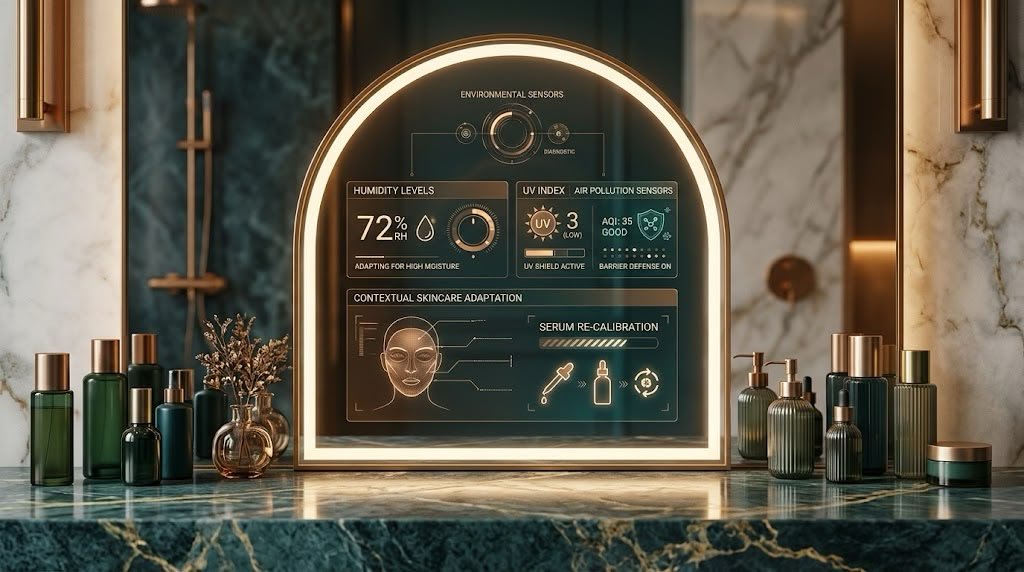
To account for these dynamic variables, advanced AI smart mirrors integrate environmental tracking sensors and cloud API weather synchronization:
- Built-in Hygrometers and Temperature Sensors: Monitor the exact ambient humidity and temperature inside your bathroom.
- Hyper-Local Air Quality and UV APIs: Pull real-time data regarding local ultraviolet index ratings, ozone levels, and particulate matter (PM2.5) air pollution based on your precise GPS location.
The mirror’s AI recommendation engine synthesizes this environmental telemetry alongside your morning facial scan. If local humidity drops drastically overnight, the system automatically recommends layering an occlusive heavy moisturizer into your morning routine to prevent trans-epidermal water loss, ensuring your skincare adapts intelligently to the outside world.
7. The Role of Augmented Reality (AR) in Real-Time Makeup Application and Virtual Try-Ons
While the primary medical and scientific focus of smart mirrors centers on clinical skin analysis and therapeutic skincare routines, their dual heritage as makeup mirrors means they excel at aesthetic enhancement through Augmented Reality (AR).
When utilizing the mirror in cosmetic mode, high-speed spatial tracking and computer vision overlay virtual makeup cosmetics directly onto your live reflection in real time.
- Virtual Try-On (VTO): Users can experiment instantly with hundreds of shades of lipstick, eyeshadows, blurs, and foundations without applying a single drop of physical product to their skin.
- Guided Step-by-Step Application: If you want to master a complex winged eyeliner or contouring technique, the mirror projects visual guidance lines directly onto your reflection, illuminating where to apply product and tracking your hand movements to provide real-time correction feedback.
This seamless fusion of medical skin diagnostics with augmented reality cosmetic styling transforms the vanity mirror into an interactive personal beauty studio.
8. Personalization Algorithms: Dynamic Skincare Routines That Evolve With Your Skin
The greatest failing of traditional skincare routines prescribed by dermatologists or beauty magazines is their static nature. You purchase a multi-step routine, use it for three months without objective feedback, and wonder why results plateau or irritation develops.
AI smart mirrors introduce dynamic longitudinal personalization. Because the mirror scans your face on a recurring weekly or monthly schedule, its underlying machine learning algorithms track your skin’s trajectory over time, evaluating whether your current routine is actually delivering measurable improvements:
- Progress Tracking: Generating visual before-and-after split-screen comparisons that quantify reductions in pore congestion or wrinkle depth.
- Routine Calibration: If your skin score shows increased inflammation or irritation after introducing a new retinol serum, the personalization algorithm flags the adverse reaction, automatically suggesting that you dial back application frequency to twice a week.
This closed-loop feedback mechanism ensures your skincare regimen evolves dynamically alongside your skin’s biological changes.
9. Dermatological Validation: Can Mirror-Based Diagnostics Rival Professional Clinical Scans?
A rigorous scientific question frequently debated by medical professionals is whether a consumer-grade smart mirror residing on a bathroom vanity can truly rival the multi-thousand-dollar professional diagnostic imaging systems (such as the Canfield VISIA complexion analysis system) utilized inside elite dermatology clinics.
The consensus among clinical dermatologists is nuanced:
- The Technological Parity: High-end smart mirrors utilize the exact same optical principles—cross-polarized lighting, UV fluorescence, and multi-spectral capture—found in clinical devices, providing remarkably accurate tracking of surface texture, pore size, and sun damage.
- The Clinical Limitation: While smart mirrors excel at routine home tracking and preventive care, they are consumer wellness devices, not certified medical diagnostic tools. They cannot diagnose skin cancers, melanoma, severe autoimmune dermatological conditions, or complex pathologies requiring physical biopsy.
Nevertheless, smart mirrors bridge the gap between clinical insight and daily self-care, empowering users to monitor baseline skin health and arrive at professional dermatologist appointments armed with months of objective biometric tracking data.
10. User Experience and Morning Routines: Integrating Smart Mirrors into Daily Life
Even the most technologically advanced hardware will be abandoned by consumers if it introduces frustrating friction into a hurried morning routine. If booting up a smart mirror requires sitting through lengthy software updates, navigating clunky menus, or enduring slow camera calibration while rushing to get to work, the device becomes a nuisance.
Leading smart mirror manufacturers invest heavily in frictionless human-computer interaction (HCI). Modern smart mirrors activate automatically via proximity sensors the moment you step up to your vanity. The facial recognition system identifies individual family members instantly, loading their personalized skincare dashboard, weather updates, calendar events, and skin scores within two seconds.
By blending skincare analytics seamlessly into ambient morning routines—displaying data while you brush your teeth or style your hair—smart mirrors deliver high-value insights without demanding unnatural behavioral changes.
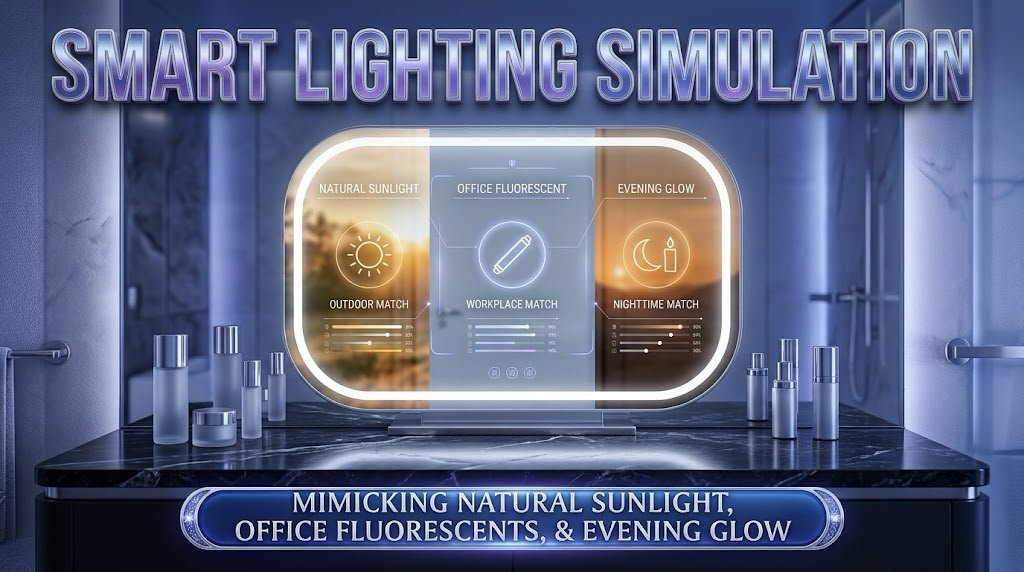
11. Smart Lighting Simulation: Mimicking Natural Sunlight, Office Fluorescents, and Evening Glow
Applying makeup or checking skincare under poor bathroom lighting is a notorious trap. Makeup applied under warm, dim vanity bulbs can look completely washed out or harshly caked when exposed to bright natural sunlight or glaring office fluorescents.
AI smart mirrors solve this through advanced smart lighting simulation systems. Surrounding the mirror glass are high-CRI (Color Rendering Index) LED arrays capable of simulating diverse environmental lighting conditions instantly:
- Daylight Mode: Replicates bright outdoor sunlight to ensure your foundation blending is seamless and natural.
- Office Fluorescent Mode: Mimics harsh commercial office lighting to test how your makeup holds up under professional working environments.
- Evening / Candlelight Mode: Simulates warm, dim restaurant or dinner lighting for evening cosmetic styling.
This versatile lighting simulation ensures that your skincare and makeup application looks flawless regardless of where your day takes you.
12. Hardware Ergonomics, Display Quality, and Anti-Fog Mirror Substrates
Designing a computer-embedded mirror that must operate flawlessly inside a humid, steamy bathroom environment requires extreme engineering resilience. Bathrooms are notoriously harsh environments characterized by rapid temperature swings, water splashes, and heavy condensation.
Manufacturers engineer smart mirrors to withstand these rigorous conditions through several specialized hardware features:
- Integrated Anti-Fog Substrates: Transparent heating films bonded behind the mirror glass maintain surface temperatures slightly above ambient dew point, ensuring the mirror remains crystal clear even immediately after a hot shower.
- IP56 Water and Dust Resistance: Robust sealing protects internal circuit boards, cameras, and NPU chips from moisture ingress and splashing.
- High-Resolution Touch Displays: Capacitive touchscreens embedded seamlessly beneath the reflective glass allow fluid gesture and touch navigation without compromising mirror reflectivity.
13. Privacy Concerns and Facial Data Governance: Protecting Biometric Imagery at Home
The deployment of cameras equipped with facial recognition and multispectral skin-scanning capabilities inside the most intimate sanctuary of the home—the bathroom—raises profound privacy and data governance concerns. Consumers are naturally protective of biometric data that maps their facial geometry and underlying dermatological conditions.
To earn consumer trust, ethical smart mirror manufacturers enforce strict data governance standards:
- Local Edge Processing: Ensuring that raw facial photographs and biometric scans are processed exclusively on the local NPU chip and never uploaded to external cloud servers.
- Physical Privacy Shutters: Providing mechanical sliding shutters or electronic hardware switches that physically disconnect power from the camera sensors when not in use.
- Encrypted Local Storage: Any historical skin score trends stored locally are protected with enterprise-grade encryption.
Transparent privacy policies and local-first data architectures are mandatory prerequisites for widespread consumer acceptance.
14. Smart Bathroom Integration: Connecting Mirrors to IoT Skincare Dispensers and IoT Hubs
An AI smart mirror does not exist in isolation; in a modern smart home, it acts as the visual and analytical command center of the broader smart bathroom and IoT ecosystem.
Through secure wireless protocols (such as Matter, Thread, Zigbee, and Bluetooth), the smart mirror integrates seamlessly with connected health and beauty devices:
- Automated Skincare Dispensers: When the mirror’s recommendation engine prescribes a specific dose of hyaluronic acid serum or retinol, it communicates directly with a connected automated countertop dispenser, which dispenses the exact prescribed milliliters into your hand.
- Smart Shower and Humidity Control: The mirror coordinates with smart bathroom ventilation fans and shower thermostats to optimize ambient humidity before you step out of the shower.
This deep IoT integration transforms routine self-care into an automated, coordinated wellness ritual.
15. Intellectual Property, Patent Landscapes, and Global Corporate Rivalries in Beauty Tech
The rapid commercial maturation of AI smart mirrors, multispectral skin-analysis algorithms, AR virtual try-on engines, and edge biometric sensors has triggered an intense, multi-billion-dollar corporate race for global intellectual property dominance. Major beauty conglomerates (such as L’Oréal and Estée Lauder), specialized consumer electronics brands, and health-tech startups are fiercely patenting every conceivable breakthrough in polarization imaging, dynamic skincare recommendation code, and anti-fog mirror bonding.
Securing foundational patents in this competitive industry dictates which corporations will control global supply chains, manufacturing licensing frameworks, and commercial distribution channels across the digital beauty era. This high-stakes corporate rivalry has transformed advanced optics laboratories and beauty-tech spin-offs into prime acquisition targets. Venture capital firms and multinational tech giants are pouring massive capital injections into engineering teams capable of solving manufacturing yield hurdles associated with smart glass integration. Furthermore, navigating global patent landscapes requires aggressive international legal strategies to prevent intellectual property infringement across competing jurisdictions. For comprehensive analyses on patent filings and intellectual property trends in beauty hardware, explore reports via World Intellectual Property Organization (WIPO) Analytics Portal alongside market strategy guides at My Tech Hub Business Portal.
16. The Societal and Psychological Impact of Quantified Beauty and Skin Tracking
The widespread consumer transition toward quantified self health tracking and AI-driven skin scoring introduces profound societal, cultural, and psychological considerations. For decades, the beauty industry was criticized for promoting unattainable aesthetic standards through airbrushed advertisements. Today, smart mirrors invite consumers to scrutinize their own reflections through clinical metrics—scoring pore size, wrinkle depth, and spot counts on a daily basis.
This digital quantification of personal appearance creates a complex psychological double-edged sword:
- Empowerment Through Data: Users gain objective insights that help them combat frustrating skin conditions like acne or rosacea with scientific precision.
- Anxiety and Perfectionism: Quantifying minor skin flaws into numerical scores can exacerbate body dysmorphia, skin anxiety, and obsessive perfectionism, particularly among younger demographic cohorts.
Balancing technological empowerment with healthy psychological self-image is an evolving ethical challenge in the digital beauty landscape.
17. Neurological Ergonomics: Minimizing Cognitive Friction in Morning Self-Care Routines
When industrial designers, software user-interface architects, and ergonomic specialists develop smart mirror interfaces, the psychological comfort, cognitive ease, and subjective user experience of everyday consumers managing their morning routines are just as critical as complex computer vision algorithms. For generations, consumers suffered from “information overload fatigue” when interacting with smart gadgets early in the morning.
Software designers invest heavily in human-computer interaction (HCI) research to ensure that smart mirror interfaces maintain absolute visual clarity, minimalist layouts, and intuitive touch or voice navigation. Advanced operating systems feature ambient glanceable dashboards that display only essential skin metrics and weather cues without overwhelming the user. This careful attention to ergonomic software design ensures that advanced technology enhances rather than disrupts morning relaxation.
18. Environmental Sustainability, Circular Economics, and E-Waste Considerations in Smart Glass
As the global consumer electronics and home goods manufacturing industry commits to aggressive carbon neutrality targets, evaluating the complete lifecycle environmental footprint of advanced smart mirrors becomes paramount. While smart mirrors contribute positively to personal wellness by reducing trial-and-error cosmetic waste (purchasing products that do not suit your skin), questions inevitably arise regarding what happens to high-resolution cameras, LED arrays, and embedded NPU computers when mirrors reach the end of their operational usefulness.
To prevent future electronic waste and material pollution crises, sustainable manufacturing pioneers are heavily prioritizing circular economy principles. Leading smart mirror brands are designing modular product architectures featuring easily separable glass panels, recyclable aluminum frames, and easily recoverable electronic sub-components. These circular design methodologies ensure that when a smart mirror reaches the end of its functional lifespan, its materials can be efficiently disassembled and recycled back into raw supply chains.
19. Consumer Economics: Navigating Premium Price Tags and Luxury Beauty Tech Subscriptions
Like any transformative consumer electronics category during its early commercial infancy, AI smart mirrors face a steep financial barrier to entry. While a traditional vanity mirror costs twenty dollars, an advanced AI-powered smart mirror equipped with multispectral cameras, anti-fog glass, NPU edge chips, and AR lighting arrays currently commands luxury price tags ranging from $300 to over $1,500.
This premium pricing structure restricts initial commercial adoption primarily to affluent early adopters, luxury beauty enthusiasts, high-end hotel suites, and premium spa salons. Furthermore, some manufacturers explore software subscription models to unlock advanced dermatological analytics, personalized formulation deliveries, and cloud backup features.
However, as component manufacturing scales over the coming decade, pricing is projected to drop toward accessible consumer appliance thresholds, mirroring the mainstream adoption trajectory of smart home thermostats and connected fitness mirrors.
20. Dermatological AI Ethics: Avoiding Algorithmic Bias Across Diverse Skin Tones and Ethnicities
A critical ethical imperative governing the deployment of AI-powered skincare diagnostics is ensuring algorithmic fairness and equity across diverse skin tones and ethnicities. Historically, early computer vision and facial recognition datasets suffered from severe sampling bias, being trained predominantly on lighter Fitzpatrick skin types.
When applied to dermatology, an AI model trained primarily on lighter skin tones can misinterpret natural melanin distribution as hyperpigmentation, misdiagnose vascular redness in darker skin tones, or fail to accurately gauge pore depth across diverse ethnic demographics.
Leading smart mirror developers and clinical dermatology labs are actively rectifying this historical bias by curating massive, diverse training datasets encompassing all six Fitzpatrick skin phototypes across global populations. Ensuring absolute diagnostic accuracy and cultural inclusivity across all skin tones is an essential requirement for ethical beauty technology.
21. Interoperability and Ecosystem Standards: Connecting Beauty Mirrors to Health Apps
In the modern landscape of personal wellness technology, standalone gadgets operating in isolated digital silos possess severely restricted utility. Consumers tracking their sleep through smart rings, fitness through smartwatches, and nutrition through calorie-counting apps expect seamless data interoperability across all platforms.
AI smart mirrors are integrating robust Bluetooth and Wi-Fi synchronization protocols that bridge the gap between skincare tracking and broader personal health dashboards (such as Apple Health and Google Health Connect). This cross-platform data aggregation allows your daily skin hydration scores and ultraviolet exposure logs to sit alongside sleep duration, stress levels, and dietary hydration intake within a single unified wellness dashboard, unlocking profound holistic health insights.
22. Professional Salon and Dermatologist Office Deployments: Clinical-Grade Vanity Mirrors
While consumer-facing smart mirrors target residential bathroom vanities, an equally explosive commercial market is unfolding across professional dermatology clinics, high-end medical spas, and luxury hair and beauty salons.
In professional salon settings, aestheticians and dermatologists utilize clinical-grade variants of AI smart mirrors to conduct client skin consultations.
- Visual Client Consultations: Projecting magnified multispectral skin scans onto large wall monitors allows practitioners to show clients exact areas of sun damage, collagen depletion, and pore congestion in stark detail.
- Treatment Tracking: Documenting baseline skin condition before administering chemical peels, laser resurfacing, or micro-needling treatments, and proving clinical efficacy during follow-up visits with objective before-and-after biometric scores.
This professional deployment enhances client trust and validates the commercial efficacy of medical-grade skincare treatments.
23. Future Horizons: Holographic Projections, Biosensors, and Sweat Analysis in Smart Glass
Looking far beyond the immediate horizon of multispectral cameras, LED lighting arrays, and NPU edge chips, visionary biomedical engineers and optical scientists are charting the ultimate evolutionary trajectory of personal beauty technology: holographic smart glass and integrated molecular biosensors.
Future smart mirror iterations are poised to integrate non-invasive biosensors directly into the glass surface or touch interface. These advanced sensors will analyze chemical biomarkers present in facial sebum and sweat in real time—detecting cortisol levels (stress markers), glucose fluctuations, and lipid oxidation without requiring blood draws. Furthermore, holographic projection technologies will allow interactive virtual try-on interfaces to float in mid-air directly in front of the mirror, dissolving the physical boundaries between digital graphics and physical reflection.
24. The Ultimate Decision Framework: Evaluating Your Skin Health Goals and Tech Readiness
As beauty enthusiasts, skincare seekers, and smart-home gadget lovers stand at this historic crossroads between traditional intuitive skincare and emerging AI smart mirrors, evaluating hardware readiness requires disciplined strategic planning. Rushing out to purchase a luxury smart mirror without analyzing your daily skincare discipline, skin health goals, and budget thresholds can lead to operational friction and misallocated capital expenditures.
To determine whether integrating an AI smart mirror makes financial and practical sense for your daily routine today, evaluate three core pillars: skincare dedication, dermatological tracking needs, and budget threshold flexibility. If you struggle with stubborn skin conditions like adult acne or hyperpigmentation, desire objective scientific tracking to optimize expensive product purchases, and command a flexible luxury budget, acquiring a smart mirror delivers transformative practical value. Evaluate your daily beauty blueprint, balance upfront capital investment against long-term skincare optimization, and decide whether your vanity is ready to embrace the smart beauty revolution.
25. Comprehensive AI Smart Mirror Performance Matrix
To help you evaluate how AI-powered smart mirrors stack up across critical performance metrics, review the comprehensive performance matrix below:
| Evaluation Category | Real-World Performance Rating | Key Functional Takeaway |
| Multispectral Imaging | ⭐⭐⭐⭐⭐ (5/5) | Cross-polarized and UV lighting reveal subsurface sun damage and bacteria. |
| Computer Vision Accuracy | ⭐⭐⭐⭐ (4/5) | Precise biometric mapping scores wrinkles, pores, and pigmentation reliably. |
| Recommendation Engine | ⭐⭐⭐⭐ (4/5) | Matches skin deficits to active ingredients and dynamic daily routines. |
| Privacy Architecture | ⭐⭐⭐⭐⭐ (5/5) | Local edge processing ensures facial scans never leave your home vanity. |
| Price Point & Value | ⭐⭐⭐ (3/5) | Premium luxury pricing ($300–$1,500+) restricts adoption to early adopters. |
Frequently Asked Questions (FAQ)
Q1: Can AI smart mirrors actually recommend skincare routines in real-time?
A: Yes. By utilizing multispectral cameras and edge computer vision, smart mirrors scan your skin’s biometric parameters (hydration, pores, wrinkles, and bacteria) in seconds and cross-reference them against a dermatological formulation database to update your daily routine instantly.
Q2: Are my private facial scans uploaded to the cloud?
A: Leading smart mirror manufacturers prioritize edge computing, meaning your facial photographs and biometric scans are processed locally on the mirror’s on-board NPU processor and protected with local encryption to ensure absolute privacy.
Q3: Do smart mirrors replace professional dermatologists?
A: No. Smart mirrors are sophisticated consumer wellness and tracking devices designed for daily preventive care and routine optimization. They do not replace certified medical professionals for diagnosing skin pathologies or medical conditions.
Conclusion: Are AI Smart Mirrors the Future of Personal Skincare?
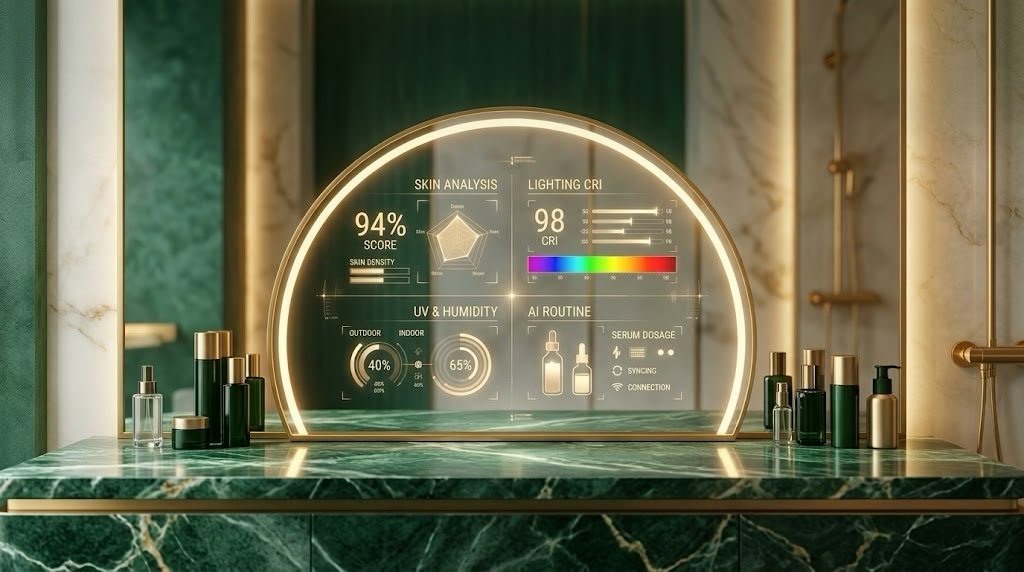
So, can AI-powered smart mirror devices really recommend skincare routines in real-time, and do they represent the future of personal beauty? The definitive answer is yes, by successfully merging clinical multispectral imaging with edge artificial intelligence and dynamic personalization algorithms, smart mirrors have transformed the household vanity into an objective, data-driven skincare laboratory.
- The diagnostic power is absolute. Multispectral lighting and computer vision reveal subsurface skin conditions that traditional mirrors miss entirely.
- The future of beauty is quantified. As hardware pricing scales down and formulation matching algorithms mature, smart mirrors are shifting personal skincare from blind guesswork into precise, real-time science.
Evaluate your skincare goals, your budget threshold, and your enthusiasm for cutting-edge home technology, and consider whether welcoming an AI smart mirror into your daily routine elevates your path to radiant, healthy skin.