
By My Tech Hub
Introduction
Every day, billions of people check the weather before leaving home. Farmers decide when to irrigate crops, airlines plan flight routes, shipping companies avoid storms, and governments prepare for floods and hurricanes—all based on weather forecasts. Yet predicting the atmosphere has always been one of science’s greatest challenges.
The Earth’s weather is an incredibly complex system where tiny changes in temperature, pressure, humidity, and wind can produce dramatically different outcomes. Traditional forecasting methods have become remarkably accurate over the past several decades, but they still require enormous computing power and struggle with rapidly changing local conditions.
Artificial intelligence is changing that equation.
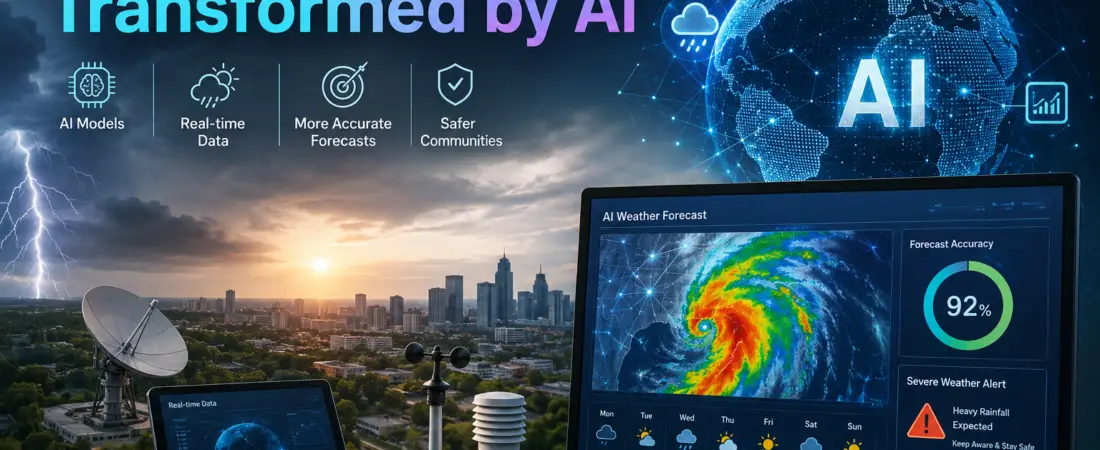
Instead of relying solely on conventional physics-based simulations, modern AI systems are learning weather patterns directly from decades of atmospheric observations and satellite imagery. These models can generate forecasts in minutes rather than hours while matching—or in some cases exceeding—the accuracy of traditional forecasting systems for many applications.
This isn’t about replacing meteorologists. Instead, AI is becoming one of their most valuable tools, helping experts detect dangerous weather earlier, improve local forecasts, reduce computational costs, and provide more personalized weather information than ever before.
In this article, we’ll explore how AI is transforming weather forecasting, the technologies behind it, where it’s already making a difference, its current limitations, and what the future may hold for one of humanity’s oldest scientific pursuits.
Table of Contents
- Why Weather Forecasting Is So Challenging
- How Traditional Weather Forecasting Works
- What AI Brings to Modern Forecasting
- The Technologies Powering AI Weather Models
- AI vs Traditional Weather Forecasting
- Real-World Applications Across Industries
- Benefits of AI Weather Prediction
- Current Challenges and Limitations
- Common Misconceptions About AI Forecasting
- What the Future Looks Like
- Frequently Asked Questions
- Final Verdict
Why Weather Forecasting Is So Challenging
Weather isn’t simply “hot” or “cold.” It’s the result of countless atmospheric interactions occurring simultaneously across the planet.
Meteorologists must account for variables including:
- Air pressure
- Temperature
- Humidity
- Wind speed
- Wind direction
- Ocean temperatures
- Terrain
- Solar radiation
- Cloud formation
- Atmospheric moisture
Each factor influences the others. A slight change in one region can affect weather hundreds or even thousands of miles away.
This phenomenon is often called the butterfly effect, where tiny variations in initial conditions can eventually lead to significantly different outcomes.
Because of this complexity, weather prediction has traditionally relied on some of the world’s most powerful supercomputers.
How Traditional Weather Forecasting Works
For decades, national weather agencies have used Numerical Weather Prediction (NWP).
Rather than “guessing,” these systems solve millions of mathematical equations that describe atmospheric physics.
The process typically looks like this:
- Collect observations from satellites, radar stations, weather balloons, aircraft, ships, and ground sensors.
- Build a global atmospheric snapshot.
- Run physical simulations forward through time.
- Generate forecasts for multiple future intervals.
- Meteorologists review and interpret the results.
This method has dramatically improved forecasting accuracy over the last 50 years.
However, it comes with several challenges:
- Extremely expensive computing infrastructure
- Forecasts may require several hours to produce
- High electricity consumption
- Difficulty modeling small-scale local weather
- Complex maintenance and software development
Here’s where things get interesting.
AI doesn’t necessarily replace these physical equations—it learns patterns from historical weather data instead.
What AI Brings to Modern Forecasting
Artificial intelligence excels at recognizing patterns in massive datasets.
Weather agencies have collected decades of:
- Satellite imagery
- Radar observations
- Historical forecasts
- Temperature records
- Ocean measurements
- Atmospheric pressure maps
- Storm tracks
AI models analyze these enormous datasets to learn how atmospheric conditions evolve over time.
Instead of solving billions of mathematical calculations every forecast cycle, AI predicts likely atmospheric changes based on patterns it has already learned.
Think of it this way:
Traditional forecasting behaves like a scientist solving every equation from scratch.
AI forecasting behaves more like an experienced meteorologist who has analyzed millions of previous weather situations and immediately recognizes similar patterns.
Neither approach is perfect—but together they are becoming remarkably powerful.
The Technologies Powering AI Weather Models
Machine Learning
Machine learning algorithms identify relationships hidden inside historical weather records.
These models improve automatically as they receive more training data.
Deep Learning
Deep learning uses neural networks with many computational layers.
These networks excel at:
- Image recognition
- Pattern detection
- Time-series forecasting
- Spatial analysis
Satellite imagery is especially well suited for deep learning because cloud formations resemble image-recognition problems already solved by modern AI.
Transformer Models
Transformers became famous through large language models, but they’re also being adapted for weather forecasting.
They process enormous datasets simultaneously and capture long-range atmospheric relationships that older neural networks often missed.
Graph Neural Networks
The Earth’s atmosphere isn’t organized like a spreadsheet.
Graph neural networks model interactions between neighboring regions, making them particularly useful for representing atmospheric systems.
Hybrid AI Systems
Most experts believe hybrid forecasting represents the future.
These systems combine:
- Traditional physics
- Numerical weather prediction
- AI correction models
- Satellite data
- Radar observations
- Human expertise
Rather than competing, AI and traditional forecasting increasingly complement each other.
AI vs Traditional Weather Forecasting
| Feature | Traditional Forecasting | AI Forecasting |
|---|---|---|
| Method | Physics simulations | Pattern learning |
| Speed | Hours | Minutes |
| Computing Cost | Very high | Significantly lower after training |
| Energy Consumption | High | Lower for inference |
| Historical Learning | Limited | Excellent |
| Local Corrections | Moderate | Often stronger |
| Physical Interpretability | High | Lower |
| Human Oversight | Essential | Essential |
The real question isn’t which system is better.
It’s how both can work together to deliver the most accurate forecasts possible.
Major Organizations Using AI for Weather Forecasting
AI weather forecasting is no longer experimental.
Several organizations are actively deploying advanced systems.
Google DeepMind
DeepMind developed AI forecasting models capable of producing highly accurate medium-range weather forecasts while dramatically reducing computational requirements.
ECMWF
The European Centre for Medium-Range Weather Forecasts has integrated AI into several forecasting workflows to complement traditional numerical models.
Microsoft
Microsoft has invested heavily in AI for environmental modeling, climate analytics, and high-resolution forecasting.
NVIDIA
NVIDIA develops AI infrastructure that enables researchers to train massive weather prediction models using GPU acceleration.
National Weather Agencies
Many government meteorological organizations now experiment with AI-assisted forecasting for:
- Thunderstorm prediction
- Flood risk
- Wildfire monitoring
- Hurricane tracking
- Air quality forecasting
Real-World Applications
Aviation
Airlines use AI-enhanced forecasts to:
- Avoid turbulence
- Optimize flight paths
- Reduce fuel consumption
- Improve passenger safety
Agriculture
Farmers increasingly depend on AI weather systems for:
- Irrigation scheduling
- Frost warnings
- Harvest planning
- Pest prediction
- Crop disease forecasting
More accurate local forecasts can significantly improve productivity while reducing water waste.
Renewable Energy
Wind farms and solar facilities rely heavily on weather.
AI helps forecast:
- Wind speeds
- Cloud cover
- Solar radiation
- Energy production
This improves power grid stability.
Emergency Management
Earlier severe weather detection helps authorities prepare for:
- Hurricanes
- Flash floods
- Tornadoes
- Heatwaves
- Winter storms
Even an extra hour of warning can save lives.
Insurance
Insurance companies use weather analytics to estimate:
- Storm damage
- Flood risk
- Crop losses
- Property exposure
Shipping and Logistics
AI forecasts allow shipping companies to optimize routes while reducing delays and fuel costs.
Benefits of AI Weather Prediction
Faster Forecast Generation
Traditional global forecasts may require hours on supercomputers.
Many AI systems produce forecasts in minutes.
Lower Computing Costs
Running large-scale numerical simulations requires enormous computational resources.
AI significantly reduces operational costs once trained.
Improved Local Forecasts
AI can learn local terrain effects that conventional models sometimes struggle to capture.
Examples include:
- Mountain valleys
- Coastal regions
- Urban heat islands
- River basins
Better Extreme Weather Detection
Machine learning can recognize subtle atmospheric signals associated with:
- Heavy rainfall
- Severe thunderstorms
- Cyclones
- Heatwaves
Early identification supports faster emergency response.
Continuous Improvement
Unlike fixed forecasting equations, AI models can continually improve as additional observational data becomes available.
But There’s a Catch: Current Challenges
Despite impressive progress, AI forecasting still faces important limitations.
Data Quality
AI depends entirely on historical data.
Poor observations lead to weaker predictions.
Rare Events
Extremely unusual weather events provide limited training examples.
This makes prediction more difficult.
Climate Change
Historical weather patterns are becoming less reliable as global climate conditions evolve.
AI must continuously adapt to changing atmospheric behavior.
Explainability
Meteorologists often want to understand why a forecast predicts a certain outcome.
Deep neural networks sometimes operate like “black boxes,” making interpretation more challenging than traditional physics-based models.
Human Expertise Remains Essential
Meteorologists provide:
- Local knowledge
- Risk communication
- Forecast interpretation
- Decision support
- Emergency coordination
AI cannot replace professional judgment during high-impact weather events.
Common Misconceptions
“AI Can Predict Weather Perfectly”
No forecasting system is perfect.
Weather remains inherently chaotic.
“Meteorologists Will Lose Their Jobs”
AI is assisting meteorologists—not replacing them.
Experts increasingly focus on interpreting AI outputs and communicating risks.
“AI Doesn’t Need Physics”
Many of the strongest forecasting systems combine AI with physical atmospheric models.
The best results come from both approaches working together.
“Only Large Countries Benefit”
Cloud computing and open-source AI tools are making advanced forecasting more accessible worldwide, including for developing nations.
AI and Climate Research
Although weather and climate are different, AI contributes to both.
Weather focuses on short-term atmospheric conditions.
Climate studies long-term patterns spanning decades.
AI assists climate scientists by:
- Detecting climate trends
- Modeling extreme events
- Analyzing satellite imagery
- Monitoring ice sheets
- Tracking deforestation
- Studying ocean temperatures
These insights help policymakers and researchers better understand environmental change.
Who Benefits Most from AI Weather Forecasting?
AI-enhanced forecasting benefits nearly everyone, but certain groups rely on it more heavily.
Best suited for:
- Meteorologists
- Farmers
- Pilots
- Emergency responders
- Utility companies
- Renewable energy providers
- Logistics companies
- Construction firms
- Outdoor event organizers
- Maritime operators
For everyday consumers, the benefits appear through more accurate smartphone weather apps and hyper-local forecasts.
What Does the Future Look Like?
The next decade could redefine weather forecasting.
Several trends are already emerging:
Hyper-Local Forecasts
Neighborhood-level predictions may become increasingly accurate.
Faster Severe Weather Alerts
AI could identify dangerous storms earlier, providing additional preparation time.
Personalized Weather
Instead of generic forecasts, apps may deliver weather information tailored to individual activities such as cycling, hiking, aviation, or agriculture.
Integration with Smart Cities
AI weather systems may automatically adjust:
- Traffic management
- Flood barriers
- Public transportation
- Energy distribution
- Emergency services
Better Global Coverage
As satellite networks expand, underserved regions may receive significantly improved forecasting quality.
Frequently Asked Questions
1. Is AI replacing traditional weather forecasting?
No. AI is increasingly complementing traditional numerical weather prediction rather than replacing it. Most experts see hybrid systems as the most effective approach.
2. Why is AI faster than conventional forecasting?
AI learns atmospheric patterns from historical data and can generate predictions without solving every physical equation from scratch, greatly reducing computation time.
3. Can AI predict hurricanes earlier?
AI can help identify developing storm patterns sooner and improve track forecasts, but official hurricane predictions still rely on multiple forecasting systems and expert meteorologists.
4. Does AI make weather forecasts more accurate?
For many forecasting tasks—especially short- to medium-range predictions—AI has demonstrated accuracy comparable to or better than traditional models. Performance varies depending on the weather event and forecasting horizon.
5. Why can’t weather be predicted perfectly?
The atmosphere is a chaotic system. Small differences in current conditions can lead to very different outcomes over time, limiting perfect long-range forecasting.
6. Does AI require massive amounts of weather data?
Yes. High-quality AI models depend on decades of observations from satellites, radar, weather stations, aircraft, and ocean buoys.
7. Can AI help during natural disasters?
Yes. AI supports earlier detection of severe weather, improves flood and wildfire risk assessments, and helps emergency services allocate resources more effectively.
8. Is AI useful for local weather forecasts?
Yes. AI is particularly effective at refining forecasts for specific regions by learning local terrain, urban heat islands, and historical weather patterns.
9. Will climate change affect AI forecasting models?
Yes. As climate patterns evolve, AI models must be retrained with updated data to ensure forecasts remain accurate under changing atmospheric conditions.
10. What industries benefit most from AI weather forecasting?
Agriculture, aviation, renewable energy, shipping, logistics, insurance, emergency management, and construction are among the industries seeing the greatest advantages.
Final Verdict
Artificial intelligence is reshaping weather forecasting in ways that would have seemed impossible just a decade ago. By analyzing enormous volumes of historical and real-time atmospheric data, AI can generate faster forecasts, improve local accuracy, and help identify severe weather events with greater confidence. For industries that depend on precise weather information—from aviation and agriculture to renewable energy and emergency management—these advances translate into safer operations, lower costs, and better decision-making.
That said, AI is not a magic solution. Weather remains one of the most complex systems on Earth, and no model can eliminate uncertainty. The strongest forecasting strategies combine AI’s ability to recognize patterns with the physical principles of traditional numerical weather prediction and the expertise of trained meteorologists.
For readers, the impact is already visible through more reliable weather apps, earlier severe weather alerts, and increasingly personalized forecasts. As AI models continue to improve and integrate with richer environmental data, weather forecasting will become even more accurate, timely, and accessible. The future isn’t about choosing between artificial intelligence and traditional meteorology—it’s about bringing them together to build smarter, more resilient forecasting systems that benefit everyone.