
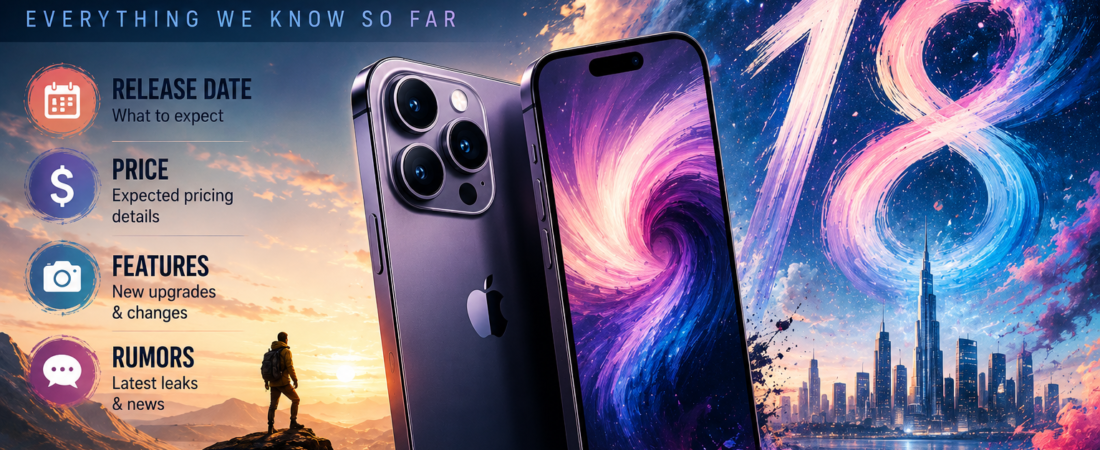
Somewhere in a design lab in Cupertino, the iPhone 18 is quietly taking shape—at least behind closed doors. Engineers are testing prototypes, while supply chain analysts are spotting dummy units in factories across Shenzhen. Apple hasn’t officially revealed a thing, yet the internet is already buzzing with rumors, predictions, and excitement about what could be its next flagship smartphone.
That’s the strange magic of Apple hype. It’s been building since January 9, 2007, the day Steve Jobs walked onto a San Francisco stage and held up a device that combined “a widescreen iPod, a revolutionary phone, and a breakthrough internet communicator.” Nobody in that room fully grasped what they were watching. The iPhone didn’t just add a new gadget to people’s pockets — it deleted an entire category of separate devices and rebuilt the phone industry from the studs up. Physical keyboards vanished within a couple of years. App stores became the new economy. And “there’s an app for that” turned from a slogan into a way of life.
Eighteen years later, Apple’s yearly iPhone reveal is less a product launch and more a cultural checkpoint, like a Super Bowl for gadget lovers. Each fall, the company trades the multi-touch novelty of 2007 for something more incremental: a faster chip here, a sharper camera there, a software trick that feels like magic for about a week before becoming normal. The iPhone has grown from a communication tool into a genuine AI companion, thanks to Apple Intelligence, on-device machine learning, and now a rebuilt Siri.
Which brings us to the iPhone 18. Even in its rumor stage — no confirmed specs, no keynote date, no official name — it’s generating an unusual amount of chatter. Part of that comes from Apple’s reported plan to break from its usual one-and-done September release and split the lineup across two seasons for the first time in company history. Part of it comes from a chip built on a manufacturing process so new that most of the tech industry hasn’t mastered it yet. And part of it is simply the never-ending appetite people have for knowing what’s next. Let’s dig into what’s confirmed, what’s rumored, and what it all means if you’re holding onto your current iPhone and wondering whether to wait.
Table of Contents
- A Brief History of the iPhone
- How Apple Changed the Smartphone Industry
- Evolution from iPhone 1 to iPhone 17
- Why People Are Already Talking About iPhone 18
- Expected Release Date
- Expected Price
- Expected Design Changes
- Display Improvements
- Camera Upgrades
- Apple Intelligence & AI Features
- Processor Expectations
- Battery & Charging
- Performance Expectations
- Software Features
- Security Improvements
- Should You Wait for iPhone 18?
- How iPhone 18 Could Shape the Future of Smartphones
- Final Thoughts
- Frequently Asked Questions
A Brief History of the iPhone
The original iPhone launched with a 3.5-inch screen, a 2-megapixel camera, and no App Store — that came a year later, in 2008, and changed everything again. There was no copy and paste at launch. No video recording. No 3G. By modern standards, it was almost primitive. But it got one thing catastrophically right: the interface. Instead of a stylus or a plastic keyboard, you just touched the screen with your finger, and it responded like it understood you.
That single idea — that a phone should feel intuitive rather than mechanical — is the thread running through every iPhone since. The iPhone 3G brought the App Store. The iPhone 4 brought Retina displays and FaceTime. The iPhone 5 stretched the screen taller. The iPhone 6 went bigger still, chasing the “phablet” trend Apple had once mocked. Touch ID, Face ID, dual cameras, OLED panels, 5G, and now on-device AI — each generation added a layer, rarely erasing what came before.
How Apple Changed the Smartphone Industry
Before 2007, the smartphone market belonged to BlackBerry’s keyboard-first design and early Windows Mobile devices that felt like tiny desktop computers. Apple’s bet was almost reckless at the time: remove the keyboard entirely and trust that software could replace it. It worked, and it forced every competitor to follow.
A few ripple effects are worth remembering:
- The App Store model became the industry standard, inspiring Google Play and every mobile ecosystem that followed.
- Capacitive touchscreens replaced resistive ones almost overnight across the entire industry.
- Mobile-first design became a requirement for websites, not an afterthought.
- The camera-phone replaced the point-and-shoot camera, reshaping an entire consumer electronics category.
Apple didn’t invent smartphones. It invented the smartphone habit — the reflex of pulling your phone out fifty times a day without thinking about it.
Evolution from iPhone 1 to iPhone 17
Tracking every model would take a book, but the big inflection points tell the story clearly.
| Era | Model(s) | Signature Leap |
| 2007–2009 | iPhone, 3G, 3GS | Touchscreen, App Store, GPS |
| 2010–2013 | iPhone 4, 4S, 5 | Retina display, Siri, taller screen |
| 2014–2016 | iPhone 6, 6s, SE | Larger displays, 3D Touch |
| 2017–2019 | iPhone X, XS, 11 | Face ID, edge-to-edge OLED, multi-camera |
| 2020–2022 | iPhone 12, 13, 14 | 5G, ProMotion, Dynamic Island |
| 2023–2025 | iPhone 15, 16, 17 | USB-C, Apple Intelligence debut, thinner “Air” design |
By the time the iPhone 17 arrived in September 2025, Apple had settled into a rhythm: Pro models pushing the camera and chip forward, standard models trailing a year or two behind on features, and a slimmer “Air” variant testing how thin a phone can get before battery life suffers. The iPhone 18 generation is where that rhythm is reportedly about to break.
Quick summary: The iPhone’s history is really the history of Apple removing friction — fewer buttons, fewer cables, fewer manual steps — while quietly making the hardware more powerful underneath. iPhone 18 continues that pattern, but it’s arriving through an unusually unconventional release strategy.
Why People Are Already Talking About iPhone 18
Three things have kept the rumor mill running overtime this year.
First, multiple supply chain reports — including reporting from The Information and consistent leaks tracked by MacRumors — indicate Apple may split the iPhone 18 lineup into two separate release windows for the first time ever. Second, the A20 chip is expected to be Apple’s first iPhone processor built on TSMC’s 2-nanometer process, a manufacturing jump significant enough that analysts are calling it one of the biggest efficiency leaps in years. Third, Apple has already confirmed something huge for software: at WWDC 2026, the company revealed that iOS 27 will bring a rebuilt Siri, with Google’s Gemini technology powering the assistant’s large language model foundation behind the scenes.
That’s a rare combination — hardware, manufacturing process, and software all shifting at once — and it’s why enthusiast forums have been buzzing since early 2026, months before any keynote invitation has gone out.
Expected Release Date
Here’s where things get genuinely unusual. Apple has released its entire iPhone lineup together every September since 2017. Reports now suggest that’s changing.
According to MacRumors, Macworld, and AppleInsider, Apple is expected to launch the iPhone 18 Pro, iPhone 18 Pro Max, and a foldable “iPhone Fold” together in September 2026, with a keynote widely predicted for around September 8 or 9, and phones landing in customers’ hands around September 18. That part lines up with Apple’s normal cadence.
What doesn’t line up: the more affordable standard iPhone 18 and iPhone 18e reportedly won’t arrive until spring 2027, alongside a second-generation iPhone Air. Ming-Chi Kuo, a well-followed Apple supply chain analyst, has also suggested the foldable device may be unveiled at the September event without shipping immediately — meaning it could be announced before it’s actually purchasable.
It’s worth being precise about what’s confirmed and what isn’t: Apple has not officially confirmed any of these dates. Everything above comes from supply chain sourcing and historical pattern-matching, not an Apple press release. Treat it as a highly credible forecast, not a locked calendar entry.
Summary box: If the split-launch rumor holds, budget shoppers who prefer the standard iPhone will need to wait until early 2027 — a real change from the “everyone gets a new iPhone in September” tradition Apple has run for nearly a decade.
Expected Price
Pricing is where analysts are watching most closely, because the A20 chip’s 2nm manufacturing process is reportedly expensive. A China Times report cited by Notebookcheck claims TSMC has warned Apple and other clients that 2nm chip costs could run 50% higher than the current 3nm process. That cost has to go somewhere.
Market research firm IDC has revised its 2026 forecast to predict a price increase for the Pro lineup:
| Model | iPhone 17 Generation | iPhone 18 Generation (Rumored) |
| Pro | $1,099 | ~$1,249–$1,299 |
| Pro Max | $1,199 | ~$1,349–$1,399 |
| iPhone Fold | — | ~$2,000–$2,400 (estimated) |
| Standard iPhone 18 | — | ~$799 (unconfirmed) |
Why the jump? A few forces are converging: rising memory prices industry-wide, the higher cost of leading-edge 2nm silicon, and Apple reportedly boosting RAM to 12GB on Pro models to support on-device AI processing. None of these figures are official. Apple has a long history of absorbing component cost increases rather than passing every dollar to customers, so a smaller bump than analysts predict wouldn’t be shocking.
Expected Design Changes
The design story for iPhone 18 depends heavily on which model you’re asking about, and the rumors genuinely conflict with each other here — which is worth calling out honestly rather than smoothing over.
Some leakers, including display supply chain analyst Ross Young, have floated the return of under-display Face ID technology, where the Face ID sensor array hides beneath the screen instead of sitting in the Dynamic Island cutout. Leaker Jon Prosser has separately claimed the selfie camera itself might shift to a corner cutout if that happens. But a competing rumor from tipster Fixed Focus Digital, cited by MacRumors, suggests the iPhone 18 Pro’s mass production is already underway with minimal exterior design changes, casting doubt on a dramatic redesign this generation.
What most sources agree on:
- A smaller Dynamic Island is likely, even if full under-display Face ID doesn’t make it.
- The camera plateau may thicken slightly to accommodate new lens hardware.
- The Pro Max could be modestly thicker and heavier to fit a larger battery.
- A deep cherry-red or “dark cherry” finish is rumored as this generation’s standout color.
Bottom line: don’t expect an iPhone X-level design overhaul. This looks more like a refinement year, with the real transformation potentially saved for the foldable iPhone.
Display Improvements
Screen sizes aren’t expected to change dramatically — Pro models are rumored to hold at 6.3 inches and 6.9 inches, matching the iPhone 17 Pro lineup. The bigger story is under the glass.
Apple is reportedly moving toward a refined LTPO+ panel with better power scaling at low refresh rates, which matters more for battery life than for how the screen looks in a store display. A smaller Dynamic Island would also mean marginally more usable screen real estate at the top of the phone, even without a size increase.
Interestingly, the standard iPhone 18e is rumored to finally graduate to a 120Hz-adjacent ProMotion-style display and Dynamic Island, features that have historically been reserved for pricier models. If true, that’s a meaningful upgrade for budget-conscious buyers, even if they have to wait until spring 2027 to get it.
Camera Upgrades
This is where iPhone 18 rumors get genuinely exciting for photography fans. The headline feature: a variable aperture main camera, which would let the physical lens element open and close to control depth of field and bokeh — something currently only possible through software simulation on iPhone. Variable aperture has appeared on a handful of Android and Chinese flagships, but never on an iPhone.
Other camera rumors circulating:
- A 24-megapixel selfie camera, up from the current 12-megapixel front sensor, for sharper detail in low light.
- Continued refinement of the triple-lens rear system with a slightly raised camera plateau.
- Improved computational photography pipelines tied directly to the new A20 chip’s neural engine.
Why does variable aperture matter so much to analysts? Because it’s a genuine hardware differentiator — something software updates can’t replicate after the fact. A fixed aperture lens can only fake background blur through algorithms; a variable one physically changes how light hits the sensor, producing more natural results in tricky lighting.
Apple Intelligence & AI Features
Here’s the one part of this story that isn’t a rumor: at WWDC 2026, Apple confirmed that iOS 27 will ship with a redesigned Siri, and that Google’s Gemini technology now powers part of Apple’s underlying foundation models. That’s a notable shift for a company that has spent years insisting it builds its AI in-house.
The practical result, based on Apple’s WWDC presentation and early developer builds, is a Siri that can hold real conversations, understand context across apps, and complete multi-step tasks — the kind of assistant Apple originally promised back in 2024 but struggled to ship on schedule.
Hardware-wise, Apple Intelligence’s most advanced features — voice customization and expanded on-device dictation among them — are reportedly tied to devices with at least 12GB of RAM, which lines up with the Pro models. If the standard iPhone 18 ships with less RAM, as some early component leaks suggest, it could mean a genuine feature gap between the Pro and non-Pro lineup for the first time in the AI era.
Summary box: iOS 27’s Siri overhaul is confirmed. Which exact iPhone 18 models get the full feature set is not yet confirmed, and RAM configuration will likely decide that.
Processor Expectations
The A20 chip is the technical headline of this generation. It’s expected to be Apple’s first iPhone processor built on TSMC’s 2-nanometer (N2) manufacturing process, following several years on 3-nanometer designs. Smaller process nodes generally mean more transistors packed into the same space, which typically translates to better performance per watt.
Early estimates suggest the A20 could be roughly 15% faster than the A19 while being up to 30% more power-efficient. Pro models are expected to get an “A20 Pro” variant with additional GPU cores for gaming and video work. Apple’s in-house C2 modem is also rumored to make its debut here, alongside a custom Wi-Fi 7 chip — both continuing Apple’s multi-year push to control more of its own silicon instead of relying on Qualcomm.
Battery & Charging
Battery rumors have actually firmed up more than most other categories, thanks to regulatory filings. Chinese 3C certification listings spotted in July 2026 reportedly show a US eSIM iPhone 18 Pro Max model rated at 5,567 mAh, compared to the iPhone 17 Pro Max’s 5,088 mAh — a jump of roughly 9%. That’s a meaningful gain, especially paired with the A20’s rumored efficiency improvements.
Expect the usual Apple charging setup to continue: USB-C wired charging, Qi2-certified MagSafe wireless charging, and no major jump in wattage. Apple has been conservative about fast-charging speeds compared to Chinese competitors, prioritizing battery longevity over headline charging numbers — a trade-off that tends to matter more once a phone is two or three years old.
Performance Expectations
Raw benchmark numbers rarely tell the full story anymore — modern iPhone chips have been fast enough for nearly any task for several generations now. Where the A20 is expected to actually matter in daily use:
- Sustained performance during long camera sessions or gaming, thanks to better thermal efficiency at 2nm.
- AI task speed, since on-device Siri and Apple Intelligence processing lean heavily on the neural engine.
- Battery drain under load, which is often a bigger real-world complaint than raw speed.
If you’re buying an iPhone mainly to check email, browse social media, and take photos, you likely won’t notice a dramatic difference between an A19 and an A20 chip. If you edit 4K video, play graphically demanding games, or lean on AI features constantly, the gains should be more noticeable.
Software Features
iOS 27 is the confirmed software companion to the iPhone 18 lineup, and beyond the Siri rebuild, Apple has previewed a handful of other changes at WWDC 2026:
- Deeper Writing Tools integration across third-party apps, not just Apple’s own.
- Expanded Photo Clean Up and generative editing tools, building on features introduced in iOS 18.
- Continued refinement of the Genmoji and Image Playground tools introduced in prior years.
- Better cross-device continuity between iPhone, iPad, and Mac for AI-assisted tasks.
Apple has stated these features arrive with iOS 27 broadly, though the most demanding ones will likely require newer hardware to run smoothly — a pattern Apple has followed since Apple Intelligence first launched.
Security Improvements
Apple rarely headlines security features in its marketing, but they tend to matter enormously to anyone who’s ever had a phone lost or stolen. Expected iPhone 18 security improvements, based on Apple’s ongoing platform direction rather than specific leaks, include:
- Continued expansion of Stolen Device Protection, which adds delays and biometric checks for sensitive changes made away from familiar locations.
- Broader satellite connectivity, reportedly expanding beyond emergency SOS toward general messaging use, which also has safety implications in areas without cell coverage.
- Ongoing Secure Enclave improvements tied to the new chip architecture, which underpin Face ID, Apple Pay, and passkey storage.
None of these are dramatic departures from Apple’s current approach — think steady hardening rather than a single flashy new feature.
Should You Wait for iPhone 18?
This is the question that actually matters for most readers, and the honest answer is: it depends on which iPhone 18 you’re waiting for.
| Your Situation | Recommendation |
| You want the latest tech now and don’t mind paying a premium | Get the iPhone 18 Pro or Pro Max in September 2026 |
| You want the standard, more affordable model | You’ll need to wait until spring 2027 |
| You currently own an iPhone 15 or newer | The upgrade may feel marginal — consider skipping a generation |
| You own an iPhone 13 or older | Almost any iPhone 18 model will feel like a major leap |
| You rely heavily on Apple Intelligence and Siri daily | Prioritize a model with more RAM (likely Pro-tier) |
| You want the newest design innovation | Consider waiting to see the foldable iPhone reviews first |
If your current phone still works fine, there’s rarely urgency to upgrade the moment new hardware ships — prices tend to soften, and early software bugs tend to get ironed out within the first couple of months. But if you’re due for an upgrade anyway and the split-release rumors hold true, the calendar itself becomes part of the decision. Buy in the fall, and you’re choosing from premium models only. Wait for spring, and you get more affordable choices but lose several months with your current device.
How iPhone 18 Could Shape the Future of Smartphones
If Apple really does split its release schedule going forward, that’s bigger than any single spec bump. It would mark the first structural change to iPhone release timing since Apple settled into its September rhythm years ago — and competitors will be watching closely to see whether staggered releases help Apple manage chip supply, spread out demand, or simply create two hype cycles a year instead of one.
The variable aperture camera, if it ships, could also become the new expectation across the smartphone industry the same way computational photography and Night Mode eventually did. And the deeper Gemini-powered Siri points toward a future where the lines between “Apple AI” and “everyone else’s AI” blur — a notable shift from the walled-garden approach Apple has favored for most of its history.
Final Thoughts
The iPhone 18 story is really two stories in one: a hardware generation chasing genuine efficiency gains through a risky new manufacturing process, and a software generation trying to finally deliver the AI assistant Apple promised years ago. Neither is guaranteed to land perfectly. Chip yields on brand-new manufacturing nodes are notoriously unpredictable in year one, and Apple’s AI ambitions have already slipped once.
Still, it’s hard not to feel a little of that 2007 energy creeping back in — not because the iPhone 18 will reinvent the smartphone the way the original iPhone did, but because Apple is once again willing to break its own playbook. A split launch schedule. A foldable form factor. A rival’s AI model quietly powering its most personal assistant. Eighteen years in, Apple is still finding new ways to make people wait for September — or, this time around, for spring, too.
Frequently Asked Questions
1. When will the iPhone 18 be released? The iPhone 18 Pro, Pro Max, and a rumored foldable iPhone are expected around September 2026, with the standard iPhone 18 and iPhone 18e reportedly delayed until spring 2027. Apple has not confirmed either date.
2. How much will the iPhone 18 cost? Analyst estimates suggest the Pro could start around $1,249–$1,299 and the Pro Max around $1,349–$1,399, both increases from the iPhone 17 generation. Standard model pricing is expected to stay closer to $799, though nothing is officially confirmed.
3. Will there be a foldable iPhone? Multiple credible reports point to an “iPhone Fold” launching alongside the iPhone 18 Pro models in September 2026, though it may be announced before it’s actually available to buy.
4. What chip will the iPhone 18 use? The rumored A20 chip is expected to be Apple’s first iPhone processor built on TSMC’s 2-nanometer process, offering better speed and efficiency than the current A19.
5. Will the iPhone 18 have a better camera? Yes, rumors point to a variable aperture main camera and an upgraded 24-megapixel selfie camera, though Apple hasn’t confirmed either feature.
6. Does the iPhone 18 support Apple Intelligence? Yes. iOS 27, confirmed at WWDC 2026, includes a rebuilt Siri that uses Google Gemini technology as part of its foundation. The most advanced features may require higher RAM, likely favoring Pro models.
7. Will the iPhone 18 have under-display Face ID? It’s genuinely unclear. Some analysts believe it’s possible this generation, while other supply chain leaks suggest minimal design changes and no under-display Face ID yet.
8. Should I buy an iPhone 17 instead of waiting? If you need a phone now and don’t want to wait for spring 2027, the iPhone 17 Pro remains a strong option, especially since prices typically drop once the iPhone 18 launches.
9. What is the iPhone 18e? It’s the rumored budget-friendly successor to the iPhone 16e, expected in spring 2027 with a modernized display and Dynamic Island for the first time in that lineup.
10. How big will the iPhone 18 battery be? Regulatory filings suggest the iPhone 18 Pro Max battery could reach around 5,567 mAh, up roughly 9% from the iPhone 17 Pro Max.
11. Will iPhone 18 prices vary by storage size? Apple has historically tiered pricing by storage capacity, and there’s no indication that pattern will change for the iPhone 18 lineup.
12. Is the iPhone 18 worth waiting for if I have an iPhone 14? Likely yes, especially for AI features and camera improvements, though your decision may also depend on whether you want a Pro model in fall 2026 or a standard model in spring 2027.