
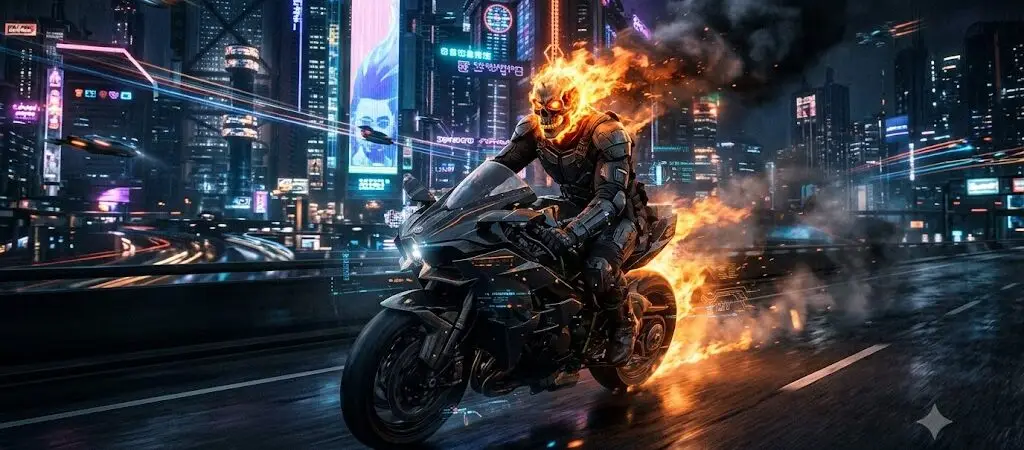
Marvel Studios confirmed at San Diego Comic-Con 2026 that Ryan Gosling will play Ghost Rider in a standalone film directed by Shawn Levy, arriving in theaters in 2028. For a tech website, the casting news is only half the story. The real question is a production one: how do you actually build a character whose entire identity is a photorealistic burning skull riding a motorcycle made of hellfire, in a way that holds up on an IMAX screen in 2028?
That’s a harder visual effects problem than most Marvel projects have faced, and it sits right at the intersection of CGI, AI-assisted filmmaking tools, and virtual production — all areas that have changed dramatically since Nicolas Cage first played the character nearly two decades ago.
Table of Contents
- What We Know About the New Ghost Rider Movie
- Why Ghost Rider Could Be One of Marvel’s Biggest VFX Challenges
- How CGI Could Create Ghost Rider’s Flaming Skull
- How VFX Could Bring the Hell Cycle to Life
- Could AI Play a Role in the New Ghost Rider Movie?
- Ghost Rider CGI vs. Modern VFX Technology
- Could Virtual Production Technology Be Used for Ghost Rider?
- What Could Ghost Rider’s Motorcycle Look Like in the MCU?
- The Future of Superhero Movie Technology
- Ghost Rider Movie: What We Know So Far
- Frequently Asked Questions
What We Know About the New Ghost Rider Movie
Marvel Studios President Kevin Feige confirmed the project during the studio’s Hall H panel on July 25, 2026, revealing that Ghost Rider is officially in development for a 2028 theatrical release, with Ryan Gosling in the lead role and Shawn Levy directing.
Here’s what’s actually confirmed:
- Actor: Ryan Gosling
- Director: Shawn Levy (Deadpool & Wolverine)
- Writer: Jonathan Tropper, who also wrote Levy’s Star Wars: Starfighter, is scripting the film.
- Studio: Marvel Studios / Walt Disney Studios
- Release window: 2028 (no exact date announced)
- MCU status: Confirmed as an official Marvel Studios production, marking the character’s first Marvel Studios theatrical outing
What’s not confirmed: an exact release date, plot details, supporting cast, whether Gosling is playing Johnny Blaze or another Ghost Rider incarnation, and whether the character will first appear in another MCU film before his solo movie. Some entertainment outlets have reported unconfirmed rumors about a Ghost Rider cameo in an earlier project, but Marvel has not verified this, so treat it as speculation rather than fact.
Why Ghost Rider Could Be One of Marvel’s Biggest VFX Challenges
Most Marvel characters need one or two signature effects — repulsor blasts, a shield throw, a size change. Ghost Rider needs several simultaneously, all convincingly “on fire” at once:
- A skull that burns without consuming itself
- Fire that behaves like hair, moving with the character’s head turns
- A full-body transformation sequence from human to Rider
- A motorcycle that must also appear to be made of flame
- Environments that plausibly react to a burning character riding through them
Each of those is its own significant effects discipline. Combined, they’re closer to the complexity of an entire effects-heavy tentpole than a single hero’s power set.
How CGI Could Create Ghost Rider’s Flaming Skull
The skull is the character’s most recognizable feature, and it’s built in layers rather than as one effect:
- 3D modeling creates the base skull geometry, detailed enough to hold up in extreme close-up.
- Digital fire simulation software generates the flame layer separately, using physics-based simulations of how fire actually moves, flickers, and responds to “wind” from motion.
- Particle effects add embers, smoke, and heat distortion around the skull.
- Volumetric lighting makes the fire believably illuminate the character’s surroundings, rather than looking pasted on top of the footage.
- Compositing blends the live-action plate, the CGI skull, and the fire simulation into a single, cohesion image.
None of this is new invention — it’s the same pipeline used for dragons, dust storms, and magic effects in other franchises — but Ghost Rider asks for it applied to a human-shaped character in close-up dialogue scenes, which is a much less forgiving test than a wide shot of a creature.
How VFX Could Bring the Hell Cycle to Life
Ghost Rider’s motorcycle, the Hell Cycle, is typically built the way most modern superhero vehicles are: as a hybrid of practical and digital work.
- Practical filming likely uses a real motorcycle (or a rig built for stunt work) for the parts of a shot involving weight, speed, and rider movement that audiences instinctively read as “real.”
- CGI flames are added afterward to make the bike appear engulfed in fire without endangering a stunt performer.
- Motion tracking locks the digital fire and skull effects to the camera and bike’s movement frame by frame, so nothing “slides” during fast riding sequences.
- Digital environments extend or replace backgrounds for scenes that need supernatural or heavily stylized locations.
Filmmakers generally favor this practical-plus-digital combination because pure CGI vehicles tend to read as weightless, while pure practical effects can’t safely produce open flame at speed. Blending the two lets a production keep the physical believability of a real stunt while layering in effects that would be impossible or unsafe to shoot for real.
Could AI Play a Role in the New Ghost Rider Movie?
Important disclaimer: there is no official confirmation that Marvel Studios, Shawn Levy, or any VFX vendor attached to Ghost Rider is using AI tools on this specific production. Nothing below should be read as a confirmed production detail — it’s an explanation of where AI-assisted tools already exist in the modern VFX pipeline generally, and how they could plausibly apply to a project like this.
Current AI-assisted techniques used across the VFX industry include:
- Previsualization — AI-assisted “previz” tools help directors and VFX supervisors block out complex sequences before expensive shoot days.
- Rotoscoping assistance — machine-learning tools can speed up the traditionally manual process of isolating a character from its background frame by frame.
- Motion tracking — AI-driven tracking software can lock digital elements (like fire) to a moving camera or actor faster than manual tracking.
- Facial animation — some studios use AI-assisted facial capture to translate an actor’s expressions onto digital elements or de-aged faces.
- Concept development — AI image tools are sometimes used internally for early concept exploration, though final designs still go through human concept artists and approval.
Whether any of these specifically touch Ghost Rider is unknown, and this article will be updated if Marvel, Levy, or an attached VFX studio confirms specific tools.
Ghost Rider CGI vs. Modern VFX Technology
It’s worth comparing what’s possible now to what the 2007 and 2011 Ghost Rider films had available, without dismissing those films’ work — they were made with the standard tools of their era.
| Capability | 2007 / 2011 Ghost Rider Films | Potential for 2028 Ghost Rider |
| Fire simulation | Simulation software available but far more limited and slower to render | More detailed, faster-to-iterate physics-based fire simulation |
| Facial integration | Skull largely replaced the actor’s face in most shots | Advanced tracking could allow more nuanced expression transfer |
| Rendering speed | Long render times limited iteration | Real-time and near-real-time rendering allow more creative iteration |
| On-set previsualization | Limited | Virtual production tools let filmmakers see rough effects live on set |
| Environment integration | Primarily greenscreen compositing | LED volume stages can provide real-time reactive lighting on actors |
The point isn’t that newer automatically means better storytelling — it’s that the tools available to solve Ghost Rider’s specific technical problems have matured substantially.
Could Virtual Production Technology Be Used for Ghost Rider?
Virtual production — the technique popularized by shows like The Mandalorian — combines:
- LED volume stages, giant screens that display real-time digital environments behind actors instead of greenscreen
- Real-time 3D environments, built in game engines rather than rendered frame-by-frame after the fact
- Virtual cinematography, where a camera’s movement is tracked and matched to the digital environment live
- In-camera lighting, where the LED screen itself lights the actor to match the digital scene
For a character whose skin should glow from firelight, this matters: instead of adding fake firelight in post-production, an LED volume could physically light Gosling’s face and costume with the correct color and movement on set, giving compositors a more believable starting point.
What Could Ghost Rider’s Motorcycle Look Like in the MCU?
While no design has been revealed, the underlying approach likely mirrors the Hell Cycle process described above: a real motorcycle or stunt rig for weight and movement, layered with CGI fire and skeletal detailing added afterward. Expect environmental effects too — scorched asphalt, embers kicked up by tires, and reactive lighting on nearby objects — all techniques used elsewhere in the MCU to sell weight and danger for vehicles that don’t exist in the real world.
The Future of Superhero Movie Technology
Ghost Rider is a useful case study for where superhero filmmaking technology is heading generally:
- AI-assisted previsualization and tracking speeding up traditionally slow VFX steps
- Real-time rendering shortening the feedback loop between a creative idea and seeing it on screen
- Virtual production reducing reliance on greenscreen for lighting-dependent characters
- Procedural environment generation for large-scale digital worlds
- Motion capture continuing to refine performance-driven digital characters
None of these guarantee a good movie — that still comes down to story and direction — but they represent the toolkit a production like this now has access to that simply didn’t exist, or wasn’t mature enough, in 2007 or 2011.
Ghost Rider Movie: What We Know So Far
| Detail | Information |
| Movie | Ghost Rider |
| Character | Ghost Rider (specific incarnation not confirmed) |
| Actor | Ryan Gosling |
| Director | Shawn Levy |
| Writer | Jonathan Tropper |
| Studio | Marvel Studios |
| MCU status | Confirmed, Marvel Studios’ first theatrical Ghost Rider film |
| Release year | 2028 |
| Exact release date | Not officially confirmed |
| Current status | In development, announced July 25, 2026 at SDCC |
Frequently Asked Questions
Is Ghost Rider getting a new movie? Yes. Marvel Studios confirmed a standalone Ghost Rider film at San Diego Comic-Con 2026, set for release in 2028.
Who will play Ghost Rider? Ryan Gosling has been cast in the lead role.
When is the new Ghost Rider movie coming out? Marvel has confirmed only a 2028 release year. An exact date has not been announced.
Who is directing the new Ghost Rider movie? Shawn Levy, who previously directed Deadpool & Wolverine, is directing.
Is Ghost Rider part of the MCU? Yes, this is being produced by Marvel Studios and will be part of the MCU.
Will the new Ghost Rider movie use CGI? Almost certainly, given the character’s fire-based transformation, though specific vendors and techniques haven’t been announced.
Could AI be used in the Ghost Rider movie? There’s no confirmation either way. AI-assisted tools are increasingly common across VFX pipelines industry-wide, but nothing production-specific has been confirmed for this film.
What technology could be used to create Ghost Rider’s flaming skull? Likely a combination of 3D modeling, physics-based fire simulation, particle effects, volumetric lighting, and compositing — the same core techniques used for other fire and creature effects in modern blockbusters.
Conclusion
The casting news is what will drive today’s search traffic, but the more interesting long-term story is a production one. Ghost Rider asks filmmakers to solve a harder version of a problem Marvel has faced before — believable fire, believable transformation, believable danger — with tools that have matured significantly since the character was last on screen. Whether Marvel confirms specific AI tools, virtual production stages, or VFX vendors over the next two years, this is a project worth watching purely as a benchmark for what 2028-era filmmaking technology can do with a character built almost entirely out of visual effects.