

Introduction: How Screenless Laptops Are Changing Computing in 2026
Screenless laptops represent a new direction in personal computing, challenging our decades-long dependence on glowing rectangular screens. For years, we have used desktop monitors to analyze spreadsheets, laptop displays to write documents, and smartphones to browse social media. Even our entertainment depends heavily on physical screens. Although technology has evolved dramatically, the way we interact with computers has remained surprisingly similar: we look at a display, use a keyboard or touchscreen, and interact with digital content through a physical device.
However, that familiar experience is beginning to change. Advances in augmented reality (AR), miniature displays, optical engineering, and spatial computing are opening the door to a different approach. Instead of relying entirely on traditional monitors, users can increasingly explore virtual displays through wearable technology. This shift is also inspiring the concept of screenless laptops, which aim to replace conventional laptop screens with virtual workspaces visible through compatible AR glasses.
So, are screens finally disappearing in 2026, or will traditional displays remain essential to our digital lives? The answer is more complicated than it might seem. AR glasses and spatial computing devices offer exciting possibilities, including portable virtual monitors, flexible multitasking, and more immersive digital experiences. Nevertheless, challenges involving comfort, battery life, pricing, software compatibility, and everyday usability still stand in the way of widespread adoption.
In this guide, we explore how screenless laptops and AR glasses could reshape personal computing. We will examine the technologies behind virtual displays, compare them with conventional screens, investigate their practical benefits and limitations, and consider whether physical displays are genuinely approaching obsolescence—or simply entering a new phase of evolution.
1. What Is Screenless Computing and How Does It Work?
To understand why invisible laptops and AR glasses are gaining mainstream traction, you must first examine the psychological fatigue associated with traditional screen-bound computing.
- The Weight of Physical Hardware: Carrying heavy laptops, managing multiple external monitors, and staring at fixed glass panels for twelve hours a day creates ergonomic strain and visual fatigue. Ambient computing replaces rigid physical boundaries with flexible, floating digital workspaces that adapt to your physical environment.
- The Concept of Invisible Displays: Instead of manufacturing glass screens that consume desk space and battery power when turned off, invisible computing projects high-resolution virtual monitors, floating windows, and holographic interfaces directly into your optical field of vision using micro-OLED projectors and waveguide lenses.
2. How Screenless Laptops Work: Virtual Displays and AR Glasses
While augmented reality (AR) glasses continue to attract attention, screenless laptops are emerging as an exciting concept in the future of personal computing. Instead of relying on a traditional built-in display, these innovative setups aim to deliver a more flexible workspace through wearable screens, virtual monitors, or spatial projection technologies. By combining compact computing hardware with digital displays that appear in the user’s field of view, screenless laptops could make it possible to work, multitask, and access information without carrying a conventional laptop screen. Although this technology is still developing, it offers a glimpse into a future where virtual displays could complement—and, in some situations, replace—physical monitors.
How Screenless Laptops Operate
- Wireless Spatial Pairing: An invisible laptop typically consists of a premium mechanical keyboard chassis housing powerful mobile silicon, a battery, and wireless radios, but zero attached display screens. When opened, it pairs instantly via ultra-wideband or Wi-Fi 7 to a pair of lightweight AR glasses, projecting a massive, multi-monitor virtual workspace in mid-air.
- Ergonomic Freedom: Users can type comfortably on a physical keyboard while resting on a couch, an airplane tray table, or a park bench, viewing towering virtual screens that float effortlessly in front of them without requiring external desk monitors. For further software evaluations on spatial productivity, read reviews via PCMag Hardware Lab or tutorials on My Tech Hub Productivity Portal.
3. How Micro-OLEDs and Waveguide Optics Power AR Displays
The primary reason early augmented reality glasses failed to replace traditional screens was poor optical quality. Early prototypes featured dim, pixelated displays with narrow fields of view that washed out entirely in normal daylight.
Overcoming Optical Engineering Hurdles
- Ultra-High-Density Micro-OLED Panels: Modern 2026 AR glasses pack multi-million pixel arrays onto silicon chips the size of a postage stamp, delivering crisp 4K visual clarity per eye with deep blacks and vibrant colors.
- Advanced Waveguide Lenses: Transparent glass or polymer lenses utilize microscopic diffraction gratings to bounce light from the tiny micro-OLED projectors directly into the user’s retina, blending digital holograms seamlessly with the real world without obstructing physical vision.
4. How AR Glasses Use Eye Tracking and Hand Gestures
When physical screens disappear, traditional input devices like computer mice and trackpads become obsolete.
- Sub-Millisecond Eye Tracking: Tiny infrared cameras embedded inside the AR glasses frame monitor your pupil movements continuously. Looking at a virtual window and executing a subtle finger pinch selects and opens applications instantly.
- Zero-Latency Gesture Control: Advanced machine learning algorithms track hand movements across 6-degrees-of-freedom (6DoF), allowing users to grab, resize, and toss virtual screens across the room with effortless spatial gestures.

5. How Screenless Laptops Transform Professional Workflows
While consumers view AR glasses and invisible laptops as futuristic entertainment gear, the fastest-growing adoption sector in 2026 is enterprise productivity.
- Infinite Desk Real Estate: Remote engineers, financial traders, and data analysts no longer need to pack heavy portable monitors when traveling. Donning a pair of lightweight AR glasses projects three 4K virtual monitors floating above an airplane seat or coffee shop table.
- Secure Confidentiality: Because virtual screens are projected directly into your retina through private waveguide lenses, people sitting next to you on a commuter train or in an open office cannot see your confidential financial data or corporate emails.
6. Battery Life and Heat Challenges of Screenless Laptops
Despite massive engineering triumphs, building powerful spatial computing hardware into a form factor as light and comfortable as traditional eyeglasses remains an uphill battle.
- Power Density Constraints: High-resolution micro-OLED projectors, depth-sensing cameras, eye-tracking sensors, and spatial computing processors demand significant electrical power. Balancing battery weight with all-day operational endurance is a constant compromise.
- Thermal Management on the Face: Managing heat dissipation directly against a user’s temples and nose bridge requires sophisticated passive cooling materials and energy-efficient silicon chips to prevent uncomfortable hardware warming during extended work sessions.
7. Screenless Laptop Costs: Are AR Glasses Affordable?
Just like early smartphones and folding phones, the bleeding edge of invisible computing and AR eyewear carries a steep financial barrier to entry.
- Luxury Tier Pricing: High-end spatial AR glasses and specialized invisible laptop setups currently command retail prices ranging from $1,200 to over $3,000, restricting early adoption primarily to enterprise professionals, software developers, and tech enthusiasts.
- The Roadmap to Mass Adoption: As optical component manufacturing yields improve and silicon manufacturing scales over the next several years, prices are projected to drop toward mainstream consumer electronics thresholds. For further consumer market analyses, read reports via Counterpoint Research or market insights on My Tech Hub Business Portal.
8. Screenless Laptops vs. Traditional Displays: Key Differences
To help you evaluate how invisible computing and AR glasses stack up against traditional screens, review the comparison matrix below:
| Feature / Metric | Traditional Screens (Laptops & Monitors) | Invisible Laptops & AR Glasses (2026) | Winner |
| Workspace Portability | Heavy, bulky, limited by physical monitor size | Infinite floating multi-monitor workspace in a pocket case | AR Glasses |
| Visual Privacy | Prone to shoulder-surfing in public spaces | Private retinal projection visible only to the wearer | AR Glasses |
| All-Day Comfort | Ergonomic strain; fixed viewing angles | Lightweight frames; adjustable virtual screen placement | AR Glasses |
| Battery Autonomy | Long battery life on laptops; wall-powered monitors | Moderate battery life due to intensive spatial processing | Traditional |
| Ecosystem Maturity | Decades of refined software compatibility and apps | Rapidly expanding, but still developing native workflows | Traditional |
Spatial Computing Hardware & Pricing Guide
To help you map out your wearable technology budget, review the hardware tier guide below:
| Hardware Category | Estimated Price Range (USD) | Best Suited For | Key Capabilities |
| Media Consumer AR Glasses | $399 – $699 | Travelers, media consumption, casual virtual screens | Private private video viewing, lightweight frame |
| Productivity Spatial Headsets | $999 – $1,999 | Remote workers, data analysts, multi-monitor setups | Full spatial multi-window desktop environments |
| Enterprise AR Systems | $2,500 – $3,500+ | Engineers, surgeons, industrial designers | High-precision holographic overlays, rugged builds |
9. How AR Display Technology Is Advancing Screenless Laptops
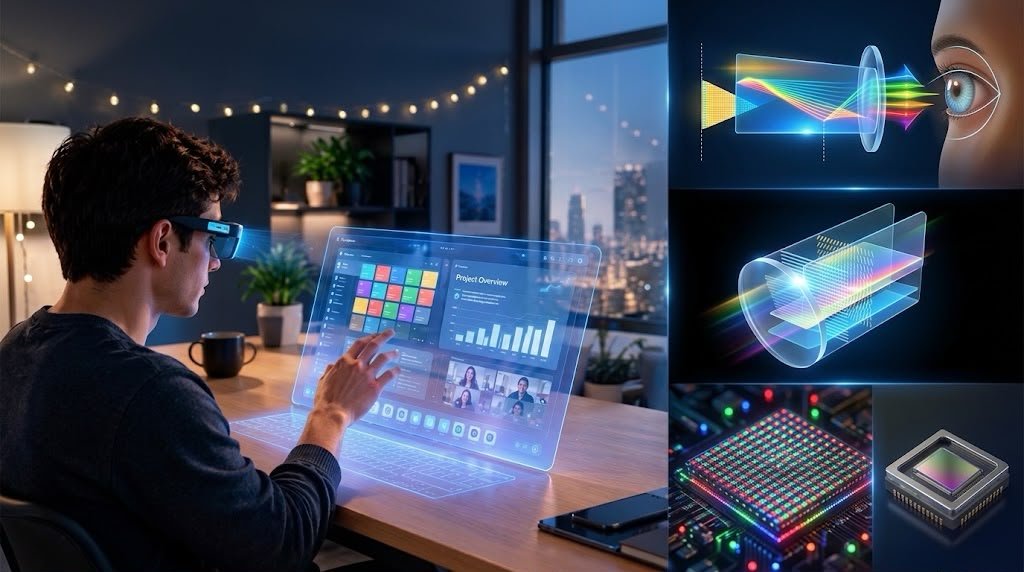
The technology behind screenless laptops is advancing rapidly, driven by improvements in optical physics, miniature displays, and augmented reality (AR). For decades, virtual reality and augmented reality devices relied on relatively bulky displays and optical systems. These components often made headsets heavy and front-loaded, limiting their comfort during extended use. Today, however, advances in display engineering are helping manufacturers develop more compact AR glasses that could make screenless computing a practical option for everyday work.
One important development is the use of micro-OLED displays. Built on silicon backplanes, these tiny screens can deliver high pixel densities within a remarkably small physical area. When integrated into compatible AR glasses, they can project detailed digital images into the user’s field of view. However, actual resolution and image quality vary by device, and not every pair of AR glasses offers 4K resolution per eye.
Another key technology is waveguide optics, which helps make lightweight virtual displays possible. Waveguides use carefully engineered optical structures to guide light through transparent lenses and direct it toward the viewer’s eyes. In an AR device, light from a miniature display or optical engine enters the waveguide and is redirected toward the eye through specialized optical elements. This allows digital content to appear in front of the wearer while preserving some view of the surrounding environment.
Together, micro-OLED displays and waveguide optics are helping shape the future of screenless laptops and AR-powered workspaces. Instead of depending entirely on a physical laptop screen, users could view virtual monitors for documents, spreadsheets, video calls, and multitasking. Although image quality, brightness, field of view, and comfort still depend on the hardware, these technologies demonstrate how computing may gradually move beyond the traditional rectangular display.
Furthermore, managing field-of-view (FoV) constraints has been a primary engineering battleground. Early AR glasses offered a cramped window of visibility, forcing users to constantly look straight ahead to keep virtual windows in frame. Modern waveguide architectures achieve expansive FoV angles exceeding 70 to 100 degrees, creating a genuinely immersive spatial canvas. For deeper technical explorations into optical physics and photon waveguide manufacturing, read reports via IEEE Photonics Society Journal alongside hardware evaluations at My Tech Hub Photonics Portal.
10. How Eye Tracking and Gesture Control Improve Screenless Laptops
When physical screens, keyboards, and computer mice disappear into ambient space, traditional point-and-click user interfaces become obsolete. Navigating an invisible multi-monitor workspace requires an entirely new paradigm of natural human-computer interaction that feels as effortless and intuitive as gesturing in the physical world.
The backbone of this natural user interface is high-precision, infrared eye tracking combined with sub-millisecond hand gesture recognition. Embedded discretely along the inner frame of modern AR glasses, microscopic infrared cameras track pupil movements at rates exceeding 1,000 Hz. This ultra-fast tracking allows the spatial operating system to instantly identify exactly which virtual window, button, or document you are looking at. To execute an action—such as opening an application, clicking a link, or scrolling down a webpage—users perform a micro-gesture, such as a subtle thumb-and-index-finger pinch, detected by outward-facing depth sensors tracking 6-degrees-of-freedom hand mechanics.
This eliminates the cognitive friction of navigating clunky menus. You simply look at an email, pinch to open it, glance at a spreadsheet column, and speak or gesture to manipulate data. For advanced software developers and spatial interface designers, mastering eye-tracked intent reduces navigational input latency to near-zero, creating a fluid symbiosis between human thought and digital execution. For further software design insights, explore documentation via ACM Computer-Human Interaction Portal or tutorials on My Tech Hub Software Directory.
11. Screenless Laptops: Ergonomic Benefits and Comfort Challenges
The human body was not biologically engineered to spend eight to twelve hours a day hunched over a stationary laptop screen or staring down at a fixed desktop monitor. Traditional office setups force users into static, rigid postures that contribute to chronic neck strain, shoulder tension, lower back pain, and severe eye fatigue—collectively known as computer vision syndrome.
Invisible computing and AR glasses introduce unprecedented ergonomic freedom by completely decoupling digital workflows from physical hardware positioning. When your multi-monitor workstation is projected as a floating holographic canvas in mid-air, you are no longer chained to a desk. You can recline comfortably on a sofa, stand up and stretch while reviewing architecture blueprints, or work from an airplane seat while maintaining perfect cervical spine alignment. Your virtual screens float at eye level wherever your head naturally rests.
Furthermore, variable-focus optics and digital accommodation adjustments eliminate the focal lock associated with staring at a glass panel inches from your face. By adjusting the virtual focal plane dynamically, AR glasses reduce the crystalline lens fatigue that plagues traditional screen users. This ergonomic revolution transforms mobile productivity from a painful physical compromise into a comfortable, health-conscious experience.
12. How Screenless Laptops Could Transform Remote Work and Business
While consumers often associate AR glasses and screenless laptops with futuristic entertainment, these technologies could also transform professional work environments. Businesses are exploring spatial computing to improve mobility, access digital information, and support complex tasks. Although widespread adoption will depend on cost, comfort, and software compatibility, screenless computing offers promising possibilities for industries that rely on information-rich workflows.
In remote work environments, financial trading offices, and engineering firms, access to multiple displays can make a significant difference to productivity. However, professionals who travel frequently often have to rely on a single laptop screen. With compatible AR glasses and a screenless laptop setup, users could create multiple virtual monitors without carrying additional physical displays. A financial analyst might monitor market data while reviewing reports, for example, while a software developer could view code, documentation, and a video meeting side by side. These virtual workspaces could make it easier to multitask in places such as airports, shared offices, and coffee shops, although actual screen count, resolution, and usability depend on the device.
Screenless laptops and spatial computing may also offer practical benefits in industrial engineering and healthcare. Using compatible AR systems, technicians could view digital instructions, equipment diagrams, or diagnostic information alongside physical machinery. Field engineers might access building plans while inspecting a site, while healthcare professionals could use specialized augmented reality applications to view relevant visual guidance. These applications require suitable hardware, reliable software, and appropriate safety procedures, particularly in clinical environments.
Ultimately, the potential value of screenless laptops in enterprise environments lies in providing flexible access to digital information without depending entirely on traditional monitors. From remote collaboration to field maintenance, virtual displays could help professionals organize information around their tasks. However, these benefits will depend on how comfortably, accurately, and reliably the technology performs in real-world working conditions.
13. Privacy and Data Security: The End of Public Screen “Shoulder Surfing”
In an increasingly interconnected world, maintaining data privacy while working in public spaces—such as crowded commuter trains, busy airport departure lounges, and open-plan corporate offices—has become an escalating challenge. Traditional laptops and tablets broadcast your confidential financial spreadsheets, private emails, and proprietary corporate code to anyone sitting within direct line of sight behind you.
Invisible computing solves this vulnerability fundamentally through private retinal projection. Because waveguide optics beam digital light waves directly into your retinas, your floating virtual screens are completely invisible to everyone else around you. To an outside observer, you appear simply to be wearing stylish eyewear while staring calmly into open space.
This cryptographic and optical privacy shield ensures that sensitive financial transactions, legal document reviews, and healthcare records remain strictly confidential, regardless of where you are working. For security-conscious enterprises handling classified data, AR glasses represent an impenetrable mobile security perimeter that completely eliminates visual data theft and public shoulder surfing.
14. Screenless Laptops: Battery Life and Heat Limitations
Despite massive engineering triumphs in micro-display optics and spatial processors, hardware designers face an unyielding physical law: the trade-off between lightweight comfort and raw processing power.
Building an untethered, standalone AR headset or invisible laptop ecosystem requires packing complex computing architecture—including multi-core neural processing units, high-resolution depth cameras, wireless radios, eye-tracking sensors, and high-capacity batteries—into a chassis light enough to rest comfortably on your nose bridge for hours. Heavy batteries cause facial slippage and nasal bruising, while high-performance silicon chips generate uncomfortable thermal heat against the user’s temples.
To overcome these constraints, modern 2026 systems utilize distributed computing architectures. Heavy spatial processing and battery power are offloaded to a pocket-sized puck or a companion wireless keyboard chassis, keeping the glasses themselves featherlight and thermally cool. As solid-state battery technology and energy-efficient silicon chips mature, these physical limitations are rapidly dissolving.
15. How Spatial Audio Enhances the Screenless Computing Experience
When physical monitors and television sets disappear, traditional box speakers attached to hardware displays vanish with them. In an invisible computing environment, audio fidelity must evolve from localized hardware sound into fully specialized acoustic immersion.
Next-generation AR glasses integrate directional open-ear micro-speakers or acoustic beamforming drivers that project audio directly into your ear canals without sealing your ears from the outside world. This spatial audio architecture anchors sound to specific virtual objects in your room. If a video conference participant is floating on the left side of your virtual workspace, their voice emanates precisely from that spatial coordinate.
This ambient audio integration ensures that you remain aware of your real-world physical surroundings—such as an approaching train announcement or a colleague walking up to your desk—while remaining completely immersed in your private acoustic and visual workspace.
16. Ecosystem Fragmentation: Navigating Competing Spatial Operating Systems
As the market for invisible computing expands rapidly, the technology sector is experiencing a familiar software fragmentation struggle. Different hardware manufacturers are deploying proprietary spatial operating systems, custom application stores, and incompatible gesture control frameworks.
For consumers and enterprise IT buyers, this fragmentation creates integration friction. Applications built for one spatial platform may not port smoothly to competing AR eyewear ecosystems. Establishing universal web-based spatial standards and open API frameworks similar to HTML and WebXR is essential to ensuring that developers can write spatial applications once and deploy them seamlessly across any invisible computing hardware brand.
17. Software Compatibility and the Future of Screenless Laptops
As the commercial ecosystem for invisible computing and wearable augmented reality glasses matures past its infancy, the software layer has emerged as the most critical battleground for technological supremacy. In the early days of personal computing and smartphones, hardware innovation was inextricably tied to proprietary operating systems that locked users into closed ecosystems—creating artificial barriers between devices and fragmenting the developer community. Today, as hardware manufacturers race to replace physical computer monitors and laptop screens with lightweight, retinal-projection eyewear, the industry faces an identical existential crossroads. If every AR glasses manufacturer builds an isolated, closed operating system with incompatible application stores and custom gesture frameworks, the mainstream adoption of screenless computing will stall under the weight of fragmentation. Consequently, engineers, software architects, and open-source standards bodies are rallying around unified web-based spatial protocols and open API standards to ensure that digital applications can render seamlessly across any wearable display brand.
This movement toward standardization is anchored heavily in the evolution of open web technologies like WebXR, HTML5 spatial extensions, and decentralized rendering pipelines. Rather than forcing developers to rewrite complex 3D user interfaces for proprietary operating systems, modern spatial frameworks allow web browsers to render high-performance, responsive holographic windows directly inside a user’s field of view. When a remote engineer walks into a conference room or a traveler boards an airplane, their AR glasses negotiate spatial layout parameters dynamically with local computing pucks or cloud instances, rendering multi-monitor workstations without requiring platform-specific app downloads. Furthermore, open-source collaboration accelerates the refinement of hand-tracking algorithms, eye-calibration matrices, and spatial audio mapping. By pooling research data across global developer communities, hardware manufacturers can eliminate redundant engineering costs and focus intensely on pushing micro-OLED panel resolution and waveguide efficiency higher. For deeper technical insights into open-source spatial standards and WebXR developer specifications, explore documentation via W3C WebXR Working Group Portal alongside software design guides at My Tech Hub Developer Portal.
18. How Screenless Laptops Could Disrupt the Display Industry
The commercial transition toward invisible laptops, AR glasses, and ambient spatial computing represents far more than a simple ergonomic upgrade for consumers—it portends a massive, multibillion-dollar economic restructuring across the global consumer electronics supply chain. For decades, the financial health of many of the world’s largest technology conglomerates has relied on the unyielding consumer demand for physical glass panels. Massive fabrication plants dedicated to manufacturing liquid crystal displays (LCDs) and organic light-emitting diode (OLED) television screens, desktop monitors, and smartphone panels operate on razor-thin profit margins driven by high-volume mass production. When consumer preferences begin shifting away from physical monitors and rigid laptop screens toward lightweight, pocket-sized computing pucks paired with retinal-projection eyewear, the traditional display manufacturing sector faces severe obsolescence risks.
This impending market inversion is forcing legacy display fabricators to rapidly pivot their research and development capital away from rigid glass substrates and toward advanced micro-OLED silicon wafers, transparent waveguide polymers, and microscopic diffraction grating optics. However, this manufacturing transition is fraught with technical peril. Fabricating micro-OLED panels requires semiconductor cleanroom environments and photolithography techniques traditionally reserved for advanced computer processor manufacturing, raising production costs and creating severe supply chain bottlenecks. Furthermore, peripheral industries—such as physical desk monitor manufacturers, ergonomic monitor mount designers, and traditional laptop chassis fabricators—must fundamentally reinvent their product roadmaps to survive in a screenless economy. For comprehensive market analytics on global display industry shifts and manufacturing trend reports, read analyses via Counterpoint Research Display Desk alongside business strategy guides at My Tech Hub Business Portal.
19. Neurological Adaptation, Sensory Integration, and the Human Brain in Immersive Virtual Spaces
As computing environments transition from two-dimensional flat glass panels into fully immersive, three-dimensional ambient space, human users undergo a fascinating process of neurological adaptation. For millions of years, human biological evolution wired our sensory systems to navigate a physical three-dimensional world defined by gravity, tactile feedback, and direct spatial depth cues. When personal computing was confined to flat desktop monitors and smartphone screens, our brains were forced to compress three-dimensional intellectual concepts into unnatural two-dimensional representations—reading flat text, interpreting static charts, and clicking icons with a mouse cursor.
Invisible computing and augmented reality glasses liberate human cognition by restoring natural spatial relationships to digital data. When financial analysts examine complex market trends, software architects review 3D code dependency trees, or medical students explore holographic anatomical models, their brains process information using natural depth perception, spatial memory, and intuitive hand gestures. However, this sensory transition is not entirely frictionless. Neuroscientists studying extended reality (XR) adaptation note that prolonged exposure to artificial focal planes can occasionally trigger sensory dissonance, vestibular mismatch, or mild simulator adaptation symptoms if hardware optics fail to match natural vergence-accommodation cues. Fortunately, modern 2026 variable-focus liquid lenses and high-refresh-rate micro-OLED displays synchronize visual depth perfectly with human eye movement, ensuring seamless neurological integration and comfortable, all-day spatial cognition without cognitive strain.
20. Cybersecurity in Spatial Environments: Mitigating Holographic Eavesdropping and Retinal Data Theft
As personal computing migrates from physical laptops locked behind passwords and secure office doors into ambient, cloud-connected spatial environments, cybersecurity paradigms must undergo a radical architectural evolution. In a traditional office setting, digital security focused on securing local hard drives, enforcing encrypted Wi-Fi connections, and preventing physical theft of hardware. In an invisible computing ecosystem where your multi-monitor workstation, confidential emails, and proprietary corporate spreadsheets are projected as floating holograms directly into your field of view via AR glasses, the attack surface expands into the physical environment itself.
This introduces novel cybersecurity threats that early computing security models never anticipated, such as holographic eavesdropping and optical side-channel attacks. Because AR glasses project digital light waves into your retinas, malicious actors equipped with specialized optical sensors or hidden high-resolution telephoto cameras could theoretically capture reflections off nearby glass surfaces or analyze subtle head movements to reconstruct what confidential documents you are reviewing. To counter these sophisticated physical threats, next-generation spatial operating systems integrate hardware-backed cryptographic enclaves, real-time gaze encryption, and dynamic environment masking that obscures virtual windows the moment an unauthorized person enters your peripheral field of view. For deeper technical insights into advanced spatial cybersecurity frameworks and threat mitigation strategies, explore documentation via NIST Cybersecurity Division Portal or security guides on My Tech Hub Security Portal.
21. Environmental Sustainability, Circular Electronics, and E-Waste Reduction in Wearable Tech
The rapid consumer adoption of mobile electronics over the past three decades has generated an unprecedented global environmental crisis characterized by mountains of toxic electronic waste (e-waste), resource-intensive mineral extraction, and high carbon footprints. Every time consumers upgrade their laptops, external monitors, tablets, and smartphones, millions of tons of heavy metals, toxic battery chemicals, and non-biodegradable plastics are discarded into municipal landfills. The transition toward invisible computing and lightweight AR glasses offers a profound structural opportunity to radically reverse this unsustainable consumer hardware lifecycle.
By replacing bulky physical multi-monitor desks, heavy laptop enclosures, and rigid desktop computers with a single pair of featherlight AR glasses and a pocket-sized computing puck, the total physical mass of consumer electronics required to maintain a high-performance professional workflow drops by over ninety percent. Furthermore, leading wearable manufacturers are embracing circular economy principles by designing modular, repairable hardware architectures. Instead of discarding an entire headset when a battery degrades or an optical lens scratches, next-generation spatial devices feature easily replaceable components, recyclable titanium-alloy frames, and biodegradable packaging materials. This reduction in raw material consumption minimizes ecological disruption, aligning personal technology evolution with rigorous global climate sustainability mandates.
22. The Democratization of Remote Collaboration: Holographic Presence and Spatial Telepresence
For decades, remote collaboration tools—ranging from static conference call audio lines to flat grid-based video conferencing platforms like Zoom and Microsoft Teams—have suffered from persistent social and psychological limitations. Staring at a grid of two-dimensional video tiles on a laptop screen fails to replicate the nuanced body language, spatial eye contact, and organic collaborative energy of sharing a physical room with colleagues. The maturation of invisible computing and augmented reality glasses in 2026 is completely redefining remote collaboration through advanced spatial telepresence and holographic avatars.
In a spatial telepresence workflow, participants wearing lightweight AR glasses do not look at flat video feeds; instead, volumetric capture cameras project life-sized, high-definition holographic avatars of remote colleagues directly into your physical room, or place all participants together around a virtual conference table floating in neutral space. Eye-tracking sensors capture subtle micro-expressions and direct eye contact, transmitting those nuances across global fiber-optic networks in real time. This breakthrough dissolves physical geographic barriers entirely, allowing international engineering teams, remote design agencies, and distributed corporate boards to collaborate with the visceral intimacy and intuitive spatial awareness of an in-person boardroom meeting, regardless of whether participants are sitting in Tokyo, London, or New York.
23. How AI Is Transforming Screenless Laptops and Spatial Computing
The true catalyst accelerating the adoption of screenless laptops and AR glasses is the convergence of wearable hardware and advanced generative artificial intelligence (AI). While optical systems create the visual experience and micro-displays deliver digital content, AI acts as the intelligent engine behind spatial computing. Unlike traditional computers, which require users to open applications, navigate folders, and perform repetitive mouse clicks, AI-powered screenless laptops could make digital workspaces more intuitive and conversational. By combining multimodal AI assistants with augmented reality, these systems could help users interact with digital information in more natural and flexible ways.
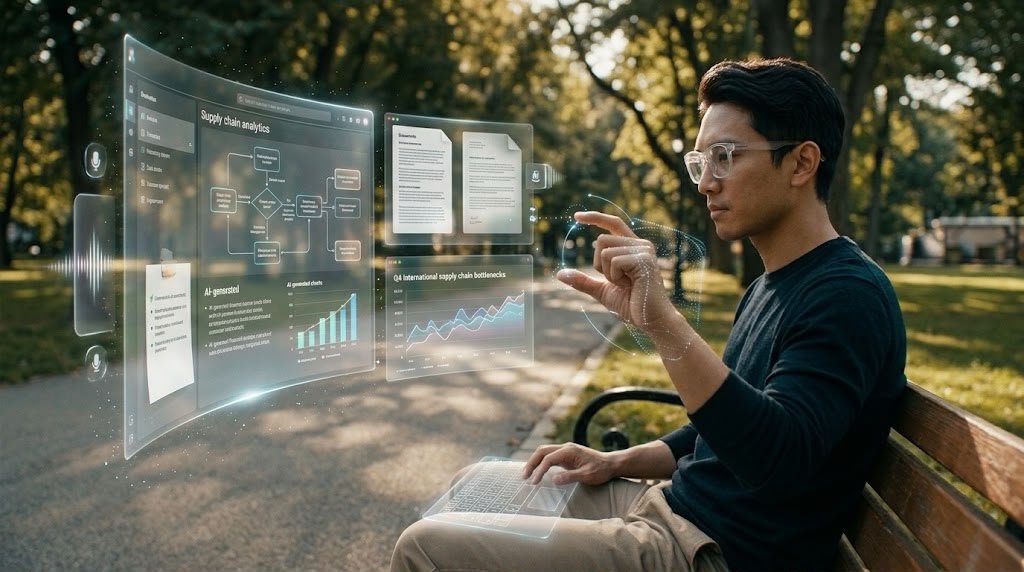
Imagine sitting on a park bench wearing sleek AR glasses connected to a screenless laptop setup. Instead of opening multiple browser tabs to research a complex business proposal, you ask your AI assistant: “Analyze our Q4 international supply chain bottlenecks, draft an executive summary, and display projected financial outcomes on a virtual whiteboard to my left.” Depending on the software, available data, and device capabilities, an AI agent could help analyze information, prepare a summary, generate spreadsheets, and organize virtual displays within your field of view. With compatible eye tracking and spatial computing features, the workspace could also respond to your attention and workflow. This combination of generative AI, AR glasses, and screenless laptops points toward a future in which digital tools feel more integrated with the physical world.
24. Future Horizons: Brain-Computer Interfaces and the Eventual Dissolution of Wearable Hardware
Looking far beyond the immediate horizon of 2026 augmented reality glasses and invisible laptops, visionary computer scientists and neurotic researchers are already exploring the ultimate conclusion of screenless computing: brain-computer interfaces (BCIs). While AR glasses successfully eliminate physical monitors by projecting light directly onto our retinas, they still rely on external eyewear frames, micro-OLED projectors, and battery packs resting on our physical bodies. The next and final evolutionary frontier in human-computer interaction is the complete dissolution of external wearable hardware entirely.
Experimental neural interface research demonstrates that direct neural telemetry can bypass optical projection altogether, transmitting visual data signals and computational commands straight to the brain’s visual cortex via microscopic, biocompatible sensor arrays. In this ultimate screenless future, checking emails, browsing the internet, and collaborating on complex software engineering projects will require zero physical screens, zero keyboards, and zero eyewear. Users will execute complex workflows purely through focused thought and intentional neural feedback loops. While fully non-invasive, consumer-grade brain-computer interfaces remain in experimental development stages, their conceptual trajectory underscores the profound, irreversible philosophical shift underway: computing is no longer a physical object we look at, but an invisible, ambient extension of human consciousness itself.
25. Are Screenless Laptops Right for You? A Practical Guide
As the consumer technology market stands at this historic crossroads between traditional screen-bound hardware and emerging invisible computing ecosystems, evaluating your personal or professional readiness for an upgrade requires disciplined self-assessment. Rushing out to adopt bleeding-edge spatial hardware without understanding your specific workflow bottlenecks can lead to frustration and wasted financial investment.
To determine whether transitioning to invisible laptops and AR glasses makes strategic sense for your lifestyle today, evaluate three core pillars: your mobility frequency, your multi-monitor dependence, and your budget threshold. If you are a mobile professional, remote consultant, or digital nomad who frequently travels and struggles with the physical limitations of tiny laptop screens, investing in a portable spatial computing setup delivers immediate, transformative productivity gains. Conversely, if your daily routine revolves around stationary creative suite rendering, competitive high-refresh-rate gaming, or rigorous office accounting where physical multi-monitor desk arrays remain irreplaceable, sticking with mature traditional hardware is the pragmatic choice. Evaluate your daily workflow, balance mobility against stationary precision, and decide whether you are ready to embrace the screenless future of 2026.
Frequently Asked Questions (FAQ)
Q1: Will AR glasses completely replace traditional computer monitors by 2026?
A: Not entirely. While AR glasses and invisible laptops are rapidly revolutionizing mobile productivity and remote work, traditional desktop monitors and laptops will remain dominant for stationary office environments due to ergonomic comfort, high-refresh-rate gaming needs, and mature software ecosystems.
Q2: Can people around me see what I am looking at through my AR glasses?
A: No. Advanced waveguide optics project light waves directly into your retinas, meaning the virtual screens are completely invisible to anyone standing next to you, providing absolute visual privacy in public spaces.
Q3: Do AR glasses cause eye strain during long work sessions?
A: Early models caused mild fatigue due to focal mismatches, but modern 2026 spatial glasses utilize advanced variable-focus optics and high-refresh-rate micro-OLED panels that dramatically reduce eye strain, allowing for comfortable multi-hour work sessions.
Conclusion: Are Screens Finally Disappearing in 2026?
So, are screens finally disappearing in 2026? The definitive answer is nuanced: physical screens are not vanishing entirely, but their monopoly on human-computer interaction is officially broken.
- Physical screens remain essential for heavy-duty gaming, stationary office workstations, and budget-conscious consumers who prefer tactile hardware.
- Invisible computing and AR glasses are winning the mobility battle, offering travelers, remote professionals, and digital minimalists the unprecedented freedom to carry an infinite multi-monitor workstation inside a pocket-sized case.
Evaluate your mobile workflow, your desire for digital minimalism, and your openness to wearable technology, and decide whether you are ready to step into the screenless future of 2026.