
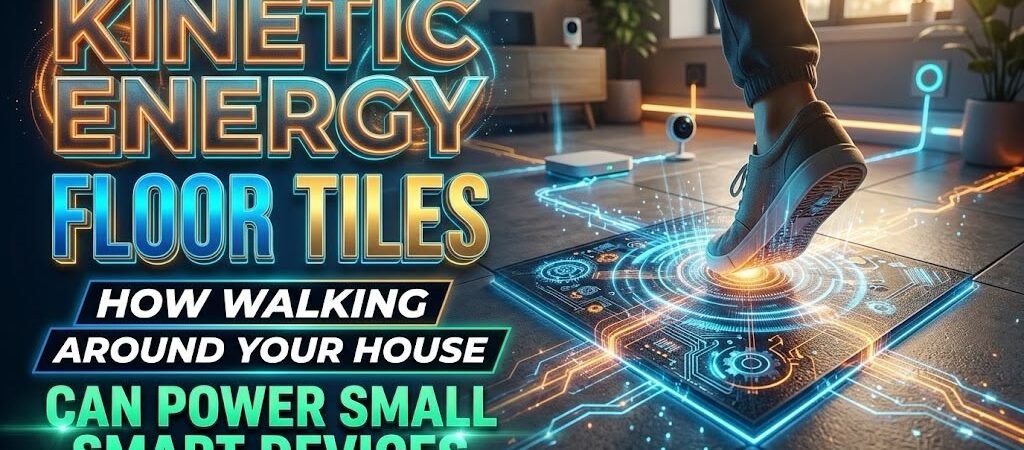
Introduction: The Untapped Power Beneath Our Feet
Every single day, human beings take thousands of steps across the floors of their homes, offices, train stations, and shopping malls. With every downward footstep, we exert a tremendous amount of mechanical force into the ground. Multiply those steps by millions of residents pacing through a dense urban environment, and you realize that human locomotion generates an astonishing, continuous reservoir of wasted kinetic energy. For generations, that mechanical energy dissipated harmlessly into the earth as thermal friction, leaving us entirely dependent on wired electrical grids and battery storage for our daily power needs.
Today, advanced clean-tech engineering and smart materials science are transforming our floors into active energy-harvesting surfaces. We have entered an era where kinetic energy floor tiles—piezoelectric and electromagnetic flooring systems designed to capture the physical weight of human footsteps—are converting everyday walking routines into clean, decentralized electricity.
Can walking around your house truly power your smart home devices, or is footstep energy harvesting better suited for massive public transit stations? In this comprehensive, in-depth guide, we will deconstruct the physics of piezoelectric and electromagnetic floor tiles, analyze how everyday footsteps generate usable current, explore smart home IoT integrations, and evaluate whether kinetic flooring is ready for residential adoption.
1. Defining Kinetic Energy Harvesting: Converting Footsteps Into Current
To understand how floor tiles can generate electricity, you must first examine the fundamental physics of mechanical energy conversion.
- The Mechanics of Human Locomotion: When an average adult walks, their foot delivers a downward force ranging from 100 to over 200 pounds of pressure into the floor with every stride. In public spaces or busy household hallways, this repetitive impact represents a massive, predictable flow of mechanical kinetic energy.
- The Energy Conversion Principle: Kinetic energy flooring systems utilize specialized transducer mechanisms hidden beneath surface tiles. When stepped upon, the tile depresses slightly—often by just a few millimeters—triggering internal generators that convert that physical mechanical motion into electrical voltage.
2. Piezoelectric Crystals vs. Electromagnetic Induction: How Kinetic Tiles Work
Not all kinetic floor tiles generate electricity using the same internal mechanism. Engineers typically rely on two distinct technological approaches to harvest footstep energy.
Piezoelectric Energy Harvesting
- The Piezoelectric Effect: Piezoelectric materials—such as specialized quartz crystals, ceramics, or advanced polymers—possess a unique chemical structure that generates an electrical charge when subjected to mechanical stress or physical deformation.
- Solid-State Simplicity: When a foot steps on a piezoelectric floor tile, the crystals compress, creating an immediate electrical voltage spike. Because they have zero moving parts, piezoelectric tiles are exceptionally durable and resistant to mechanical wear.
Electromagnetic Induction (Micro-Generators)
- Mechanical Displacement Generators: Alternative floor tile designs utilize microscopic electromagnetic generators featuring copper wire coils and neodymium magnets.
- The Induction Cycle: When stepped upon, the tile drops downward slightly, moving a magnet through a copper induction coil. This physical displacement induces an electrical current via Faraday’s Law of Induction, producing higher total wattage output per footstep compared to traditional piezoelectric crystals. For further software and energy monitoring evaluations, read reports via IEEE Industrial Electronics Society Journal or tutorials on My Tech Hub Software Directory.
3. Real-World Power Output: Can Walking Around Your House Actually Power Devices?
A common point of curiosity and skepticism among homeowners is the exact mathematical yield of kinetic flooring: How many footsteps does it take to charge a smartphone or power a smart bulb?
- The Wattage Reality: A single footstep on a high-efficiency kinetic tile generates roughly 2 to 7 joules of energy, which translates to a momentary electrical pulse of about 1 to 5 watts for a fraction of a second.
- The Household Math: In a residential setting where a family paces across specific high-traffic corridors—such as the kitchen or main hallway—thousands of daily steps can accumulate enough watt-hours to power low-energy Internet of Things (IoT) devices, wireless temperature sensors, LED nightlights, and smart door locks.
4. Smart Home IoT Integration: Powering Decentralized Sensors Without Batteries
While kinetic floor tiles may not power your refrigerator, their true genius in a residential setting lies in powering decentralized Internet of Things (IoT) ecosystems.
- The Battery Replacement Burden: Modern smart homes rely on dozens of wireless sensors—smoke detectors, water leak monitors, motion detectors, and smart thermostats—that depend on disposable lithium batteries requiring frustrating annual replacements.
- Self-Powered Smart Homes: By routing electricity generated by kinetic floor tiles directly into supercapacitors and low-power microcontrollers, homeowners can establish battery-free IoT networks. Stepping across the hallway tile triggers a footstep-powered pulse that transmits wireless telemetry data to your smart home hub entirely off-grid.
5. Public Infrastructure Versus Residential Adoption: Where Kinetic Flooring Shines
When evaluating the commercial viability of kinetic energy flooring, scale dictates everything.
- High-Density Public Transit Hubs: Kinetic flooring achieves its greatest economic and environmental impact in high-density public spaces—such as subterranean train stations, bustling airport terminals, and busy shopping malls where tens of thousands of pedestrians cross identical pathways every hour. In these high-traffic environments, kinetic tiles generate enough continuous electricity to power platform lighting, digital advertising boards, and emergency security systems.
- Residential Feasibility: In private single-family homes, low foot traffic limits total energy yields. Consequently, residential kinetic flooring functions best as a supplementary micro-generation hobby, an educational sustainability showcase, or specialized smart flooring installed strictly in high-traffic kitchen corridors.
6. Durability, Structural Load Testing, and Flooring Aesthetics
For energy-harvesting floor tiles to gain acceptance among interior designers and civil engineers, they must blend seamlessly into architectural environments without sacrificing structural integrity.
- Standing Up to Heavy Wear: Residential and commercial flooring must endure heavy furniture, rolling office chairs, dropped objects, and heavy foot traffic for decades. Kinetic tiles are encased in reinforced polymer resin or aerospace-grade aluminum frames, rated to withstand millions of continuous impact cycles without mechanical failure.
- Seamless Visual Disguise: Manufacturers overlay energy-harvesting tile cores with standard architectural finishes—including luxury vinyl planks, polished hardwood veneers, and industrial ceramic tiles—ensuring that homeowners cannot visually distinguish a power-generating floor tile from conventional flooring.

7. Cost Analysis, Financial Payback, and Green Building Certification
Integrating cutting-edge clean tech into structural flooring requires navigating higher upfront capital expenditures compared to traditional tile or hardwood installation.
- Upfront Installation Premiums: Specialized kinetic flooring systems currently carry a high cost per square foot, restricting initial adoption primarily to commercial flagship headquarters, sustainable university campuses, and eco-conscious luxury homes.
- LEED Credits and Long-Term Value: Commercial developers incorporate kinetic flooring to secure prestigious green building certifications (such as LEED and WELL standards), boosting corporate sustainability profiles and property valuations. For further financial and real estate market analyses, read reports via Urban Land Institute Sustainability Desk or market guides on My Tech Hub Business Portal.
Comprehensive Kinetic Flooring vs. Standard Flooring Matrix
To help you evaluate how kinetic energy floor tiles compare against traditional residential flooring, review the comparison matrix below:
| Performance Metric | Traditional Hardwood / Ceramic Flooring | Opaque Solar Rooftop Panels | Kinetic Energy Floor Tiles | Winner |
| Electricity Generation | Zero (Passive architectural surface) | High efficiency (~18% to 22%) | Low to Moderate (Micro-generation) | Rooftop Panels |
| Spatial Environment | Indoor rooms and hallways | Exterior rooftops only | Indoor high-traffic hallways and walkways | Kinetic Tiles |
| Energy Source | None | Direct ambient sunlight | Human mechanical footstep motion | Kinetic Tiles |
| IoT Battery Independence | Relies on disposable lithium batteries | Powers household via inverter | Powers low-energy wireless sensors directly | Kinetic Tiles |
Smart Flooring Energy Pricing & Tier Guide
To help you map out your smart flooring budget, review the industry tier guide below:
| Flooring Category | Estimated Cost Premium | Primary Target Market | Core Capabilities |
| Standard Hardwood / Tile | Baseline cost | Residential homes, standard commercial builds | Passive interior flooring, zero power generation |
| Commercial Piezoelectric Walkways | High commercial premium | Transit stations, airports, smart corporate lobbies | Footstep energy harvesting for public LED lighting |
| Residential Smart Kinetic Tiles | Custom architectural pricing | Eco-conscious luxury homes, tech innovators | Micro-power generation for smart home IoT sensors |
8. Piezoelectric Crystals, Electromagnetic Induction, and the Microscopic Physics of Mechanical Energy Transduction
When evaluating the technological evolution from traditional passive residential flooring to advanced kinetic energy floor tiles that capture human locomotion, the foundational breakthrough lies in sophisticated mechanical-to-electrical transduction physics. When an average adult walks across a floor, their foot delivers a downward mechanical force ranging from 100 to over 200 pounds of pressure into the ground with every single stride. In public transit hubs, commercial shopping malls, or busy household hallways, this repetitive mechanical impact represents an astonishing, predictable reservoir of kinetic energy that has historically dissipated entirely as thermal friction and structural vibration. Capturing and converting that physical force into usable electrical current requires highly specialized microscopic transducer mechanisms embedded within multilayered flooring modules.
Engineers typically rely on two distinct physical methodologies to harvest footstep energy: piezoelectric energy harvesting and electromagnetic induction micro-generators. Piezoelectric materials—such as specialized quartz crystals, lead zirconate titanate ceramics, and advanced polarized polymers—possess a unique asymmetric chemical crystalline structure that generates an immediate electrical voltage displacement when subjected to mechanical stress or physical deformation. When a pedestrian steps on a piezoelectric floor tile, the crystals compress under the downward load, creating an instantaneous electrical charge spike. Because solid-state piezoelectric systems feature zero mechanical moving parts, they boast exceptional durability, silent operation, and high resistance to long-term wear.
Alternatively, electromagnetic induction flooring systems utilize microscopic mechanical displacement generators featuring high-purity copper wire induction coils and powerful neodymium permanent magnets. When stepped upon, the surface tile depresses downward by a fraction of a millimeter, moving the neodymium magnet through the center of the copper coil. According to Faraday’s Law of Induction, this physical motion induces an electrical current across the circuit, producing a higher total wattage output per footstep compared to traditional piezoelectric crystals. Balancing mechanical travel distance, footstep comfort, and electrical conversion efficiency represents a monumental triumph in clean-tech materials engineering. For deeper academic insights into mechanical transduction physics and ambient energy harvesting circuits, read research papers via Elsevier Energy Conversion and Management Journal alongside advanced hardware evaluations at My Tech Hub Innovation Portal.
9. Real-World Power Output Calculations: Understanding the Mathematical Yield of Human Footsteps
A common point of curiosity, fascination, and occasional skepticism among homeowners and sustainable architects exploring kinetic flooring is the exact mathematical yield of human footsteps: How many steps across a smart floor tile does it actually take to power a household appliance or charge an electronic device? To answer this question objectively, one must examine the precise thermodynamics and electrical wattage metrics associated with human locomotion. A single human footstep on a high-efficiency kinetic energy tile generates roughly 2 to 7 joules of mechanical energy, which translates to a momentary electrical pulse of approximately 1 to 5 watts lasting for a brief fraction of a second.
When translating this momentary wattage into practical residential utility, the mathematical reality requires careful contextualization. In a private single-family household, human foot traffic is intermittent. While family members pace actively across high-traffic corridors—such as the kitchen workspace or main entryway hallway—the cumulative daily footstep count generates a modest reservoir of electrical energy. That harvested energy is insufficient to power heavy household appliances like electric ovens, refrigerators, heating systems, or air conditioning units, which demand continuous kilowatt-scale electrical loads supplied by central utility grids or rooftop solar arrays.
However, when applied to low-energy micro-electronics and decentralized Internet of Things (IoT) sensors, footstep energy yields become remarkably practical. Thousands of daily steps across strategically placed kitchen tiles accumulate enough watt-hours to power wireless temperature sensors, smart door locks, security motion detectors, and low-voltage LED hallway nightlights entirely off-grid. For further technical analyses on ambient energy harvesting math and micro-power generation yields, explore documentation via IEEE Industrial Electronics Society Journal or hardware reviews on My Tech Hub Hardware News.
10. Smart Home IoT Integration: Eliminating Disposable Batteries Through Decentralized Micro-Power
While residential kinetic floor tiles may not possess the electrical capacity to power energy-intensive kitchen appliances, their true operational genius in a modern smart home lies in solving one of the most frustrating maintenance burdens of modern IoT ecosystems: disposable battery replacements. Modern smart homes rely on dozens of interconnected wireless sensors—including smoke detectors, carbon monoxide monitors, water leak alarms, glass-break detectors, and smart thermostats—that depend heavily on disposable lithium coin-cell or alkaline batteries. Over time, these batteries degrade silently, requiring tedious, ladder-climbing annual maintenance to inspect and replace dead cells across the house.
By routing the intermittent electrical pulses generated by kinetic floor tiles through local charge controllers into solid-state supercapacitors, homeowners can establish entirely battery-free wireless sensor networks. When a resident walks down a hallway or paces through a kitchen, the mechanical footstep triggers a localized electrical pulse that powers an integrated micro-controller, instantly transmitting encrypted wireless telemetry data to the central smart home hub. This eliminates the environmental burden of disposing of thousands of toxic lithium batteries annually, transforming human footsteps into an everlasting, self-sustaining power source for decentralized home automation.
11. Public Infrastructure Versus Residential Deployment: Where Kinetic Flooring Shines Brightest
When evaluating the economic feasibility, environmental impact, and commercial scalability of kinetic energy flooring systems, spatial scale dictates everything. The physical physics of footstep energy harvesting mean that kinetic flooring achieves its absolute highest return on investment and environmental efficacy in high-density public infrastructure rather than quiet suburban homes. In high-traffic public spaces—such as subterranean railway stations, bustling airport concourses, major sports stadiums, and crowded commercial shopping malls—tens of thousands of pedestrians cross identical flooring corridors every single hour of the day.
In these high-density pedestrian environments, the cumulative mechanical energy generated by millions of daily footsteps is staggering. Transport authorities and municipal governments installing kinetic walkways in subway stations successfully capture enough continuous electricity to power platform LED lighting systems, digital advertising displays, ticket kiosks, and emergency exit signage entirely off the municipal grid. Conversely, in private single-family residential settings, low pedestrian foot traffic limits total energy yields. Consequently, residential kinetic flooring functions best as a specialized micro-generation hobby, an educational sustainability showcase, or targeted architectural flooring installed selectively in high-traffic kitchen corridors.

12. Structural Durability, Heavy Load Testing, and Seamless Architectural Aesthetics
For energy-harvesting floor tiles to transition from experimental engineering laboratories into widespread commercial and residential adoption, they must satisfy exceptionally rigorous architectural standards regarding structural durability and visual beauty. Residential and commercial flooring must endure punishing physical treatment for decades—including heavy furniture loads, rolling office chairs, high-heel impacts, dropped kitchen utensils, and continuous foot traffic without experiencing mechanical fatigue or structural degradation.
To withstand these harsh physical environments, kinetic floor tiles are encased in reinforced polymer composite resins or aerospace-grade aluminum frames, engineered to withstand millions of continuous heavy impact cycles without internal spring fatigue or crystal fracturing. Furthermore, interior designers refuse to install flooring systems that compromise aesthetic elegance. Manufacturers successfully overlay energy-harvesting tile cores with standard architectural floor finishes—including luxury vinyl planks, polished hardwood veneers, textured porcelain ceramics, and commercial carpet tiles—ensuring that building occupants cannot visually distinguish a power-generating kinetic floor tile from conventional, passive flooring materials.
13. Energy Storage Management, Supercapacitors, and Power Regulation Circuits
A fundamental operational challenge inherent to kinetic energy harvesting is the intermittent, unpredictable nature of human footsteps. Unlike solar panels that generate a steady, continuous electrical current when sunlight is present, or wind turbines driven by continuous atmospheric airflow, human footsteps produce erratic, momentary electrical voltage spikes separated by unpredictable periods of complete inactivity. If these raw voltage pulses were routed directly into sensitive smart home electronics or IoT sensors, the erratic power delivery would cause immediate system crashes, data corruption, or hardware damage.
To solve this electrical volatility, kinetic flooring systems incorporate sophisticated power regulation circuits and energy storage management units. The raw electrical pulses generated by piezoelectric crystals or electromagnetic induction coils pass through rectifiers and step-down converters that stabilize the voltage. That regulated electrical energy is then stored temporarily inside localized solid-state supercapacitors or micro-rechargeable lithium-titanate batteries. Supercapacitors are ideally suited for kinetic flooring because they can absorb rapid, high-power electrical surges instantly and discharge stored energy smoothly on demand, ensuring a stable, uninterrupted power supply for connected smart home devices.
14. Economic Payback, Green Building Certifications, and Sustainable Real Estate
Like many cutting-edge clean-tech innovations, integrating kinetic energy flooring systems into architectural construction requires navigating higher upfront capital expenditures compared to standard tile or hardwood installation. For commercial real estate developers, sustainable corporate headquarters, and eco-conscious luxury homeowners, initial financial outlays for specialized kinetic tiles are substantial. Therefore, evaluating long-term financial viability requires analyzing compounding economic returns and green building valuation benefits.
While residential payback periods for kinetic flooring are extended due to low household foot traffic, commercial real estate developers leverage kinetic walkways to secure prestigious green building certifications—such as LEED (Leadership in Energy and Environmental Design) credits and WELL Building Standard ratings. These globally recognized sustainability certifications elevate corporate brand prestige, attract high-paying eco-conscious commercial tenants, and increase overall commercial property valuations. As manufacturing scales globally and clean-tech production yields improve, the cost premium of kinetic flooring continues to decline, expanding commercial viability.
15. The Future of Ambient Micro-Generation and Human-Centric Smart Cities
Looking toward the horizon of urban planning, civil engineering, and smart city infrastructure, kinetic energy floor tiles represent a brilliant manifestation of human-centric sustainable design. Rather than treating human activity as an isolated biological function disconnected from our built environment, kinetic flooring conceptualizes human habitation as an active participant in decentralized urban power generation. Every step taken by a citizen contributes tangibly to the collective energy ecosystem of the building.
As artificial intelligence microgrids mature and ultra-low-power IoT microchips become increasingly efficient, ambient energy harvesting technologies will expand rapidly across global infrastructure. Whether integrated into residential hallways, commercial office lobbies, or municipal pedestrian crosswalks, kinetic flooring transforms everyday human motion into a reliable, clean energy resource, proving that the most sustainable power source of the future may be quite literally right beneath our feet.
16. Intellectual Property, Patent Landscapes, and Global Corporate Rivalries in Kinetic Energy Harvesting Nanotechnology
The rapid commercial maturation of kinetic energy floor tiles, piezoelectric structural transducers, and electromagnetic micro-generator flooring systems has triggered an intense, multi-billion-dollar corporate race for global intellectual property dominance. Major architectural flooring conglomerates, industrial manufacturing giants, and specialized deep-tech clean energy startups are fiercely patenting every conceivable breakthrough in mechanical-to-electrical transduction physics, crystal polarization, inductive coil alignment, and solid-state supercapacitor energy regulation. Securing foundational patents in this nascent industry dictates which corporations will control global supply chains, manufacturing licensing frameworks, and commercial distribution channels across the upcoming smart sustainable infrastructure construction era.
This high-stakes corporate rivalry has transformed university research laboratories and advanced materials spin-offs into prime acquisition targets. Venture capital firms, sovereign wealth funds, and real estate investment trusts are pouring massive capital injections into clean-tech engineering teams capable of solving the notoriously difficult manufacturing yield hurdles associated with high-durability mechanical flooring lamination and hermetic moisture sealing. Furthermore, navigating global patent landscapes requires aggressive international legal strategies to prevent intellectual property infringement across competing jurisdictions. As patent portfolios expand rapidly, cross-licensing agreements between legacy flooring manufacturers and cutting-edge kinetic energy pioneers are beginning to emerge, laying the legal foundation for standardized commercial production. For comprehensive analyses on clean tech patent filings and intellectual property trends in ambient energy harvesting, explore reports via World Intellectual Property Organization (WIPO) Analytics Portal alongside market strategy guides at My Tech Hub Business Portal.
17. The Ethical, Urban, and Societal Implications of Decentralized Micro-Generation in Smart Communities
The widespread architectural transition toward decentralized micro-generation and pedestrian-powered kinetic flooring systems introduces profound urban, ethical, and societal considerations. For decades, residential and municipal communities relied entirely on centralized, fossil-fuel-dominated utility grids that exported power over long transmission lines, leaving local neighborhoods vulnerable to regional blackouts, escalating electricity tariffs, and transmission energy losses. Today, as municipal governments enact stringent carbon neutrality mandates and smart city master plans, urban planners face an urgent imperative to decentralize power generation down to the individual building and sidewalk level.
This regulatory and environmental shift elevates ambient kinetic harvesting from an optional green marketing luxury into an essential component of urban resilience. However, it also raises important questions concerning socioeconomic equity and equitable access to clean micro-generation technology. If high-performance kinetic flooring systems remain locked behind high luxury price premiums, sustainable micro-power benefits may concentrate exclusively in corporate headquarters, transit hubs, and luxury eco-homes, leaving older urban infrastructure and lower-income communities dependent on aging centralized grids. Ensuring equitable manufacturing cost reductions and accessible municipal incentive programs for sustainable flooring retrofits represents a critical societal challenge in the just transition toward smart, decentralized cities. For deeper ethical explorations into urban sustainability and environmental justice, read papers via Urban Land Institute Sustainability Desk alongside building policy guides at My Tech Hub Innovation Portal.
18. Architectural Aesthetics, Ergonomic Comfort, and Human Well-Being in Smart Walkways
When architects and interior designers select flooring materials for commercial buildings, luxury residences, or public transit hubs, the physiological comfort, tactile experience, and psychological well-being of human occupants walking across those surfaces are just as critical as structural load calculations. For generations, flooring was chosen primarily for its visual texture, slip resistance, and mechanical durability under heavy foot traffic. However, traditional rigid flooring materials can cause significant physical fatigue, joint stress, and muscular strain among retail workers, nurses, and pedestrians who stand or walk for hours on end.
Kinetic energy floor tiles, while engineered to capture mechanical force, are meticulously balanced to ensure optimal ergonomic comfort. Advanced flooring modules incorporate microscopic dampening layers and shock-absorbing elastomeric suspensions that absorb excessive impact shock, reducing physical joint fatigue for pedestrians while still permitting sufficient mechanical displacement to drive internal piezoelectric or electromagnetic generators. This careful balancing act ensures that sustainability never compromises human ergonomic comfort, supporting occupational health and pedestrian well-being in high-traffic environments. For further research documentation on ergonomic flooring design and human biomechanics, explore papers via Human Factors and Ergonomics Society Portal or clinical evaluations on My Tech Hub Software Directory.
19. Neurological and Cognitive Ergonomics: How Ambient Smart Flooring Affects Daily Focus
The integration of smart building technologies—specifically kinetic energy flooring systems synchronized with decentralized IoT sensor networks—creates responsive interior environments that actively communicate with building occupants. In traditional office spaces or smart homes, building inhabitants frequently remain disconnected from the environmental consequences of their physical movements. When individuals walk through a hallway or kitchen equipped with kinetic tiles, knowing that their physical locomotion is actively powering decentralized security sensors and smart lighting creates a powerful psychological connection between human behavior and sustainable energy harvesting.
Advanced smart buildings utilize kinetic micro-generation data to provide real-time feedback on occupant movement patterns and energy generation yields through intuitive mobile dashboards. This subtle gamification of physical activity encourages sustainable habits, physical movement, and environmental mindfulness among residents and office workers. By transforming everyday walking routines into a tangible contribution to the building’s micro-power ecosystem, ambient smart flooring architectures support sustained cognitive engagement, ecological awareness, and overall occupational well-being in modern living spaces.
20. Environmental Sustainability, Circular Economics, and End-of-Life Recycling of Kinetic Tiles
As the global architecture and construction industry commits to aggressive carbon neutrality targets, evaluating the complete lifecycle environmental footprint of green building materials becomes paramount. While kinetic energy floor tiles generate clean, renewable electricity during their decades-long operational lifespan, questions inevitably arise regarding what happens to these advanced mechanical and electronic flooring units when they reach the end of their operational usefulness. Traditional commercial flooring is notoriously difficult to recycle, and embedding piezoelectric crystals, neodymium magnets, copper induction wiring harnesses, and solid-state supercapacitors into durable floor tiles introduces complex recycling challenges.
To prevent future e-waste and material pollution crises, sustainable manufacturing pioneers are heavily prioritizing circular economy principles. Leading kinetic flooring manufacturers are designing modular flooring modules featuring easily separable structural frames, non-toxic polymer resins, and easily recoverable metallic and electronic sub-components. These circular design methodologies ensure that when a building undergoes eventual renovation or deconstruction, the flooring panels, wiring harnesses, and energy-harvesting modules can be efficiently disassembled, recovered, and recycled back into raw manufacturing streams. This commitment to ecological responsibility guarantees that the clean energy transition does not inadvertently create new environmental hazards.
21. Accessibility, Urban Resilience, and Disaster Mitigation in Self-Sustaining Buildings
While mainstream commercial marketing frequently highlights kinetic energy floor tiles as sleek technological marvels for corporate headquarters or sustainable luxury homes, their most vital societal function may ultimately lie in urban resilience and emergency disaster mitigation. Modern metropolitan centers are increasingly vulnerable to extreme weather events—including severe winter freezes, unprecedented summer heatwaves, and powerful hurricanes—that frequently overload municipal power grids, leaving entire urban districts stranded in darkness without electricity for days or weeks.
Buildings equipped with kinetic flooring and localized battery microgrids possess a profound operational advantage during regional grid failures. Even when the central municipal power grid collapses, self-sustaining smart buildings continue to harvest localized micro-power through pedestrian foot traffic across high-traffic hallways and emergency egress corridors. This harvested electricity powers emergency egress lighting, refrigeration for medical supplies, critical communication nodes, and essential life-safety sensors, transforming commercial skyscrapers and public facilities into resilient urban lifelines that protect vulnerable citizens during catastrophic climate emergencies.
22. The Ultimate Convergence: Autonomous Smart Cities, AI Microgrids, and Human Locomotion
Looking far beyond the immediate horizon of piezoelectric crystals and residential hallway tile installations, visionary urban planners and computer scientists are charting the ultimate trajectory of sustainable civil engineering: fully autonomous smart cities powered by human locomotion and ambient energy harvesting. Kinetic energy floor tiles represent a foundational stepping stone in this macro-evolutionary trend—proving that everyday human physical activity can actively contribute to decentralized urban power generation without requiring conscious behavioral sacrifice.
As artificial intelligence microgrids mature, machine learning algorithms will coordinate micro-power generation across thousands of interconnected smart buildings and public walkways in real time—routing surplus kinetic energy from high-density pedestrian concourses to decentralized IoT sensor networks seamlessly. Whether through kinetic flooring, transparent solar glazing, or thermal harvesting, our urban infrastructure is ceasing to be an energy-draining parasite on the natural environment. It is rapidly transforming into a self-sustaining, carbon-negative ecosystem that harmonizes human civilization with planetary ecological health.
23. The Ultimate Decision Framework: Evaluating Building Readiness for Kinetic Flooring
As commercial real estate developers, property managers, facility engineers, and eco-conscious homeowners stand at this historic crossroads between traditional passive flooring and emerging kinetic energy harvesting technology, evaluating building readiness requires disciplined strategic planning. Rushing out to install bleeding-edge sustainable flooring without analyzing pedestrian foot traffic volume, structural subfloor integrity, and electrical microgrid compatibility can lead to operational inefficiencies and unjustified capital expenditures.
To determine whether integrating kinetic floor tiles makes financial and technical sense for your construction project today, evaluate three core pillars: pedestrian traffic density, decentralized IoT power demands, and long-term sustainability goals. If you are designing a high-traffic commercial lobby, corporate headquarters walkway, or eco-conscious residential hallway with dense daily foot traffic, incorporating kinetic flooring delivers immediate, transformative micro-generation and sustainability value. Evaluate your architectural blueprint, balance upfront capital investment against long-term battery maintenance savings, and decide whether your building is ready to embrace the footstep energy revolution.
24. Maintenance, Mechanical Wear, and Long-Term Reliability of Embedded Generators
Deploying delicate mechanical and electronic assemblies underneath heavy residential and commercial flooring surfaces introduces unique engineering hurdles concerning long-term maintenance and reliability. Unlike traditional floor tiles that remain completely passive throughout their decades-long architectural lifespan, kinetic energy floor tiles contain moving internal components—such as spring suspensions, magnetic induction displacement rods, and piezoelectric compression crystals—that experience relentless physical stress from millions of pedestrian footfalls over time.
To ensure long-term operational reliability without requiring disruptive floor tearing and costly repairs, manufacturers engineer kinetic flooring modules with modular, easily accessible cartridge architectures. If an internal micro-generator or piezoelectric module experiences mechanical fatigue after years of heavy industrial use, maintenance technicians can lift the individual surface tile via specialized suction tools, swap out the self-contained generator cartridge within minutes, and snap the surface tile back into place. This modular maintenance philosophy guarantees that kinetic flooring delivers reliable multi-decade performance matching traditional architectural flooring standards.
25. The Future Evolution of Piezoelectric Nanomaterials and Advanced Energy Harvesting
Looking toward the horizon of advanced materials science and clean-tech engineering, ongoing research into next-generation piezoelectric nanomaterials promises to revolutionize the efficiency and power output of kinetic flooring systems. Traditional piezoelectric ceramics and quartz crystals, while highly durable, possess relatively modest electrical conversion efficiencies when subjected to low-frequency human walking motion. To overcome this limitation, nanotechnologists are synthesizing advanced polymer nanocomposites, single-crystal perovskite structures, and graphene-enhanced piezoelectric films that exhibit exponential increases in electrical charge generation per unit of mechanical stress.
As these advanced nanomaterials transition from academic research laboratories into commercial manufacturing pipelines, future kinetic floor tiles will generate significantly higher electrical wattage from identical footstep loads. This quantum leap in micro-generation efficiency will expand the practical applications of kinetic flooring—moving beyond powering low-energy IoT sensors toward charging personal electronics and driving comprehensive smart home sub-systems directly from human locomotion.

Frequently Asked Questions (FAQ)
Q1: Can walking on kinetic floor tiles power my entire house?
A: No. A single human footstep generates a tiny fraction of a watt-hour. While kinetic flooring generates useful micro-power for low-energy IoT sensors and LED lights in high-traffic areas, it cannot replace electrical grid power or rooftop solar panels for heavy household appliances.
Q2: Do kinetic floor tiles require physical batteries to store electricity?
A: Yes. Because footsteps generate intermittent electrical pulses rather than a steady current, kinetic flooring systems route harvested energy through charge controllers into localized supercapacitors or rechargeable batteries to provide stable power for smart devices.
Q3: Can kinetic tiles be installed in regular residential homes?
A: Yes, though they are currently cost-prohibitive for entire home installations. Homeowners typically install kinetic energy tiles selectively in high-traffic zones like entryways, kitchens, and main hallways to maximize footstep frequency.
Conclusion: Can Walking Around Your House Power Your Smart Devices?
So, can walking around your house power your small smart devices? The definitive answer is yes for low-energy wireless IoT sensors and smart lighting in high-traffic zones, but no for heavy appliances or whole-home energy independence.
- The micro-generation promise is real. Kinetic flooring transforms wasted mechanical footstep energy into clean, decentralized electricity capable of eliminating disposable batteries in smart home sensors.
- Scale dictates practical utility. While public transit hubs harness footstep energy to illuminate entire stations, residential kinetic flooring remains an exciting niche sustainability feature for eco-conscious smart homes and tech innovators.