
Introduction:
For the past decade, the extraordinary commercial and scientific renaissance of artificial intelligence has been dominated by a singular architectural paradigm: massive statistical pattern recognition. From deep convolutional neural networks classifying millions of images to massive transformer-based language models predicting the next token in a vast corpus of human text, modern AI systems have achieved breathtaking milestones by learning surface-level correlations. These models ingest petabytes of historical data, optimize billions or trillions of parameters via gradient descent, and output startlingly coherent responses, translations, and classifications.
This reactive limitation becomes glaringly apparent when artificial intelligence is deployed into dynamic, open-world environments such as autonomous driving, dexterous humanoid robotics, and interactive gaming. A self-driving car trained purely on reactive imitation learning may navigate familiar highway lanes flawlessly, but when confronted with an unprecedented, chaotic physical scenario—such as a pedestrian spilling a box of bouncy balls across a wet intersection—it falters because it lacks an internal simulation of physical reality
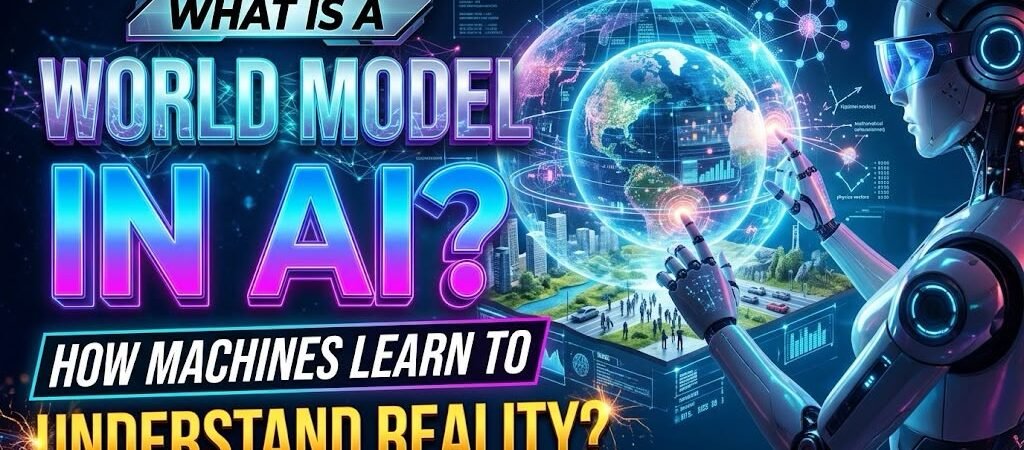
Enter the concept of the world model in artificial intelligence—an internal, generative representation of the environment constructed by an artificial neural network that enables the system to simulate physical dynamics, predict future states, reason about unobserved variables, and plan multi-step actions without trial-and-error exposure to physical peril. Promulgated by leading AI researchers like Yann LeCun through architectures such as the Joint Embedding Predictive Architecture (JEPA), world models represent the definitive leap from mere statistical curve-fitting toward true machine comprehension of reality.
1. Defining World Models in Artificial Intelligence: Internal Simulations of Physical Reality
To understand what a world model is, one must first contrast it with standard reactive machine learning models. In cognitive science and control theory, a world model is an internal representation of the external environment utilized by an agent to make decisions, predict the consequences of actions, and simulate alternative courses of action before executing them in the physical world. Human beings possess rich, intuitive world models from infancy. When you toss a set of keys onto a kitchen counter, your brain does not engage in real-time differential equation calculations; instead, your internal mental simulator instantly predicts the trajectory, velocity, kinetic energy transfer, and acoustic resonance of the keys hitting the granite surface.
In artificial intelligence, a world model is a computational subsystem—typically embedded within a larger reinforcement learning or autonomous agent architecture—that learns the transition dynamics of the environment. Given the current state vector s_t (or high-dimensional sensory observations like video frames) and a planned action vector a_t, a world model predicts the subsequent state s_{t+1} and the immediate reward r_{t+1}. Mathematically, it models the conditional probability distribution:
P(s_{t+1}, r_{t+1} \mid s_t, a_t)
By possessing this predictive capability, an AI agent is no longer blind. It can “dream” or mentally simulate hundreds of thousands of possible futures in latent space, evaluate which trajectory maximizes long-term reward or minimizes catastrophic risk, and execute only the optimal physical action. This capacity for internal mental simulation bypasses the dangerous, time-consuming trial-and-error constraints of model-free reinforcement learning, allowing machines to learn efficiently, generalize robustly to out-of-distribution scenarios, and understand the immutable cause-and-effect laws governing reality.
2. The Historical Evolution of Predictive Modeling: From Control Theory to Deep Learning
The intellectual lineage of world models traces its roots back decades through control theory, cybernetics, and model-based reinforcement learning (MBRL), long before the modern deep learning boom. In classical control theory, engineers designed explicit, hand-crafted mathematical models of physical systems—such as aircraft flight dynamics or industrial chemical reactors—using differential equations derived from Newtonian physics. These deterministic or stochastic state-space models allowed controllers to compute optimal control inputs via algorithms like Model Predictive Control (MPC). However, these classical models failed when applied to complex, unstructured, real-world environments where explicit mathematical formulation was impossible.
As machine learning matured through the 1990s and 2000s, researchers began substituting hand-crafted equations with data-driven statistical models, such as Gaussian Processes, Hidden Markov Models (HMMs), and linear dynamical systems. While these statistical models could capture simple environmental dynamics, they suffered severely from the curse of dimensionality when confronted with high-dimensional sensory inputs like raw high-definition video or complex tactile arrays.
The true renaissance of world models arrived with the advent of deep representation learning in the mid-2010s. Pioneers like Jürgen Schmidhuber, David Ha, and Alex Graves demonstrated that deep neural networks—specifically recurrent neural networks (RNNs) and variational autoencoders (VAEs)—could ingest raw pixel streams from simulated environments (such as Atari video games or racing simulators), compress those massive sensory inputs into compact, low-dimensional latent representations, and learn accurate predictive models of future game frames entirely in latent space. This historical convergence of deep learning pattern recognition with classical model-based control theory unlocked the modern era of neural world modeling.
3. Model-Based Reinforcement Learning (MBRL) vs. Model-Free Reinforcement Learning
To fully appreciate the operational supremacy of world models, one must examine the fundamental methodological split in machine learning reinforcement training: Model-Free Reinforcement Learning (MFRL) versus Model-Based Reinforcement Learning (MBRL).
Model-free reinforcement learning algorithms—such as Deep Q-Networks (DQN) and Proximal Policy Optimization (PPO)—learn policies or value functions directly from trial-and-error interactions with the environment without building an explicit representation of how the environment works. While model-free algorithms achieved legendary milestones by defeating human world champions in complex games like Go, Chess, and Dota 2, they suffer from crippling structural inefficiencies:
- Extreme Sample Inefficiency: Model-free algorithms require millions or billions of physical environment interactions to learn optimal policies. Training a robotic arm to pick up a Lego brick via model-free RL might require thousands of hours of physical trial and error, wearing down mechanical actuators.
- Zero Generalization: A model-free policy trained in a virtual simulation often fails utterly when deployed in the real world due to minor domain discrepancies (the “sim-to-real gap”).
Model-based reinforcement learning, driven by world models, solves these deficiencies fundamentally. By explicitly learning a neural network simulator of environmental dynamics, an MBRL agent can train its policy inside its own internal “dream” or latent imagination. The agent interacts with the physical world sparingly to collect calibration data, updates its internal world model, and conducts billions of simulated rollouts entirely within the neural network’s latent space. This reduces physical sample requirements by orders of magnitude, enabling safe, rapid, and adaptable learning in complex physical domains. For further academic insights into model-based reinforcement learning architectures, read research papers via Journal of Machine Learning Research (JMLR) alongside advanced hardware evaluations at My Tech Hub AI Research Portal.
4. Yann LeCun’s Vision: Autonomous Machine Intelligence and the Architecture of JEPA (Joint Embedding Predictive Architecture)
One of the most profound theoretical and architectural breakthroughs in modern world model research has been championed by Turing Award laureate Yann LeCun, who argued forcefully that traditional generative modeling (such as autoregressive next-token prediction in LLMs or pixel-by-pixel image generation) is fundamentally incapable of achieving human-level machine intelligence. LeCun posited that the physical world is inherently unpredictable and stochastic at the pixel level; attempting to predict every single pixel or word in a complex scene forces a model to waste massive computational capacity on irrelevant details (like fluttering leaves or background noise) rather than capturing abstract causal structures.
To solve this, LeCun proposed the Joint Embedding Predictive Architecture (JEPA). Unlike generative models that attempt to reconstruct missing inputs in pixel space, JEPA operates entirely within an abstract latent representation space.
- The Encoder Mechanism: High-dimensional sensory inputs (such as video frames x) are mapped via an encoder network s_x = Enc(x) into compact, semantically rich continuous vector embeddings.
- The Predictor Network: Rather than predicting future pixels, the JEPA predictor network attempts to predict the latent representation of a future state s_y given the latent representation of the current state and an action vector: \hat{s}_y = Pred(s_x, a).
- Energy-Based Regularization: JEPA utilizes an energy-based loss function that penalizes the model only when its internal predictions diverge from actual encoded latent states, avoiding the collapse problems that plague traditional self-supervised learning architectures.
This architectural shift—moving away from pixel-level generation toward abstract latent space prediction—represents the bedrock of modern autonomous machine intelligence, enabling machines to grasp underlying physical invariants without getting bogged down in microscopic perceptual noise.
5. Cognitive Architecture and Cognitive Science Parallels: How Human Brains Construct Mental Simulations
The computational mechanics of neural world models share striking, profound parallels with modern cognitive neuroscience and developmental psychology regarding how biological brains understand reality. For decades, cognitive scientists—most notably Kenneth Craik in his seminal 1943 book The Nature of Explanation—proposed the hypothesis of the “mental model.” Craik argued that the human mind translates external physical reality into small-scale internal structural models that it utilizes to reason, anticipate future events, and test alternative courses of action safely inside the skull.
In contemporary neuroscience, this is understood through the framework of predictive processing and the Bayesian brain hypothesis. According to this neurobiological model, the human brain is not a passive sensory receiver waiting to be stimulated; it is an active, incessant prediction engine. The cerebral cortex constantly generates top-down predictions about incoming sensory inputs from the eyes, ears, and proprioceptors, comparing those internal predictions against bottom-up sensory feedback.
Artificial intelligence world models replicate this exact biological computational loop. By training neural networks to minimize prediction error in latent space, engineers are essentially instantiating silicon equivalents of cortical prediction hierarchies. This explains why artificial world models exhibit emergent properties similar to biological cognition, such as surprise detection, anomaly recognition, and intuitive physics reasoning. For further neuroscientific documentation on predictive processing and cognitive architectures, explore papers via Trends in Cognitive Sciences Journal or research guides on My Tech Hub Cognitive Science Portal.

6. State Space Representation and Latent Dynamics: Compressing High-Dimensional Sensorial Reality
One of the most formidable computational challenges in building world models for real-world applications is the sheer dimensionality of sensory data. A single second of high-definition video captured by an autonomous vehicle camera or a humanoid robot stereo rig contains tens of millions of raw pixels. Processing, storing, and predicting future states at the raw pixel level is computationally intractable and prone to compounding error cascades over long temporal horizons.
To overcome this, world models rely heavily on state space representation learning and latent dynamics modeling. The architecture typically decouples perception from prediction through a multi-stage pipeline:
- Perceptual Compression: A deep convolutional or transformer-based encoder compresses high-dimensional observational data (x_t \in \mathbb{R}^{H \times W \times C}) into a low-dimensional continuous latent vector (z_t \in \mathbb{R}^{d}, where d \ll H \times W \times C).
- Transition Dynamics Modeling: A recurrent state-space model (RSSM) or transformer predicts the evolution of the latent state over time based on executed actions: \hat{z}_{t+1} = f_\theta(z_t, a_t).
- Decoder Reconstruction (Optional): A decoder network maps the latent vector back to observation space only when visualization or verification is required.
By operating entirely within a compressed, information-dense latent space, the world model strips away distracting perceptual noise (such as lighting shifts or background textures) and focuses exclusively on tracking the underlying state variables that matter—such as object positions, velocities, mass, and topological connectivity. This latent compression is the secret weapon that allows neural networks to simulate complex physical scenes with astonishing computational efficiency.
7. Predictive Coding and Free Energy Principles in Artificial Neural Networks
As world model architectures grow increasingly sophisticated, theoretical computer scientists and neuroscientists are converging around unifying mathematical frameworks to explain why these models succeed. Chief among these is Karl Friston’s Free Energy Principle, originally formulated in theoretical neuroscience to explain how biological systems maintain their internal organization against the second law of thermodynamics by minimizing variational free energy.
In the context of artificial intelligence, minimizing free energy is mathematically equivalent to minimizing prediction error and maximizing model evidence. A world model governed by the free energy principle operates as an active inference engine. It possesses two distinct mechanisms to reduce surprise (prediction error):
- Perceptual Inference: Updating the internal latent state representation when sensory observations violate internal expectations.
- Active Inference (Action): Executing physical actions in the environment that force the external world to conform to the model’s preferred internal states.
This unified formulation bridges perception, learning, and decision-making into a single optimization objective. The world model does not merely observe reality; it actively queries reality, formulates hypotheses, tests predictions, and refines its internal ontology of the universe. This mathematical rigor elevates world models from ad-hoc engineering heuristics into principled foundations for artificial general intelligence.
8. Generative World Models: From Diffusion Models and Video Generation to Spatial Coherence
The rapid proliferation of large-scale generative models—particularly diffusion models and transformer-based video generators—has injected a massive surge of capability into world model research. Where early world models relied on simple deterministic autoencoders and recurrent networks that blurred future predictions over long horizons, modern generative world models synthesize hyper-realistic, temporally consistent video predictions that rival physical reality.
When trained on billions of video frames depicting physical interactions, human locomotion, fluid dynamics, and vehicular navigation, generative diffusion models implicitly learn the statistical mechanics of the physical world. When prompted with an initial video frame and an action vector (such as steering angle or robotic arm torque), these models can “imagine” hundreds of future frames with stunning spatial coherence. Objects do not magically vanish; shadows align correctly with light sources; liquids slosh in accordance with gravitational vectors; and solid barriers block movement.
This breakthrough in generative video modeling has transformed world models into powerful interactive simulators. Researchers can prompt the model with novel scenarios that have never occurred in the training data, allowing autonomous agents to stress-test their decision-making policies against rare edge cases, hazardous weather conditions, and catastrophic failure modes safely within a generative latent simulation before touching physical hardware.
9. Physics Engines and Intuitive Physics: Teaching Machines Gravity, Friction, and Inertia
For an artificial intelligence to operate safely and effectively in the physical world, it must internalize the immutable laws of classical mechanics—specifically intuitive physics. Human toddlers demonstrate a rudimentary understanding of gravity, support, collision, solidity, and inertia by the age of a few months; they express surprise when a solid object appears to float in mid-air or pass through a solid barrier. Early machine learning models lacked this basic common sense, frequently proposing physically impossible actions.
Modern world models acquire intuitive physics not by hardcoding Newtonian equations into software libraries, but by learning mechanical invariants directly from observational video data. Through self-supervised training on physical interactions, neural networks construct internal representations of:
- Mass and Momentum: Understanding that heavier objects require greater force to accelerate and possess higher kinetic energy upon impact.
- Friction and Restitution: Modeling how surfaces resist sliding motion and how elastic objects bounce versus inelastic objects deform.
- Occlusion and Object Permanence: Recognizing that an object continues to exist even when temporarily hidden behind another physical barrier.
By embedding these intuitive physics priors directly into the latent dynamics of the world model, AI agents avoid proposing absurd, physically impossible trajectories, drastically accelerating learning convergence and enhancing operational safety in robotics and autonomous systems.
10. Robotics and Embodied AI: How World Models Enable Dexterous Manipulation and Safe Navigation
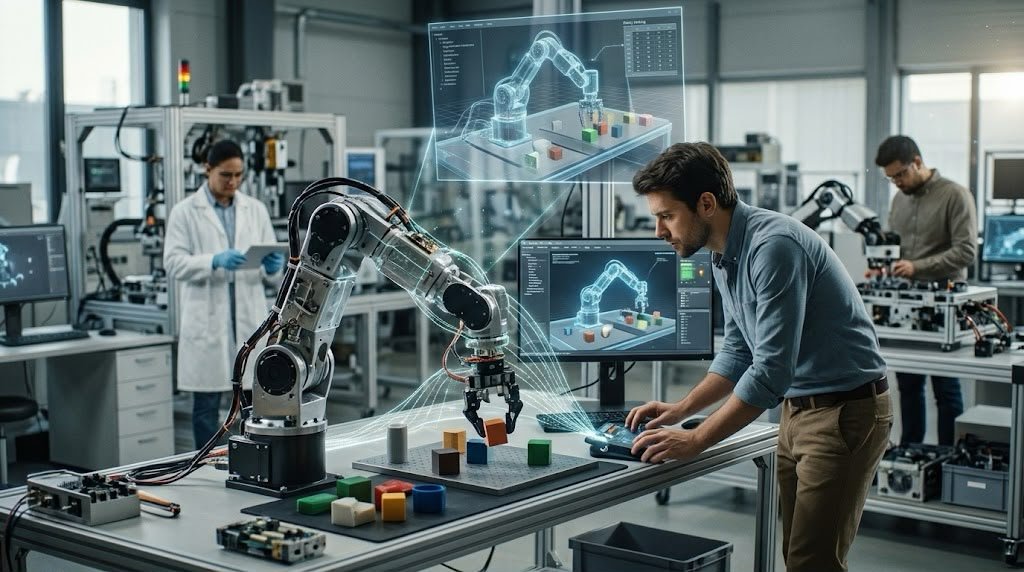
The most profound real-world testing ground for artificial world models is Embodied AI—the scientific discipline dedicated to instilling machine intelligence into physical robotic bodies operating in unstructured human environments. Whether dealing with autonomous humanoid robots folding laundry in residential homes or industrial robotic arms assembling delicate electronics on factory floors, physical manipulation requires sub-millimeter precision, real-time tactile feedback, and rapid error recovery.
Model-free reinforcement learning has historically struggled with robotic manipulation because a physical robot cannot afford millions of trial-and-error failures that break expensive actuators or damage surrounding property. World models revolutionize robotic learning through imagined rollout planning.
- The robot’s onboard perception system encodes the current physical scene into a latent state.
- The internal world model simulates 1,000 potential grasp trajectories and hand configurations in latent space.
- The model evaluates the success probability of each simulated trajectory based on physics priors and learned friction dynamics.
- The robot executes only the single optimal physical action.
This mental rehearsal allows robots to learn complex contact-rich manipulation tasks—such as pouring liquids, untangling cords, and inserting plugs—with astonishing sample efficiency. For further technical case studies on embodied AI and robotic world modeling, read reports via IEEE Robotics and Automation Society Portal alongside industry whitepapers at My Tech Hub Robotics Portal.
11. Autonomous Vehicles and Real-Time Spatial Prediction: Navigating Dynamic Urban Environments
In the high-stakes domain of autonomous driving, split-second decision-making in chaotic urban traffic represents the ultimate stress test for artificial intelligence. Traditional autonomous driving software stacks relied on modular pipelines: perception modules detected bounding boxes around cars and pedestrians; motion forecasting modules extrapolated linear trajectories; and planning modules computed collision-free paths. This fragmented pipeline frequently failed when unexpected multi-agent interactions occurred—such as a pedestrian making eye contact, hesitating, and suddenly darting across the road.
Modern autonomous driving architectures developed by leading mobility firms leverage end-to-end generative world models to master real-time spatial prediction. Instead of treating perception and prediction as separate silos, these models ingest raw camera and LiDAR streams, construct a unified spatio-temporal latent world model of the entire traffic intersection, and simulate the future behavior of all surrounding road users simultaneously.
By modeling the psychological intent, cooperative dynamics, and hidden variables of human drivers, cyclists, and pedestrians, the world model allows the autonomous vehicle to “reason” about future traffic scenarios several seconds in advance. If the model anticipates that a delivery van double-parked ahead is likely to open its door based on learned behavioral cues, the autonomous vehicle slows down preemptively, demonstrating smooth, human-like defensive driving rooted in deep predictive understanding.
12. World Models in Large Language Models (LLMs): Do Transformers Build Internal Realities?
A fascinating, highly contentious debate raging within the artificial intelligence research community concerns whether massive Large Language Models (LLMs) like GPT-4, Claude, and their successors have inadvertently constructed internal world models merely by predicting the next token in vast corpora of human text.
Critics argue that LLMs are merely sophisticated stochastic parrots—surface-level pattern matchers regurgitating statistical associations without a grounded semantic anchor in physical reality. They point to instances where LLMs fail basic spatial reasoning puzzles or exhibit logical hallucinations when queried about physical mechanics.
Conversely, prominent empirical studies suggest that as transformer models scale in parameter count and training data diversity, they spontaneously develop linear representations of physical state variables, board game rules, temporal sequences, and social dynamics within their hidden layers. For example, when training an LLM on transcripts of chess games or computational code execution, the transformer learns an internal tracking mechanism of the board state or variable states to predict subsequent tokens accurately.
While these textual world models lack direct sensorimotor grounding in the physical world, they demonstrate that the core transformer architecture is a universal simulator capable of constructing abstract relational ontologies from symbolic data alone. This blurring of lines between linguistic text processing and physical world modeling points toward unified multimodal architectures capable of bridging text, vision, and physical simulation.
13. Multimodal World Models: Synthesizing Vision, Audio, Text, and Kinesthetic Feedback
The human experience of reality is fundamentally multimodal. We do not perceive the world through isolated sensory channels; we integrate sight, sound, touch, proprioception, and language into a unified, coherent stream of consciousness. If artificial intelligence is to achieve a comprehensive understanding of reality, its world models must transcend single-modality limitations and synthesize multiple sensory streams simultaneously.
Multimodal world models ingest and predict across diverse sensory topologies:
- Visual Inputs: High-definition video frames tracking spatial layouts and object permanence.
- Auditory Streams: Environmental sounds (such as breaking glass, screeching tires, or spoken commands) providing immediate causal feedback.
- Kinesthetic and Tactile Feedback: Proprioceptive joint angles, torque limits, and tactile pressure arrays measuring physical contact resistance.
- Linguistic Grounding: Symbolic natural language descriptions that anchor abstract concepts to sensory observations.
By fusing these heterogeneous modalities into a joint latent embedding space, the world model forms a holistic, resilient ontology. If a visual camera is momentarily blinded by glaring sunlight, the model seamlessly relies on audio feedback and kinesthetic resistance to maintain its physical simulation accuracy. This multisensory redundancy is essential for robust operation in messy, unpredictable real-world environments.
14. Simulation-to-Reality (Sim2Re) Transfer: Training Policies in Virtual Universes Before Real-World Deployment
One of the most profound practical triumphs enabled by world models is the radical acceleration of Simulation-to-Reality (Sim2Re) transfer. Training complex AI policies directly on physical hardware is bottlenecked by physical wear and tear, safety risks, slow data collection speeds, and high financial costs. Consequently, researchers prefer to train autonomous agents inside simulated virtual universes (such as Isaac Sim, MuJoCo, or Unreal Engine environments) where millions of parallel training steps can be executed instantaneously on GPU clusters.
However, policies trained in pristine digital simulations historically suffered catastrophic failure when deployed onto physical robots due to the “sim-to-real gap”—the subtle, unmodeled discrepancies between virtual physics simulations and messy physical reality (such as unmeasured joint backlash, sensor noise, micro-friction variations, and aerodynamic turbulence).
World models bridge the sim-to-real gap through domain randomization and learned residual dynamics. Instead of relying on hand-crafted virtual physics engines, engineers train a neural world model on real-world sensory data collected during brief physical calibration runs. The world model learns the exact discrepancy between the ideal simulator and messy reality, allowing the reinforcement learning agent to practice in the simulator while accounting for real-world stochasticity. When the policy is finally deployed onto the physical hardware, it transfers flawlessly on the first try, saving countless hours of physical experimentation and hardware preservation.
15. Counterfactual Reasoning and Imagination: Simulating Alternate Futures Before Taking Action
Perhaps the most intellectually dazzling capability unlocked by advanced world models is counterfactual reasoning—the cognitive ability to ask “What if?” and simulate alternate histories and futures that never actually occurred. Standard statistical models can extrapolate trends based on historical training distributions, but they cannot evaluate hypothetical interventions or reason about counterfactual causal pathways.
An AI agent equipped with a robust world model possesses true imagination. When faced with a complex decision node—such as whether an autonomous delivery drone should fly through a severe wind gust or detour around a thunderstorm—the world model forks its internal simulation:
- Simulation Branch A: Executes the direct flight path, simulating wind shear turbulence, battery drain acceleration, and delivery delay probabilities.
- Simulation Branch B: Executes the detour path, simulating increased energy consumption, obstacle clearance margins, and arrival times.
By running these parallel counterfactual rollouts in latent space, the agent weighs the long-term risk-reward trade-offs of actions it has never physically executed before. This counterfactual imagination is the defining hallmark of higher-order intelligence, enabling machines to exhibit prudence, foresight, and strategic adaptation in novel, unencountered crises.
16. Computational Bottlenecks, Training Instability, and the Curse of Dimensionality in Latent Space
Despite their breathtaking conceptual elegance and empirical successes, building and scaling world models remains an extraordinarily difficult engineering and scientific challenge fraught with severe computational hurdles. Training massive generative world models on petabytes of multimodal video and sensor data demands staggering compute clusters equipped with tens of thousands of specialized AI accelerators, consuming millions of dollars in electrical power and capital expenditure.
Key technical roadblocks plaguing world model research include:
- Compounding Error Cascades in Long Horizons: When a world model predicts future states autoregressively (predicting state t+1 from state t, then state t+2 from state t+1), tiny prediction errors at each step compound exponentially. Over a long temporal horizon of several seconds, the latent simulation drifts into hallucinatory absurdity, diverging wildly from physical reality.
- Representation Collapse: Unsupervised latent space models are notoriously susceptible to representation collapse, where the neural network maps all diverse sensory inputs into a trivial, constant vector, rendering the predictive simulation useless.
- High Memory Footprint: Storing high-dimensional spatial-temporal dynamics across multi-layer transformer architectures requires immense GPU VRAM bandwidth, restricting real-time edge deployment on resource-constrained robotic hardware.
Solving these architectural instabilities requires ongoing breakthroughs in state-space models (like Mamba and selective structured state-space architectures), energy-based regularization loss functions, and hardware-software co-design.
17. Interpretability and Safety: Inspecting What Neural Networks “Believe” About Reality
As artificial intelligence systems governed by internal world models assume mission-critical responsibilities in autonomous driving, surgical robotics, nuclear plant control, and national defense, the issue of model interpretability and safety verification becomes paramount. Traditional deep neural networks operate as inscrutable “black boxes”—ingesting inputs and outputting actions via billions of opaque floating-point weights whose internal logical justifications are virtually impossible for human auditors to inspect.
If an autonomous vehicle’s world model causes a collision because its internal simulation incorrectly predicted that an icy patch of asphalt possessed high frictional grip, how do safety engineers debug the neural network? Unlike traditional software code where developers can trace faulty conditional statements, debugging a neural world model requires advanced mechanistic interpretability techniques.
Researchers are developing probing classifiers, concept bottleneck models, and latent space visualization toolkits to peer inside the “mind” of world models. By probing specific activation vectors within the transformer layers, engineers can decode what the network “believes” about object velocity, mass, and spatial layout in real time. Ensuring that an AI’s internal world model aligns strictly with objective physical safety bounds before granting it autonomous executive control is one of the most urgent regulatory and scientific frontiers in modern computer science.
18. Ethical, Societal, and Philosophical Implications of Autonomous Machines with Internal Realities
The transition from reactive statistical pattern-matchers to autonomous agents possessing rich, generative world models and counterfactual imagination invites profound ethical, societal, and philosophical questions. When machines are no longer merely executing pre-programmed rule sets or parroting human training text, but are actively “dreaming” alternate futures, evaluating consequences, and formulating independent goal-directed plans in latent simulations, society must re-evaluate foundational concepts of agency, moral responsibility, and machine autonomy.
In legal frameworks governing liability for autonomous accidents (such as an autonomous delivery drone or self-driving car causing property damage during an emergency evasion maneuver), attributing fault becomes extraordinarily complex when the machine’s decision stemmed from an internally generated counterfactual simulation that a human operator could neither observe nor override in real time. Furthermore, as generative world models achieve hyper-realistic fidelity, the potential for synthetic media generation, deepfake simulation, and psychological manipulation scales exponentially. Establishing robust international governance frameworks, ethical oversight boards, and safety auditing standards to govern the deployment of world-model-driven agents is an indispensable societal imperative.
19. Intellectual Property, Patent Landscapes, and Global Corporate Rivalries in World Model Research
The rapid commercial maturation of world model architectures, joint embedding predictive frameworks, and generative physical simulators has triggered an intense, multi-billion-dollar corporate race for global intellectual property dominance. Major technology conglomerates, specialized autonomous driving pioneers, humanoid robotics startups, and elite academic research labs are fiercely patenting every conceivable breakthrough in latent dynamics modeling, predictive coding algorithms, Sim2Real transfer pipelines, and spatio-temporal transformer architectures. Securing foundational patents in this nascent industry dictates which corporations will control global supply chains, software licensing frameworks, and commercial distribution channels across the upcoming autonomous intelligence era.
This high-stakes corporate rivalry has transformed artificial intelligence research laboratories and university spin-offs into prime acquisition targets. Venture capital firms, sovereign wealth funds, and multinational defense contractors are pouring massive capital injections into neural engineering teams capable of solving the notoriously difficult computational hurdles associated with real-time latent simulation and multimodal world modeling. Furthermore, navigating global patent landscapes requires aggressive international legal strategies to prevent intellectual property infringement across competing jurisdictions. As patent portfolios expand rapidly, cross-licensing agreements between legacy tech giants and cutting-edge AI research labs are beginning to emerge, laying the legal foundation for standardized commercial production. For comprehensive analyses on AI patent filings and intellectual property trends in advanced neural architectures, explore reports via World Intellectual Property Organization (WIPO) Analytics Portal alongside market strategy guides at My Tech Hub Business Portal.
20. The Ultimate Horizon: Toward Artificial General Intelligence (AGI) Rooted in Grounded Reality
As we synthesize the sprawling trajectory of world model research, it becomes abundantly clear that generative internal simulation is not merely a specialized subfield of machine learning; it is arguably the foundational cornerstone upon which Artificial General Intelligence (AGI) will ultimately be built. For decades, artificial intelligence flirted with disembodied intelligence—striving to conquer human knowledge exclusively through abstract symbols or disembodied text prediction.
True general intelligence, however, requires grounding. It requires an agent to possess a continuous, active, predictive grasp of physical space, temporal causality, social interaction, and environmental consequence. World models provide that vital grounding. They transform passive pattern-matchers into active, inquiring explorers capable of imagining alternate realities, reasoning about counterfactual outcomes, and acting purposefully in an uncertain universe.
As research breakthroughs in JEPA architectures, multimodal fusion, neurosymbolic reasoning, and hardware efficiency converge over the coming years, the gap between machine simulation and physical reality will dissolve entirely. We stand on the precipice of an epochal transformation where machines will no longer merely process our data; they will understand our reality.
Frequently Asked Questions (FAQ)
Q1: What is a world model in artificial intelligence?
A: A world model is an internal representation or neural simulation of the external environment constructed by an artificial intelligence system. It allows the AI to predict how the environment will evolve over time, simulate the consequences of alternative actions, and reason about physical or social dynamics without needing to test every action through dangerous or time-consuming trial and error in the physical world.
Q2: How do world models differ from traditional machine learning models?
A: Traditional machine learning models (like standard classifiers or reactive reinforcement learning policies) operate as stimulus-response engines, mapping inputs directly to outputs based on historical correlations. World models, by contrast, explicitly model transition dynamics (P(s_{t+1} \mid s_t, a_t)), allowing the AI to “dream” and simulate future scenarios in latent space before making decisions.
Q3: Why are world models considered essential for autonomous robotics and driving?
A: Physical robots and autonomous vehicles operate in chaotic, high-stakes environments where model-free trial-and-error learning is dangerously impractical. World models enable robots to plan dexterous manipulations and vehicles to predict complex pedestrian movements by mentally simulating thousands of possible future trajectories in fractions of a millisecond.
Conclusion: How World Models Redefine the Future of Artificial Intelligence
So, what is a world model in AI, and how are machines learning to understand reality? The definitive answer is that world models represent the fundamental architectural transition from reactive statistical correlation to active causal simulation, empowering machines to comprehend the physical laws governing our universe.
- The paradigm shift is absolute. By abandoning purely pixel-based generative reconstruction in favor of abstract latent space prediction (such as JEPA architectures), modern AI systems capture the underlying invariants of physics and human behavior.
- The future of AGI is grounded. As multimodal fusion, intuitive physics priors, and counterfactual imagination mature, artificial intelligence is evolving from a fragile pattern-matcher into a robust, reasoning agent capable of safely navigating and shaping our physical world.
Evaluate your technological roadmap, your autonomous systems architecture, and your approach to intelligent automation, and consider embracing the transformative power of world models for the future of artificial intelligence.