Introduction: What Is Vibe Coding?
For decades, software development revolved around writing code, long before vibe coding emerged as a new approach to building applications. Traditional development meant learning programming languages, managing dependencies, and spending hours tracking down bugs and cryptic compiler errors. Developers had to translate every idea into precise instructions that computers could understand. Even a simple application could require considerable time, technical knowledge, and patience.
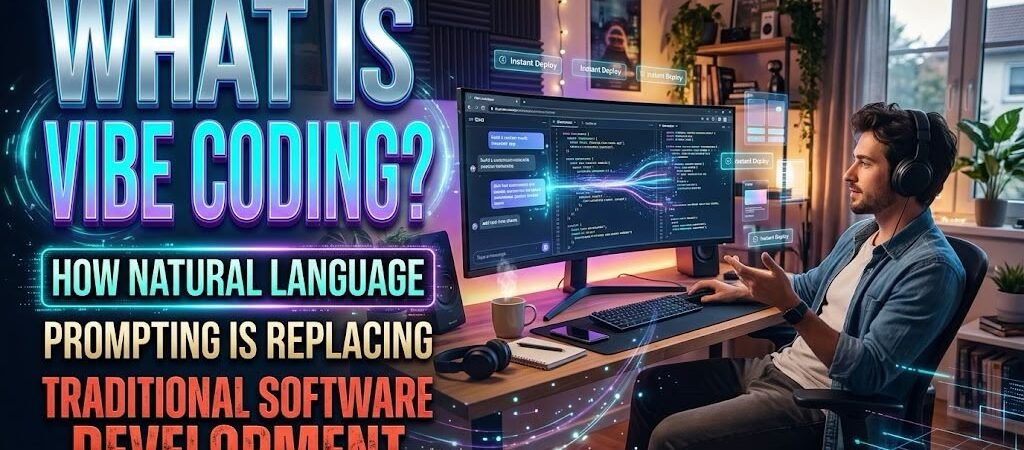
Today, artificial intelligence is changing that process. Vibe coding is a new approach to software development that allows people to build applications by describing what they want in plain, conversational language. Instead of writing every line of code manually, users can explain their ideas to AI coding tools, review the generated code, and refine the results through follow-up prompts.
This shift is opening new possibilities for experienced developers, entrepreneurs, and beginners with little or no programming experience. AI-powered tools can help create prototypes, build user interfaces, automate repetitive tasks, and turn ideas into working software more quickly. However, human guidance remains essential. AI-generated code still needs testing, debugging, and security checks before it can be trusted in real-world applications.
So, what is vibe coding, how does it work, and can it really change the future of software development? Let’s explore the tools, benefits, limitations, and practical applications behind this growing technology trend.
Instead of focusing on low-level syntax, you focus entirely on the product’s “vibe,” functionality, and user experience. In this comprehensive, in-depth guide, we will deconstruct what vibe coding is, explore how natural language prompting works in modern AI code editors, analyze the pros and cons of AI-driven development, and look at how this trend is reshaping the future of technology. For broader industry insights into artificial intelligence trends and creator workflows, you can explore reports via MIT Technology Review AI Desk alongside developer documentation from GitHub Developer Portal and technical analyses at My Tech Hub Innovation Blog.
1. What Is Vibe Coding and Why Is It Becoming Popular?
The term “vibe coding” captures a profound psychological and technical shift in how humans interact with computers.
- The Core Definition: Vibe coding is a software creation workflow where you describe your desired outcome in everyday human language, and an advanced AI system .
- Focusing on the Result, Not the Code: In traditional development, you write the implementation. In vibe coding, you review the behavior of the running application, provide high-level feedback (“make the dashboard look cleaner,” “add a dark mode toggle,” or “fix this authentication bug”), and let the AI handle the mechanics.
If you would like to read more about the trends in natural-language programming through in-depth analysis from professional fieldpeople, check downloadable reports by ACM Digital Library Computer Science Journal or software manuals on My Tech Hub Software Directory.
2. How Vibe Coding Works: A Step-by-Step Process
Understanding how vibe coding operates in practice reveals why it has accelerated prototyping speeds by orders of magnitude. Rather than working inside isolated code files, you engage in a continuous conversational loop with your development environment.
The Five-Step Vibe Coding Workflow
- Describing the Vision: You open an AI-powered IDE or application builder and type out your product concept in plain English (e.g., “Build a minimalist habit tracker app with local storage, a daily streak counter, and a clean pastel interface”).
- Instant AI Scaffolding: Within seconds, the AI generates the complete project architecture—setting up file structures, installing dependencies, writing front-end components, and configuring back-end routing.
- Behavioral Testing: Instead of auditing every line of source code, you run the application and evaluate its behavior. Does it load correctly? Do the buttons trigger the right actions?
- Conversational Iteration: If something needs adjustment, you report back in plain language (“The submit button is misaligned on mobile screens; fix the CSS flexbox layout”), rather than manually hunting through event handlers.
- Deployment: Once the application matches your vision, you deploy it straight to production with minimal friction.
3. Best Vibe Coding Tools: Cursor, Windsurf, and AI IDEs
A new generation of intelligent development environments developed specifically for cooperative activities with AI created the viability of vibe coding.
Essential Platforms in the Vibe Coding Stack
- Windsurf (by Codeium): Touted as an agentic IDE, Windsurf pairs code completion with autonomous task execution, supporting multi-file context and deep project-wide understanding.
- AI App Builders (e.g., Bolt.new): Platforms that allow non-technical creators to spin up fully functional full-stack web applications straight from a browser prompt in minutes.

4. How Vibe Coding Helps Beginners Build Software
One of the most profound social impacts of vibe coding is the complete dismantling of technical barriers to entry. Historically, if an entrepreneur or creative professional had an idea for a software tool, they either had to learn Python and JavaScript for months or hire expensive engineering teams.
- Empowering Domain Experts: Accountants, graphic designers, marketers, and teachers can now build custom internal dashboards, automated workflow scrapers, and client portals tailored precisely to their professional workflows without writing a single syntax rule.
- Rapid Idea Validation: Startups can build functional Minimum Viable Products (MVPs) in a single afternoon, testing market demand before committing thousands of dollars in development capital. For further startup case studies, explore insights via TechCrunch Startup Hub or tutorials on My Tech Hub Developer Portal.
5. Vibe Coding Risks: Security Flaws, Technical Debt, and Maintenance
While the speed and accessibility of vibe coding are intoxicating, veteran software engineers and security researchers emphasize that abandoning traditional coding discipline carries significant risks.
Major Risks of Pure Vibe Coding
- Unmaintainable Spaghetti Code: When you rely entirely on AI to generate code you never read or understand, maintaining, scaling, or debugging complex enterprise systems becomes nearly impossible when the AI hits a logical wall.
- Security Vulnerabilities: AI models can hallucinate insecure coding patterns, hardcode API keys, or introduce critical authentication flaws. Applications handling user data, encryption, or financial transactions demand rigorous human security audits.
6. Vibe Coding vs. Agentic Engineering: The Role of Human Judgment
To reconcile the incredible velocity of vibe coding with the rigor required for production-grade software, the industry is embracing agentic engineering—a disciplined hybrid methodology.
Best Practices for Responsible AI Development
- The Research-Plan-Implement Loop: Before generating code, prompt your AI assistant to analyze the existing repository, outline a step-by-step implementation plan, and wait for human executive approval before writing files.
- Rigorous Automated Testing: Pair AI-generated codebases with robust automated test suites. If an AI agent breaks a core function, tests catch the regression instantly.
- Human Oversight on Critical Systems: Use vibe coding freely for frontend prototyping, internal utilities, and landing pages, but apply strict human code review and security audits to backend payment gateways and data encryption layers.
Comprehensive Vibe Coding Platform Reference Guide
To help you evaluate tools and frameworks for natural language development, review the comparison matrix below:
| Tool / Platform | Primary Function | Learning Curve | Estimated Cost (USD) | Best Suited For |
| Cursor AI | AI-native code editor (VS Code fork) | Easy to Moderate | Free tier / $20/mo | Professional developers wanting deep codebase intelligence |
| Windsurf | Agentic IDE with multi-file context | Moderate | Free tier / $15+/mo | Autonomous task execution and rapid feature building |
| Bolt.new | Browser-based full-stack AI builder | Very Easy | Free tier / Usage tokens | Non-coders spinning up web prototypes instantly |
| GitHub Copilot | Inline code completion & chat assistant | Easy | $10 / month | Developers wanting fast inline text completion |
7. Vibe Coding: AI Code Reviews, Testing, and Quality Checks
While natural language prompting allows creators to spin up fully functional software applications in minutes, generating raw code is only half the battle. As an application scales beyond a simple prototype, hidden logic bugs, memory leaks, and stylistic inconsistencies can compromise its performance. Relying solely on manual inspection is impossible when an AI agent can write hundreds of lines of code in seconds.
Automating the Quality Assurance Loop
- AI-Powered Linters and Static Analysis: Modern vibe coding environments integrate automated linter agents that scan generated codebases in real-time. These tools check adherence to language-specific style guides, catch syntax deprecations, and flag unoptimized algorithms before the code is even executed.
- Autonomous Unit Testing Agents: Advanced agentic IDEs can be instructed to write their own unit tests based on your natural language descriptions. If you prompt the AI, “Write comprehensive test suites for this user authentication module,” the agent generates automated test scripts, runs them, debugs failing edge cases, and verifies stability without manual intervention.
8. What Is Vibe Coding? Writing Effective Prompts for AI
In traditional software development, success was measured by your mastery of programming logic and algorithmic syntax. In the era of vibe coding, your primary technical skill is conversational prompt engineering—specifically how effectively you structure context, establish constraints, and communicate architectural intent to artificial intelligence models.
Best Practices for Structuring Prompts in Code Editors
- Providing Upstream Context: Vague prompts yield generic code. Effective prompts establish clear technical context up front: “We are building a responsive React dashboard using Tailwind CSS and TypeScript. All components must adhere to mobile-first design principles and support dark mode natively.”
- Iterative Scaffolding and Modular Prompting: Instead of asking an AI to build an entire monolithic software platform in a single massive prompt, break your product vision down into discrete modular phases. Prompt the database schema first, review and lock it in, then prompt the backend API endpoints, and finally build the frontend UI components sequentially.
9. What Is Vibe Coding? Security Risks in AI-Generated Code
One of the most persistent concerns raised by cybersecurity professionals regarding vibe coding is the potential introduction of critical vulnerabilities. Large language models are trained on billions of lines of public code—some of which may contain outdated security practices, unpatched vulnerabilities, or insecure cryptographic methods.
Hardening AI-Generated Applications
- Common AI Security Blind Spots: Unmonitored AI generators can occasionally introduce common vulnerabilities such as SQL injection flaws, cross-site scripting (XSS) weaknesses, or hardcoded API keys left exposed in client-side JavaScript files.
- Mandatory Human-in-the-Loop Auditing: While vibe coding accelerates prototyping velocity, any application handling sensitive user data, payment processing, or personal identification must undergo rigorous automated vulnerability scanning and manual security reviews before public deployment.
10. Vibe Coding vs. Traditional Programming: Key Differences
The rapid rise of natural language software development has sparked intense cultural and philosophical debates within the global technology community, creating a generational divide between traditional software engineers and the new wave of AI-native creators.
Bridging the Engineering Divide
- The Skepticism of Traditional Engineers: Veteran software engineers who spent decades mastering complex system architecture, memory management, and low-level algorithms often view vibe coding with skepticism, arguing that developers who do not understand underlying syntax cannot properly debug complex production failures.
- The Rise of the AI-Empowered Architect: Rather than replacing software engineers, vibe coding is elevating their professional roles. Engineers are shifting away from manual typing toward high-level system orchestration, code review, and architectural design—accomplishing in hours what once required entire engineering sprints.
11. Vibe Coding Costs: AI Token Usage and Budget Optimization
Running continuous, multi-file agentic workflows, codebase indexing operations, and iterative natural language prompts across powerful frontier models (like Claude 3.5 Sonnet or GPT-4o) can accumulate significant API usage and subscription costs. Managing token consumption efficiently is an essential operational skill for vibe coding practitioners.
Strategies for Cost-Effective AI Development
- Selective Codebase Indexing: Instead of feeding your entire enterprise code repository into the AI context window for every minor prompt, configure your IDE to index only relevant directories and active component files.
- Model Tiering for Development Tasks: Utilize fast, lightweight, and cost-effective models for routine syntax refactoring, comment generation, and bug fixing, while reserving expensive flagship reasoning models strictly for complex architectural design and algorithmic problem-solving.
12. Vibe Coding in Business: Intellectual Property and Copyright Risks
For corporate organizations and commercial enterprises exploring vibe coding workflows, critical questions surrounding data privacy, proprietary source code ownership, and intellectual property (IP) infringement loom large.
Navigating Enterprise Compliance
- Protecting Proprietary Code: Ensure your AI coding environment or enterprise API tier operates under strict zero-data-retention policies, guaranteeing that your internal company source code is never used to train public foundational models.
- Licensing and Copyright Complexities: Because AI models are trained on vast public open-source repositories, legal questions persist regarding whether AI-generated code might inadvertently reproduce copyrighted code snippets. Utilizing enterprise-vetted tools with indemnification clauses helps shield businesses from potential IP liabilities.
13. Vibe Coding: Team Collaboration and AI-Assisted Development
Software development is inherently a team sport. When multiple engineers—and their respective AI agents—are simultaneously pushing changes to a shared Git repository, managing merge conflicts, code reviews, and architectural consistency requires modernized collaboration protocols.
Maintaining Harmonious Team Workflows
- Standardized AI Guardrails: Engineering teams establish shared system prompts, coding standards, and pre-commit hook linters that force all AI-generated code to adhere to strict repository conventions regardless of which developer prompted it.
- AI-Assisted Pull Request Summaries: Modern development pipelines utilize AI agents to automatically generate detailed pull request (PR) descriptions, explaining the architectural rationale behind recent code changes to human reviewers.
14. The Evolution of No-Code to AI-Driven Full-Stack Application Builders
The boundary between traditional code editors and visual no-code platforms is dissolving. Browser-based AI builders like Bolt.new, v0, and Lovable represent a brand-new category of creation tools that combine natural language prompting with instant visual rendering.
Instant Full-Stack Prototyping
- From Prompt to Live URL in Seconds: These platforms generate fully styled frontend interfaces, connect backend databases, and deploy live production URLs instantly from a single conversational sentence.
- Bridging Prototypes to Production Code: While early tools focused purely on throwaway UI prototypes, modern AI builders allow creators to export clean React, Node.js, and SQL codebases directly into professional IDEs for further customization.

15. The Impact on Technical Education: How Programming Curriculums Must Adapt
As natural language prompting automates syntax memorization and boilerplate code writing, computer science education and coding bootcamps face an urgent imperative to radically modernize their curriculums.
Redefining Technical Education
- Moving Beyond Syntax Memorization: Teaching students how to memorize loops, syntax rules, and basic sorting algorithms is no longer sufficient when AI agents handle those tasks instantly.
- Emphasizing System Design and Logic: Modern computer science education is shifting toward high-level problem formulation, system architecture, database design, cybersecurity fundamentals, and mastering the art of conversational prompt engineering.
16. Future Horizons: Self-Coding Software and Autonomous Product Teams
Looking toward the horizon of digital technology, vibe coding is merely the opening chapter of a much larger transformation. We are rapidly transitioning from AI assistants that write code when prompted to fully autonomous software engineering agents.
The Next Frontier of Autonomous Tech
- Self-Healing and Self-Updating Software: Future applications will monitor their own performance metrics, autonomously detect internal bugs, write patches, and deploy updates without human intervention.
- Autonomous Product Teams: Solopreneurs will manage fleets of specialized AI agents acting as product managers, front-end developers, QA testers, and marketing copywriters—building billion-dollar software enterprises as solo operators.
17. The Democratization of Software Entrepreneurship: Launching Micro-SaaS Startups Without an Engineering Degree
One of the most profound socio-economic transformations accelerated by vibe coding is the complete democratization of software entrepreneurship. Historically, launching a software-as-a-service (SaaS) startup required either raising substantial venture capital to hire a team of full-stack engineers or spending years mastering complex frameworks like React, Node.js, and SQL. Today, individual creators, domain experts, and small business owners are launching fully functional micro-SaaS businesses in a matter of days.
Empowering Solo Founders and Creators
- Zero-Cost Prototyping and Rapid MVP Launch: Creators can now build, test, and iterate on software ideas with near-zero upfront engineering capital. If an app concept fails to resonate with market users, pivoting to a brand-new product architecture takes only a few conversational prompts.
- Focusing on Niche Market Problems: Solo founders no longer need to build massive, generalized enterprise software suites. Instead, they can build hyper-targeted micro-tools solving acute operational problems for specific niche industries—such as automated scheduling apps for local landscapers or specialized inventory trackers for boutique bakeries—generating profitable recurring revenue streams as single-person operators.
18. Maintaining Codebase Comprehension and Architectural Ownership in AI-Driven Projects
As natural language prompting handles the heavy lifting of writing thousands of lines of code, a subtle psychological trap emerges for creators: the temptation to abandon architectural comprehension entirely. When you never inspect or read the underlying code generated by your AI agent, your relationship with the software shifts from being its creator to being a passive observer.
Preserving Long-Term Project Control
- The Danger of the Black-Box Codebase: If an AI-generated application encounters a complex runtime error or a deep logic bug that the AI fails to debug autonomously, a creator with zero code comprehension will find themselves completely paralyzed, unable to fix their own product.
- Balancing Speed with Code Familiarity: Successful vibe coders treat AI assistants as brilliant junior engineers rather than infallible gods. Reviewing key architectural files, understanding core data flows, and maintaining high-level structural oversight ensures you retain true ownership of your software assets.
19. The Evolution of Version Control, Git Workflows, and Autonomous Code Merging
Version control systems like Git and platforms like GitHub have served as the sacred bedrock of software collaboration for decades. In the age of vibe coding, version control is evolving from a manual code-tracking utility into an automated playground for autonomous agent swarms.
Modernizing Repository Workflows
- Automated Commit Messages and Branching: AI-native IDEs and extensions now automatically generate descriptive commit messages, categorize feature branches, and handle routine merge conflicts based on natural language summaries of recent code modifications.
- Semantic Code History Searching: Instead of combing through raw commit hashes and cryptic diff logs to find when a bug was introduced, developers can query their Git history conversationally: “Show me the exact prompt and file changes that broke the user authentication login flow last Tuesday.”
20. The Ultimate Paradigm Shift: From Software Mechanics to Human Imagination
As we stand at the precipice of this new technological era, the true significance of vibe coding extends far beyond faster typing speeds or cleaner user interfaces. It represents a fundamental liberation of human creativity. For the past fifty years, human imagination in computing has been ruthlessly throttled by the rigid syntax constraints of machines. We had to learn how computers think, memorizing arcane command structures just to make pixels move on a screen.
Unlocking Limitless Digital Creation
- Machines Learning Human Language: Vibe coding inverts that relationship entirely. Now, computers are learning how humans think, translating our natural language, intuition, and creative visions directly into working digital reality.
- The Future of Digital Expression: When syntax is no longer a barrier, the only true limitation in software development is the depth of human imagination. Whether you want to build an immersive educational tool, an AI-powered creative writing suite, or an automated business workflow, your voice and your vision are all you need to bring it to life.
21. Ethical AI Governance, Accountability, and Intellectual Property Safeguards in Autonomous Development
As natural language prompting and autonomous coding agents take over the heavy lifting of software engineering, profound ethical and legal questions arise concerning code provenance, copyright infringement, and moral accountability. When an AI agent generates a complex software application or refactors a proprietary codebase, determining who holds legal authorship becomes a complex gray area. Furthermore, because foundational models are trained on billions of lines of public code, enterprises must navigate potential licensing liabilities and ensure compliance with open-source software licenses.
- Ensuring Code Provenance and Enterprise Indemnity: Modern vibe coding platforms and enterprise-tier AI assistants offer strict indemnification clauses and zero-data-retention guarantees, protecting corporate developers from copyright infringement claims. To explore deeper frameworks on software ethics and intellectual property compliance, review insights via Electronic Frontier Foundation (EFF) Legal Guide alongside developer resources at My Tech Hub Developer Portal.
- Establishing Ethical Guardrails: Establishing clear internal governance policies ensures that AI-generated code does not inherit biased algorithms, unsecured data pipelines, or vulnerable cryptographic dependencies that could compromise user privacy or violate regulatory frameworks like GDPR.

22. Collaborative Human-AI Pair Programming: Redefining Team Synergy
The integration of natural language prompting into software engineering has fundamentally transformed team dynamics. Instead of traditional pair programming—where two human developers sit side-by-side sharing a keyboard—modern engineering squads practice collaborative human-AI pair programming, where an autonomous agent acts as an indefatigable junior partner capable of generating boilerplate code, writing unit tests, and refactoring legacy files on demand.
- Amplifying Creative Brainstorming: When tackling complex system architecture challenges, developers use AI coding assistants as conversational sparring partners, prompting the model to propose alternative database schemas or evaluate algorithmic trade-offs in real-time. For further team collaboration strategies, read guides via GitHub Developer Blog or explore workflow tutorials on My Tech Hub Software Directory.
- Managing Cognitive Load: By offloading repetitive syntax writing, documentation formatting, and syntax translation to AI agents, human engineers preserve vital mental bandwidth for high-level creative problem-solving and user experience design.
23. The Evolution of Continuous Integration and Automated Deployment Pipelines
As vibe coding accelerates the velocity of software creation, traditional continuous integration and continuous deployment (CI/CD) pipelines must evolve to keep pace. When code can be written, tested, and modified through natural language prompts in a matter of seconds, human-dominated code review bottlenecks can stall project momentum.
- Agentic CI/CD Automation: Modern deployment pipelines incorporate autonomous testing agents that run security scans, performance benchmarks, and end-to-end regression tests the moment an AI agent pushes a code commit.
- Self-Healing Deployment Failures: If an automated build fails due to a broken dependency or a misconfigured environment variable, advanced deployment agents analyze the error log, write a corrective patch, and redeploy the application automatically without human intervention.
24. Bridging the Gap: How Legacy Enterprises Are Modernizing With Vibe Coding
While nimble startups and solo founders embrace vibe coding to launch products overnight, legacy enterprise organizations burdened by decades-old monolithic software codebases face a massive modernization challenge. Millions of lines of legacy code written in outdated programming languages require expensive maintenance and specialized engineering talent.
- Accelerating Legacy Refactoring: Enterprise engineering teams are utilizing AI coding agents to parse legacy codebases, translate outdated programming languages into modern frameworks, and automatically generate comprehensive system documentation.
- Minimizing Enterprise Downtime: By running AI refactoring tools inside secure, isolated sandbox environments, enterprises can modernize core business logic incrementally without disrupting live production systems or risking catastrophic customer-facing downtime.
25. The Ultimate Horizon: Moving Toward Fully Autonomous Software Enterprises
Looking ahead to the future of digital innovation, vibe coding represents the foundational stepping stone toward fully autonomous software enterprises. We are transitioning from tools that simply assist human programmers to autonomous agent swarms capable of conceiving, building, marketing, and maintaining digital products independently.
- Autonomous Product Lifecycle Management: Future systems will monitor user feedback, analyze market trends, write new feature code, and deploy updates autonomously based on real-time business performance metrics.
- Redefining Human Potential: When the mechanics of software creation are fully automated by natural language intelligence, human creativity becomes the ultimate currency. Your vision, imagination, and ability to solve human problems are all that stand between an idea and a living digital reality.
Frequently Asked Questions (FAQ)
Q1: Is vibe coding the same as traditional no-code development?
A: No. No-code platforms rely on rigid visual drag-and-drop UI blocks and closed database schemas. Vibe coding uses natural language to generate actual underlying programming code (Python, JavaScript, React, SQL), giving you infinite flexibility to customize logic while retaining conversational control.
Q2: Do I need to know how to program to try vibe coding?
A: Not necessarily. Platforms like Bolt.new and Cursor allow individuals with zero coding background to build functional applications by simply describing their vision in plain English. However, understanding basic logical structures helps you guide the AI much more effectively.
Q3: Will vibe coding replace professional software engineers?
A: It will not replace software engineers, but it is fundamentally redefining their profession. Engineers are transitioning from manual syntax writers into high-level system architects, directors, and quality auditors who oversee AI-generated codebases.
Conclusion: Embracing Intent Over Syntax in Modern Development
The emergence of vibe coding marks one of the most exciting cultural and technological transitions in computing history. By replacing tedious syntax memorization and manual line-by-line coding with intuitive natural language prompting, artificial intelligence has lowered the barriers to digital creation.
Whether you are an experienced software architect looking to multiply your productivity or an entrepreneur bringing your first app idea to life, mastering the art of conversational prompting is essential. Embrace the speed of AI, maintain rigorous security standards, and focus your creative energy where it matters most: defining the vision, solving real human problems, and bringing bold ideas to life.