

Introduction: The Evolution of Foldable Phones in 2027
Foldable phones in 2027 are expected to represent a significant step forward in smartphone technology, building on years of innovation in flexible displays, hinge engineering, and mobile computing. For years, the consumer technology industry viewed foldable smartphones as fragile, ultra-expensive novelty gadgets reserved for early adopters and tech enthusiasts willing to tolerate visible screen creases, bulky designs, and delicate internal hinges. Early generations came with considerable compromises: consumers paid premium flagship prices for devices that were often thicker, heavier, and perceived as less durable than traditional smartphones.
However, the technology landscape has evolved considerably. Book-style foldables and clamshell flip phones have moved beyond their experimental beginnings, offering increasingly practical options for users who want larger displays, compact designs, and more versatile multitasking experiences. As manufacturers continue refining flexible screens, hinge mechanisms, software, and on-device artificial intelligence, foldable phones in 2027 could offer an even more compelling balance of portability, productivity, and everyday usability. The key question is whether the next generation will finally overcome the remaining limitations and make foldable technology a practical choice for a wider range of consumers.
In this comprehensive, in-depth guide, we will deconstruct what to expect from next-gen folding phones in 2027, analyze structural industry shifts, explore upcoming pricing trends, and evaluate whether 2027 will finally be the year foldables conquer the mainstream consumer market. For broader industry insights into mobile display science and market shifts, you can explore reports via The Verge Mobile Desk alongside market analytics from Counterpoint Research and expert evaluations at My Tech Hub Mobile Tech Portal.
1. Foldable Phones in 2027: Apple’s Entry and Rising Competition
The competitive hierarchy of the foldable smartphone market is undergoing a historic realignment. While Samsung pioneered and dominated the early foldable decade, market analysts project that 2027 will mark a massive turning point driven by ecosystem maturation and new market entrants.
- The Entry of iOS into the Foldable Arena: Following early market arrivals, Apple’s established presence is projected to capture a substantial share of global foldable shipments by 2027. Fueled by intense consumer brand loyalty, Apple’s expanding foldable lineup is expected to accelerate mainstream adoption across North America and Europe.
- Samsung’s Counter-Strategy: To defend its global standing against surging competition, industry leaks indicate that Samsung is expanding its Galaxy Z lineup significantly, planning up to six diverse foldable and expandable devices for 2027, including enhanced book-style foldables, refined flip models, and advanced multi-fold hardware.
For deeper financial analysis on global smartphone market share movements, read reports via Smart Analytics Global Market Reports or market overviews on My Tech Hub Business Insights.
2. Foldable Phone Technology in 2027: Better Hinges and Reduced Screen Creases
One of the most persistent technical complaints from early foldable users has been the visible and tactile screen crease running down the center of flexible OLED panels. For 2027, manufacturers are finally resolving this engineering hurdle.
Eliminating the Crease
- Waterdrop Hinge Evolution: Next-gen hinge mechanisms utilize complex multi-axis droplet curves that allow the flexible display to roll inside the chassis with a wider radius, virtually eliminating internal stress and flattening the screen crease into near-invisibility.
- Advanced Ultra-Thin Glass (UTG): Newer iterations of chemically strengthened ultra-thin glass combined with shock-dispersing polymer sub-layers provide the scratch resistance of glass paired with the flexibility required for hundreds of thousands of folds.
3. Foldable Phone Batteries in 2027: Silicon-Carbon Technology and Slimmer Designs
The physical thickness and weight of foldable phones have always been constrained by battery physics. Traditional lithium-ion batteries require rigid enclosures, forcing manufacturers to choose between unacceptably thick phones or disappointingly short battery endurance.
The Silicon-Carbon Revolution
- Higher Energy Density: By 2027, silicon-carbon (Si-C) anode battery technology has become standard across flagship foldables. Si-C cells pack significantly more milliamp-hours (mAh) into a fraction of the physical thickness.
- All-Day Endurance in Slab-Like Bodies: Next-gen book-style foldables are achieving folded profiles under 9mm while housing massive 5,000+ mAh batteries, finally matching or exceeding the battery endurance of traditional non-folding flagship phones.
4. Foldable Phones in 2027: Tri-Fold Designs and Expandable Displays
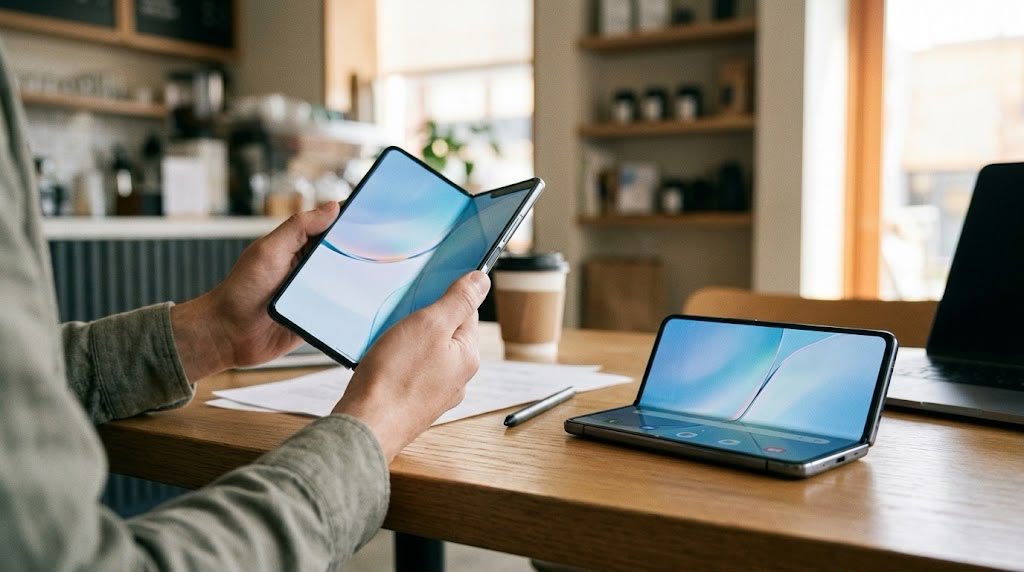
While standard book-style foldables (which open like a book into a tablet) and clamshell flip phones dominate current shipments, 2027 is ushering in experimental, highly ambitious alternative form factors.
Expanding Form Factors
- The Tri-Fold Wave: After early prototypes making their way into the market, tri-fold devices with multiple hinges that transform into large 10-inch screens are beginning to become commercially available, paving the way for real laptop replacements.
- Slidable and Rollable Concepts: Industry supply chain leaks suggest that expandable rollable phones (tentatively dubbed slidable displays) are moving closer to commercial reality, allowing users to expand their screen width dynamically with the tap of a button.
5. AI Features in Foldable Phones in 2027: Smarter Dual-Screen Experiences
Hardware form factor innovations are only as powerful as the software running on them. In 2027, artificial intelligence is deeply integrated into foldable operating systems, specifically tailored to take advantage of dual-screen and flexible display architectures.
Context-Aware Split-Screen Workflows
- Dynamic Content Splitting: Next-gen AI assistants can automatically split information across the inner folding display—running live translation on one half of the screen while displaying a summarized transcript or contextual notes on the other.
- Generative Window Management:Multimodal AI agents are poised to manage individual windows of floating applications smartly, using the environment in use, time of day, and calendar schedule to predict which programs will likely need to be open together.
6. Foldable Phone Durability in 2027: Dust and Water Resistance
Early foldables were notoriously vulnerable to dust particles wedging inside mechanical hinges and destroying internal displays. Achieving robust ingress protection was long considered impossible for folding mechanisms.
Rugged Engineering Standards
- IP68 Certification for Foldables: By 2027, leading manufacturers have successfully engineered micro-sweeper brushes and airtight gasket seals into their hinge mechanisms, achieving full IP68 water and dust resistance on folding handsets.
- Drop-Resistant Armor Frames: Utilizing advanced aerospace-grade titanium alloys and impact-resistant ceramic shield covers, next-gen foldables are engineered to survive accidental drops onto concrete without shattering flexible internal OLED layers.
7. Foldable Phone Cameras in 2027: Can They Match Flagships?
Historically, foldable phones lagged behind traditional slab flagships in camera hardware because manufacturers had to cram complex periscope zoom lenses and large sensor modules into razor-thin folding chassis halves.
Professional Optics in Foldable Chassis
- Periscope Zoom Integration: 2027 flagships feature advanced folded-optics periscope lenses offering 5x to 10x optical zoom without adding unsightly camera bumps.
- Computational Photography Pipelines: Advanced on-device neural processing units (NPUs) instantly correct for lighting variations across dual screens, ensuring that selfies captured using the outer cover screen or rear cameras maintain professional studio quality.
8. Pricing Trends: Will Foldables Finally Reach Mass-Market Affordability?
For years, foldable phones remained locked behind an elite $1,700 to $2,000+ price barrier. As component manufacturing yields improve and component costs stabilize, pricing is beginning to shift.
Economic Accessibility
- Mainstream Pricing Tiers: While ultra-premium tri-fold devices and specialized form factors command high-end luxury prices, standard clamshell flip foldables are creeping closer to the $800 to $1,000 threshold.
- Carrier Financing and Trade-In Incentives: Aggressive carrier trade-in programs and multi-year zero-interest installment plans are making foldable upgrades economically accessible to mainstream consumers who previously hesitated at full upfront retail costs.
Comprehensive Next-Gen Foldable Market & Technology Matrix
To help you evaluate what major hardware advancements are defining the 2027 foldable landscape, review the reference matrix below:
| Technology Feature | Early Foldable Generation (2023–2024) | Next-Gen Foldables (2027 Outlook) | Primary Consumer Benefit |
| Screen Crease | Noticeable visual indentation and tactile ridge | Virtually invisible flat display panel | Pristine viewing and writing experience |
| Battery Chemistry | Standard graphite lithium-ion cells | High-density silicon-carbon (Si-C) anodes | All-day battery life in ultra-thin chassis |
| Dust & Water Resistance | Limited water resistance; zero dust protection | Full IP68 dust and water immersion ratings | Ultimate daily durability and peace of mind |
| Chassis Thickness | Bulky 11mm to 14mm folded profiles | Slim sub-9mm profiles | Feels identical to a standard slab phone in hand |
| Form Factor Variety | Mostly standard book-style and simple flip | Tri-folds, rollables, and wide variants | Tailored multitasking and workstation flexibility |
Next-Gen Foldable Pricing & Feature Reference Guide
To help you map out your mobile technology budget for upcoming releases, review the price tier guide below:
| Device Category | Estimated Price Range (USD) | Primary Target User | Key Hardware Highlights |
| Clamshell Flip Foldable | $899 – $1,199 | Style-conscious users & mobile social creators | Compact pocket footprint, large cover screen, high portability |
| Standard Book-Style Foldable | $1,699 – $1,899 | Power users, professionals, & multitaskers | Dual-screen tablet productivity, multi-window split apps |
| Ultra-Premium Tri-Fold / Rollable | $2,199 – $2,699+ | Tech enthusiasts, executives, & early adopters | Massive expandable canvas, laptop-class multitasking |

9. Advanced Thermal Dissipation and Vapor Chamber Engineering in Ultra-Thin Chassis
As next-generation folding smartphones achieve razor-thin profiles—often measuring under nine millimeters when folded—designing an effective thermal management system becomes one of the most punishing engineering challenges for hardware manufacturers. Traditional smartphones rely on internal metal heat spreaders and graphite sheets to disperse heat away from high-performance application processors (SoCs). However, folding devices split internal computing components across two separate chassis halves, complicating thermal pathways.
Engineering Miniature Cooling Solutions
- Micro-Vapor Chambers: Next-gen foldables integrate custom-molded, ultra-thin vapor chambers that span across the hinge gap however these microscopic chambers contain specialized cooling fluids that vaporize when exposed to heat generated by heavy gaming or artificial intelligence processing, transferring thermal energy rapidly away from the processor and dissipating it across the large glass exterior surfaces.
- Preventing Thermal Throttling: By maintaining optimal operating temperatures, advanced thermal dissipation prevents processors from thermally throttling during extended multi-window multitasking sessions, ensuring consistent, high-performance frame rates and seamless AI responsiveness.
10. The Evolution of Under-Display Camera (UDC) Technology and Visual Immersion
One of the most persistent visual interruptions on early folding phones was the punch-hole camera cutout piercing through the internal tablet display or cover screen. For next-gen folding devices, perfecting under-display camera (UDC) technology removes visual clutter entirely, delivering a truly uninterrupted cinematic viewing canvas.
Overcoming Optical Challenges Beneath the Screen
- Pixel Density and Light Transmittance: Hiding a camera lens beneath an active OLED display requires balancing two conflicting engineering goals for example the screen pixels above the camera must be dense enough to hide the lens completely, yet translucent enough to allow sufficient light to pass through to the camera sensor.
- AI-Powered Image Reconstruction: Next-generation foldables utilize dedicated neural processing units running advanced image restoration algorithms because these AI pipelines instantly correct for diffraction, haze, and color shifts caused by light passing through the pixel matrix, delivering sharp, natural selfies and clear video conference calls without sacrificing screen real estate.
11. Multi-Tasking Operating Systems: Desktop-Class Workflows in Your Pocket
Hardware form factor innovations are meaningless if the software fails to utilize the expanded screen estate effectively. Next-gen folding operating systems in 2027 are shifting away from simple smartphone scaling toward true desktop-class productivity environments.
Redefining Mobile Productivity
- Floating Windows and Freeform Resizing: Advanced operating systems allow users to open, resize, and stack multiple application windows simultaneously on the inner tablet display, mirroring the multitasking flexibility of a high-end laptop.
- Ecosystem Drag-and-Drop Continuity: Next-gen software enables seamless file, image, and text drag-and-drop operations across split screens and connected tablet accessories, transforming foldables into legitimate portable workstations for traveling professionals and digital creators.
12. Supply Chain Maturity, Component Yields, and Manufacturing Scalability
The historical reason folding phones commanded exorbitant retail prices exceeding two thousand dollars was not just corporate greed; it was the punishingly low manufacturing yield rate of flexible OLED panels, micro-hinge assemblies, and ultra-thin glass layers.
Industrial Scaling and Cost Reduction
- Improving Panel Yields: As global display manufacturing facilities refine their chemical deposition and laser-cutting processes, the percentage of flawless flexible panels produced per batch has risen dramatically.
- Standardized Modular Hinge Designs: Manufacturers are moving toward modular, highly standardized hinge architectures that reduce assembly complexity and production line defects. This supply chain maturation is the primary economic driver making next-gen foldables increasingly accessible to mainstream retail buyers.
13. Stylus Integration (Active Pen Support) Across Flexible Glass Panels
For digital artists, note-takers, and enterprise professionals, the ability to write or draw directly on a large screen with a precision stylus is an indispensable workflow requirement. However, designing a flexible plastic or ultra-thin glass display that can withstand repeated pressure from a sharp pen tip without scratching or puncturing required radical innovation.
Engineering Pressure-Resistant Displays
- Digitizer Layer Placement: Next-gen foldables integrate specialized electromagnetic resonance (EMR) digitizer layers beneath the flexible display substrate, enabling responsive, low-latency pen tracking without interfering with the folding mechanism.
- Custom Soft-Tip Styluses: Specialized active styluses utilize dampening soft tips designed to distribute point-load pressure evenly across the delicate screen surface, ensuring a paper-like writing experience that preserves long-term display integrity.
14. Global Standardization of Foldable App Development and Responsive UI Frameworks
Early foldable software suffered from awkward app scaling, where applications designed for standard rectangular phone screens looked pixelated, stretched, or abruptly broken when unfolded onto a square tablet display.
The Unified Software Ecosystem
- Responsive UI Guidelines: Major software ecosystems have established rigorous developer guidelines and adaptive UI frameworks that allow applications to re-flow their layouts fluidly when transitioning from a narrow cover screen to an expansive inner display.
- Developer Adoption and Tooling: With millions of active foldable devices in circulation globally, software developers are actively optimizing mobile applications, mobile games, and productivity suites to take full advantage of dual-screen aspect ratios natively.
15. The Convergence of Wearable AR/VR Ecosystems and Folding Smartphones
As spatial computing, augmented reality (AR) glasses, and wearable technology mature, next-gen folding smartphones are evolving into the primary computational hub for decentralized wearable ecosystems.
The Smartphone as a Mobile Command Center
- Processing Powerhouse for Lightweight Glasses: Rather than packing heavy batteries and powerful chips into lightweight augmented reality glasses, future workflows leverage the immense processing power of a folded smartphone tucked inside your pocket, streaming high-definition spatial graphics wirelessly to your smart eyewear.
- Dual-Screen Control Interfaces: Your folding phone can serve as an intuitive touchscreen control pad, virtual keyboard, or secondary context display while interacting with immersive augmented reality environments.
16. Security, Biometric Enclaves, and Hardware-Backed Privacy Protection
As folding smartphones handle increasingly sensitive personal, corporate, and financial data—functioning as mobile workstations and digital wallets—hardware-level security architecture has become paramount.
Securing Mobile Data Environments
- Isolated Secure Enclaves: Next-gen foldables integrate dedicated hardware security co-processors that isolate biometric authentication data (Face ID, ultrasonic fingerprint scans) and cryptographic passkeys away from the main operating system.
- Physical Privacy Screen Technology: Advanced display layers restrict viewing angles on demand, preventing shoulder-surfing and visual data theft when reviewing confidential corporate documents in crowded public spaces like airplanes or commuter trains.
17. Environmental Sustainability, Recyclability, and Eco-Conscious Manufacturing
As global consumer electronics regulations tighten across Europe and North America, sustainability and environmental accountability are taking center stage in the design of next-gen mobile hardware.
Green Engineering Practices
- Recycled Aerospace Materials: Manufacturers are utilizing high percentages of recycled titanium alloys, aluminum frames, and ocean-bound plastics in structural chassis components.
- Modular Repairability Initiatives: Next-gen foldables are incorporating modular internal architectures and accessible adhesive pull-tabs, making it significantly easier for authorized technicians to replace degraded batteries and worn-out exterior display glass without discarding the entire device.
18. Consumer Adoption Trends: Demographics, Regional Growth, and Market Shifts
The demographic profile of foldable phone buyers has evolved beyond tech enthusiasts and early adopters into mainstream consumer segments, corporate executives, and creative professionals.
Analyzing Regional Market Expansion
- Stronghold Markets in Asia: Markets in East Asia and urban European centers lead global foldable adoption rates, driven by high consumer density and early telecommunication infrastructure investments.
- North American Momentum: With carrier financing incentives and aggressive trade-in promotions lowering financial barriers, North American consumers are rapidly embracing clamshell flip and book-style foldables as their primary daily driver smartphones.
19. Open-Source Ecosystems Versus Walled Gardens in Flexible Computing
As folding phones and expanding form factors redefine software interaction models, the philosophical debate between open-source customization and tightly controlled walled gardens continues to shape user experiences.
Balancing Openness and Optimization
- Ecosystem Continuity: Ecosystems like Apple prioritize tight vertical integration, ensuring hardware, operating system animations, and folding apps operate with flawless synchronization.
- Open Customization Freedom: Android-based manufacturers offer deep customizability, allowing power users to tweak multi-window grid layouts, launcher behaviors, and third-party taskbar integrations to suit individualized productivity workflows.

20. The Ultimate Vision: Toward the Ubiquitous Flexible Computing Era
Looking toward the horizon of consumer electronics, next-gen folding phones represent a foundational stepping stone toward a broader technological revolution—an era where rigid, flat glass screens are entirely replaced by adaptable, flexible computing surfaces embedded seamlessly into our daily lives.
What the Future Holds
- Ubiquitous Smart Surfaces: As manufacturing costs plummet and durability reaches absolute perfection, flexible display technology will expand beyond smartphones into automotive dashboards, smart home appliances, and wearable clothing.
- Redefining Human-Computer Interaction: The fundamental way we consume media, manage work, and connect with one another is permanently changed by the freedom of form factor engineering.
Frequently Asked Questions (FAQ)
Q1: Will 2027 foldables be durable enough to drop without breaking?
A: Yes, significant advances in ultra-thin glass flexibility, aerospace-grade titanium frames, and shock-absorbing polymer layers make 2027 foldables drastically more resilient against accidental drops than their fragile predecessors.
Q2: Do foldable phones still suffer from battery drain issues?
A: Not to the extent of older models. The widespread adoption of high-density silicon-carbon batteries allows 2027 foldables to house large 5,000+ mAh cells while maintaining ultra-thin profiles, ensuring reliable all-day battery endurance.
Q3: When will folding phones completely replace traditional slab smartphones?
A: While foldables are capturing a rapidly growing percentage of flagship sales, traditional slab phones will remain dominant for budget-conscious buyers due to price gaps, though foldables are steadily transitioning into mainstream luxury standards.
Conclusion: The Era of Flexible Computing Has Arrived
The evolution of foldable smartphones from experimental luxury novelties into sophisticated, durable daily drivers represents one of the most exciting design triumphs in modern consumer electronics. By 2027, overcoming historical hurdles like visible screen creases, poor battery endurance, delicate hinges, and high price entry points has transformed foldables into practical powerhouses.
Whether you are looking forward to ultra-slim book-style productivity powerhouses, innovative tri-fold workstations, or pocket-friendly clamshell flip devices, next-gen folding phones offer a glimpse into a truly flexible digital future. Evaluate your mobile workflow, your budget, and your tech preferences, and get ready to experience the next great leap in mobile computing.