
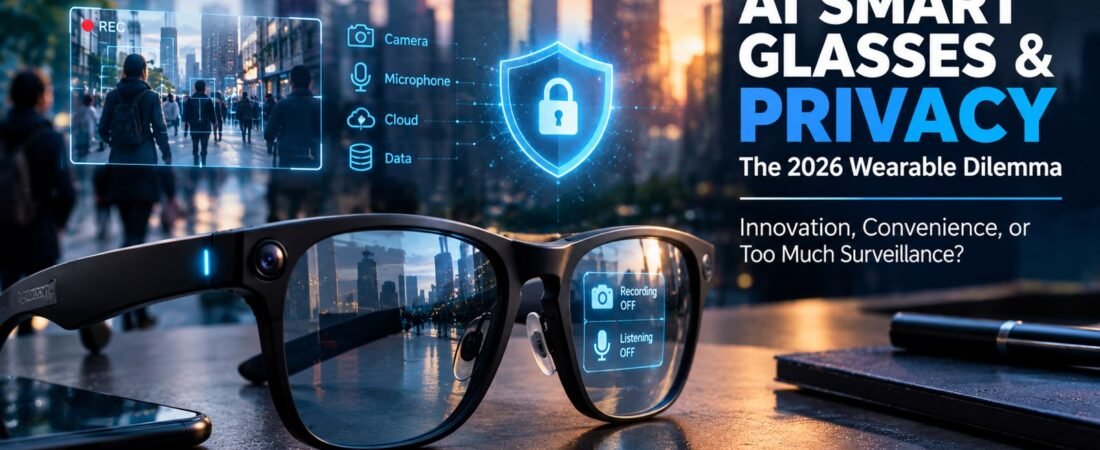
Introduction: The Fine Line Between Convenience and Surveillance
The development of consumer wearables has been consistent throughout the years. Tech experts have been saying year after year that fitting smaller displays is going to correlate with wearing watches, attaching fitness monitors to waist belts, and fitting cameras into smart glasses.When early iterations of smart glasses hit the market, consumers marveled at the ability to capture hands-free point-of-view videos, stream live events, and query built-in voice assistants without pulling a smartphone from their pockets.For an extended understanding of the development of wearable devices and important developments in this field, please check these two sources: Top Tech Trends Shaping Consumer Wearables This Year, as well as market overviews at The Verge Wearables Desk and research on privacy at Electronic Frontier Foundation (EFF).
However, as adoption grows, a deep societal friction is boiling to the surface. The very features that make smart glasses appealing—discreet lenses, always-on microphones, and continuous cloud-connected recording—have turned them into ground zero for a heated privacy debate. From coffee shops and office spaces to public transit and residential neighborhoods, people are increasingly asking a fundamental question: where does personal convenience end, and unauthorized public surveillance begin?
The history of consumer technology is filled with devices that crossed ethical boundaries before society established proper guardrails. When camera phones first arrived, indoor venues quickly instituted bans to protect private spaces. Smart glasses represent a significantly more complex challenge because recording equipment is integrated directly into an accessory worn passively on the face, making intent difficult for bystanders to gauge. As public awareness regarding biometric data collection expands, consumers are no longer willing to accept silent, invisible recording.
Navigating the delicate balance between high-tech innovation and individual privacy rights has become the most urgent challenge facing wearable manufacturers today. Let us examine why this backlash is unfolding, how companies are attempting to respond, and what it means for the future of everyday tech.
1. Always-On Lenses: Why Public Spaces Are Pushing Back
The core anxiety surrounding modern smart eyewear centers on continuous, unannounced capture.
- The Bystander Dilemma: When a person dons camera glasses in a busy restaurant or gym or a park, everyone in the vicinity becomes a possible source of information without consent.
- Indicator Light Controversies: While manufacturers incorporate small LED recording indicators, critics argue these lights are easily obscured, taped over, or misunderstood by casual observers who assume the wearer is simply wearing normal prescription frames.
2. The Corporate Data Dilemma: Where Does Your Voice and Visual Data Go?
Hardware capture is only half of the equation.When smart glasses record images, environmental sounds, and voice searches, all is sent to the cloud for running contextual AI functions. For a deeper look into safeguarding your personal information, check out guides on How Local On-Device AI Protects Your Personal Data.
- Cloud Processing vs. Local Storage: Training and executing complex multimodal AI models often requires routing sensitive media files through remote server farms, raising red flags regarding corporate data retention policies.
- Anonymization Limits: Even when companies strip metadata, facial recognition integration and object tracking mean that personal habits, daily routines, and unwitting bystanders can still be mapped and analyzed.

3. How Manufacturers Are Adapting with Camera-Free and Privacy-First Designs
The mounting public backlash has forced hardware designers to rethink their product roadmaps entirely, driving a significant pivot toward privacy-conscious alternatives. For product recommendations in this category, explore Camera-Free Smart Glasses: The Best Privacy-First Wearables to Buy.
- The Rise of Audio-Only Frames: Recognizing that many users want hands-on audio assistance and media playback without the legal and social baggage of a camera, companies are releasing dedicated audio-only My smart frames. They eliminate any concerns about privacy in public because they completely remove optical sensors without losing any functionalities.
- Physical Shutter Integration: Includes a Physical Shutter: Among the newer releases of models that still include cameras, recent models feature physical shutters and visible mechanical indicators which keep any inadvertent capturing of video from taking place.
4. Regulatory Scrutiny and the Push for Global Compliance
Governments and data protection authorities are stepping up oversight to ensure wearable tech complies with strict regional privacy frameworks. To understand the legal frameworks governing this space, read Navigating Digital Privacy and Surveillance Laws.
- Data Protection Mandates: Regulatory bodies are increasingly penalizing unverified biometric data harvesting, forcing manufacturers to implement strict opt-in protocols and transparent data deletion policies.
- Geographic Restrictions: Certain jurisdictions have moved to restrict the deployment of continuous-recording consumer devices in sensitive public zones, compelling tech firms to adapt their software regionally.
5. Major Advantages and Risks of Modern Smart Eyewear
Advantages
- Hands-Free Productivity: Streamlines navigation, live translation, and quick communication without requiring screen distractions.
- Accessibility Support: Offers powerful audio-visual assistive tools for individuals with sensory impairments.
Risks and Challenges
- Erosion of Public Trust: Widespread mistrust can lead to blanket social bans on wearing smart glasses in public spaces.
- Data Vulnerabilities: Expanded cloud routing of personal media increases exposure to potential data leaks or unauthorized access.
6. Common Misconceptions About Wearable Privacy
It is widely believed that smart glasses are capable of recording only when the user starts the process of video recording. However, modern smart glasses powered by Artificial Intelligence require continuous sensing of their surroundings and listening for audio.
7. The Psychology of Being Watched: Social Etiquette in the Era of Smart Eyewear
With the continued advancement of wearable technology, society has been compelled to adapt the undefined social norms regarding personal space and social boundaries. In previous settings, directing a single video camera or camcorder at someone in the gym, locker room, or restaurant is considered unacceptable. Nevertheless, since smart glasses are just like ordinary prescription and designer glasses, the usual social cues meant to signify that a recording is in progress have been completely removed.
This ambiguity creates deep psychological discomfort for bystanders. When people cannot tell whether a casual conversation, business meeting, or private phone call is being quietly recorded and archived to a cloud server, social trust begins to erode.
Navigating the New Social Norms
- The Normalization of Venue Bans: To protect customer comfort and proprietary trade secrets, a growing number of fitness clubs, restaurants, corporate boardrooms, and schools have instituted blanket bans on all eyewear featuring optical sensors.
- The Burden of Consent: The social contract of polite society has shifted; rather than assuming privacy as a default baseline in public spaces, individuals now frequently assume they are being recorded, fundamentally altering how casual, candid human interactions take place.
For further exploration of modern digital etiquette and evolving social contracts, read insights via My Tech Hub Software Directory.
8. Enterprise Applications and Industrial Efficiency: Where Smart Glasses Shine
While consumer privacy concerns dominate public discourse, the enterprise and industrial sectors have embraced smart eyewear with immense enthusiasm. In professional, manufacturing, and logistics environments, the debate shifts away from social anxiety toward raw operational productivity, workplace safety, and hands-free efficiency.
Transforming Warehouse and Field Operations
- Remote Expert Assistance: Field technicians repairing complex industrial machinery or medical equipment can wear smart glasses to stream live first-person video feeds back to remote senior engineers, receiving real-time visual guidance and technical overlays directly in their field of view.
- Hands-Free Inventory Logistics: Warehouse workers utilizing augmented reality smart frames can view picking lists, barcode scanners, and indoor navigation paths projected directly onto their lenses, eliminating the need to hold handheld scanners or paper clipboards.
By removing screen distractions and keeping workers’ hands completely free, industrial smart glasses have proven to be transformative tools in commercial supply chains.
9. Battery Constraints and Thermal Management in Micro-Form Factors
Designing a pair of smart glasses is an engineering nightmare constrained by the laws of physics. Unlike bulky smartphones or even smartwatches that feature large internal volumes to house powerful processors and high-capacity battery cells, smart glasses must look, feel, and weigh almost identical to ordinary prescription frames—typically targeting a total weight under 50 grams.
The Physics of Miniature Wearables
- Battery Endurance Limits: Fitting a battery capable of driving continuous camera recording, wireless data transmission, and multimodal AI processing into thin eyeglass temples severely restricts active runtime, with most consumer models offering only a few hours of intermittent use before requiring a recharge case.
- Thermal Throttling Risks: Because processors sit directly against the user’s temples and bridge of the nose, managing heat dissipation without burning the wearer’s skin is a massive hurdle, often forcing manufacturers to throttle processing speeds during extended video capture tasks.
10. The Evolution of Audio-Only Smart Frames: Sound Without Vision
Recognizing the intense public friction and regulatory hurdles surrounding optical lenses and camera sensors, a significant faction of the wearable tech industry has pivoted toward audio-only smart frames. These devices strip away cameras completely, focusing entirely on open-ear directional audio speakers, high-end microphone arrays, and integrated voice assistants.
Why Audio-Only Frames Are Gaining Traction
- Zero Surveillance Anxiety: Because these frames contain no optical sensors or recording lights, they completely bypass the public privacy backlash and venue bans that plague camera glasses.
- Seamless Ambient Awareness: Open-ear acoustic drivers deliver podcasts, phone calls, and navigation prompts while leaving your ear canals unblocked, allowing you to hear environmental traffic sounds and surrounding conversations safely.
For shoppers looking for a less intrusive entry point into wearable tech, audio-only frames represent a practical compromise. For product evaluations in this category, explore Camera-Free Smart Glasses: The Best Privacy-First Wearables to Buy.
11. Multimodal AI Integration: Turning Eyewear Into Contextual Assistants
The true technological leap driving recent interest in smart glasses is not the hardware framing itself, but the deep integration of multimodal artificial intelligence. Rather than serving as passive cameras or basic Bluetooth headphones, modern smart frames act as intelligent companions that can perceive and interpret the physical world alongside you.
What Multimodal AI Enables
- Real-Time Visual QA: You can look at a foreign street sign, a complex plant, or a landmark while walking down a city sidewalk and ask your glasses, “What am I looking at?” The built-in camera captures a frame, analyzes the visual data through cloud or on-device AI models, and whispers the answer directly into your ear.
- Live Language Translation: Traveling abroad becomes effortless when your glasses translate spoken foreign dialogue or printed restaurant menus into your native language in real-time.
For deeper technical breakdowns on how neural processors handle environmental data, read How Local On-Device AI Protects Your Personal Data.
12. Security Vulnerabilities and Biometric Data Risks
As smart glasses evolve into continuous sensory capture devices, they become prime targets for malicious hackers. The sheer volume of sensitive personal information flowing through these frames—including voiceprints, facial geometry data of people around you, real-time GPS locations, and environmental audio logs—creates unprecedented cybersecurity risks.
Protecting Against Exploits
- Encrypted Data Pipelines: Manufacturers must secure every layer of data transmission from the glasses to companion apps and cloud servers to prevent man-in-the-middle interception.
- Mitigating Remote Access Exploits: If a cybercriminal manages to hack a user’s smart glasses firmware, they gain a mobile wiretap and a live-streaming security camera pointed directly at everything the wearer encounters.
Maintaining rigorous device hygiene, updating firmware promptly, and understanding data permissions are critical defenses for modern wearable users.
13. The Future of Augmented Reality (AR) Heads-Up Displays (HUDs)
While current AI smart glasses rely heavily on audio feedback and basic companion camera captures, the ultimate endgame of the industry remains true Augmented Reality (AR)—projecting vivid, full-color digital holographic graphics seamlessly into your physical field of view.
Overcoming Optical Engineering Hurdles
- Micro-LED and Waveguide Technology: Developing ultra-bright, microscopic projector displays that can beam crystal-clear text and graphics onto transparent glass lenses in blazing midday outdoor sunlight requires billions in research and development.
- Field of View and Form Factor: Balancing a wide, immersive holographic field of view while keeping the glasses lightweight and stylish remains the final frontier for hardware engineers aiming to replace smartphones entirely.
14. Regulatory Compliance, GDPR, and Global Privacy Laws
Data protection authorities across the European Union, North America, and Asia are closely scrutinizing the commercial rollout of continuous-recording consumer wearables. Under strict legal frameworks like the General Data Protection Regulation (GDPR), capturing images and biometric data of unconsenting bystanders in public spaces creates massive legal liabilities for hardware manufacturers.
Compliance Mandates for Tech Firms
- Strict Opt-In Protocols: Companies are being pressured to implement software safeguards that blur or mask bystander faces automatically in public recordings unless explicit, verifiable consent is granted.
- Regional Software Restrictions: Certain markets may see delayed feature rollouts or mandatory software disabled states to ensure local biometric privacy laws are strictly respected.
To stay informed on international technology laws, read Navigating Digital Privacy and Surveillance Laws.
Smart Glasses Pricing & Tier Reference Guide
To help you compare different smart eyewear options across the market, review the pricing breakdown below:
| Eyewear Category | Core Feature Set | Estimated Price Range (USD) | Primary Target User |
|---|---|---|---|
| Basic Audio Frames | Open-ear speakers, mic, voice AI (No Camera) | $149 – $199 | Users wanting discreet audio and calls without privacy backlash |
| Camera-Equipped Smart Glasses | 1080p video, photos, AI assistant, LED indicator | $299 – $399 | Content creators and tech enthusiasts wanting POV capture |
| Augmented Reality (AR) HUD | Heads-up display data projection, navigation overlays | $499 – $799+ | Enterprise professionals and early adopters |
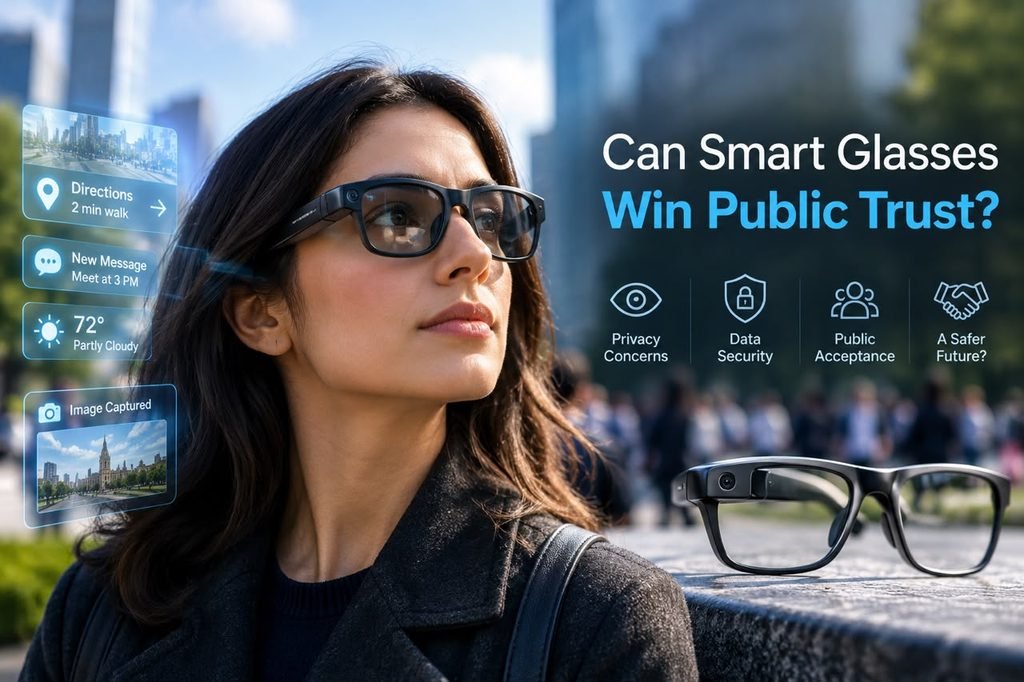
Conclusion: Can Smart Glasses Win Public Trust?
The future of smart eyewear will not be determined solely by processing power or battery life, but by public trust. As consumer sensitivity toward privacy reaches an all-time high, hardware manufacturers that prioritize transparent data policies, physical recording safeguards, and camera-free alternatives will successfully normalize wearables. Those that ignore public concern risk turning innovative technology into socially unwelcome gadgets. Balance, consent, and clear boundaries remain the ultimate keys to sustainable tech adoption. For further reading on ethics in technology, see Ethics in Technology: Where Do We Draw the Line on Surveillance?.
Frequently Asked Questions (FAQ)
Q1: Do all smart glasses come equipped with built-in cameras?
A: No. While many popular models feature cameras, an increasing number of privacy-first manufacturers offer camera-free audio glasses designed strictly for sound and voice commands.
Q2: How can bystanders tell if someone is recording them with smart glasses?
A: Most devices feature a small LED light when recording, though privacy advocates argue these lights are often too small or easily obstructed.
Q3: Where do voice commands and captured images go after recording?
A: Depending on the device, data is either processed locally on an on-device NPU or routed to cloud servers for AI analysis, depending on privacy settings.
Q4: Are smart glasses banned in certain public venues?
A: Yes, many gyms, theaters, schools, and private businesses have instituted strict bans on wearable recording devices to protect patron privacy.
Q5: Can prescription lenses be fitted into AI smart glasses?
A: Yes, major brands partner with optical providers to ensure smart frames accommodate standard prescription and corrective lenses.
Q6: How do camera-free audio glasses protect privacy?
A: By removing optical sensors and cameras entirely, they eliminate visual recording risks while retaining open-ear audio and AI voice assistance.
Q7: Are regulators planning stricter rules for wearable tech?
A: Global data protection authorities are actively reviewing biometric collection policies to enforce stricter transparency and user consent frameworks.