
Introduction
eSIM technology is changing how smartphones and other connected devices access mobile networks. Instead of relying on a removable plastic SIM card, an eSIM uses a small, programmable chip built directly into a device. This allows users to activate mobile plans digitally, switch network providers, and manage multiple cellular profiles without physically changing SIM cards.
For decades, traditional SIM cards have played an essential role in mobile communication. From the larger SIM cards used in early mobile phones to today’s tiny nano-SIMs, they have securely stored subscriber information and helped mobile networks authenticate users. However, changing carriers or using a local network while travelling has traditionally required users to remove and replace a physical SIM card.
That process is becoming less practical as smartphones become thinner, more advanced, and increasingly dependent on digital services. Physical SIM cards also require space inside devices and can make network switching less convenient.
This is where eSIM (Embedded Subscriber Identity Module) technology comes in. Its built-in chip can be remotely programmed with digital SIM Profiles, making mobile connectivity easier to activate and manage. Depending on the device and network provider, users can also store multiple profiles and switch between supported mobile plans.
But is eSIM technology really better than a traditional SIM card? How secure is it, which smartphones support it, and what limitations should users understand before making the switch?
In this guide, we explore how eSIM technology works, its major benefits, potential risks, device compatibility, and what its future could mean for mobile connectivity.
1. Introduction to eSIM Technology: From Physical SIM Cards to Digital Connectivity
To fully comprehend the revolutionary significance of eSIM technology, one must first examine the historical trajectory and functional purpose of the physical SIM card within telecommunications history. This decoupling allowed users to move their phone number and subscription data instantly from one handset to another simply by transferring the plastic card.
Over the ensuing decades, as mobile devices evolved from bulky handheld communicators into sleek, computer-powered smartphones, the physical footprint of the SIM card underwent continuous miniaturization to conserve internal device space. The industry progressed rapidly through successive physical form factors:
- Full-Size SIM (1FF): The original credit-card-sized token utilized in first-generation mobile phones.
- Mini-SIM (2FF): The standard removable chip introduced with the widespread adoption of 2G GSM networks.
- Micro-SIM (3FF): A reduced-footprint card adopted widely during the early smartphone boom of the 2010s.
- Nano-SIM (4FF): The microscopic plastic card measuring 12.3mm by 8.8mm that currently dominates legacy mobile handsets.
Despite these successive reductions in physical dimensions, the core operational limitation remained unchanged: every single profile change required manufacturing, shipping, and handling a piece of plastic. When a consumer wanted to switch carriers or purchase a local prepaid data plan while traveling abroad, they remained utterly dependent on physical logistics—visiting a retail storefront, purchasing a plastic card, and physically manipulating tiny card trays. eSIM technology eliminates this physical friction entirely by digitizing the subscriber identity module into a secure software profile downloaded over the air.
same for this
2. What Is eSIM Technology? Understanding Its Architecture and Embedded Chip
Unlike a traditional nano-SIM card, which can be extracted from a phone and inserted into another device, an eSIM is an integral, microscopic hardware component of the motherboard, operating seamlessly alongside the device’s main applications processor, modem, and storage memory.
At its core, an eSIM performs the exact same telecommunications function as a physical SIM card: it securely stores the International Mobile Subscriber Identity (IMSI) number and the corresponding cryptographic authentication key (Ki) required to verify a subscriber’s identity with mobile network operators. However, because the eSIM hardware is permanently integrated into the device, it is physically incapable of storing a single static network profile. Instead, an eSIM houses an advanced software architecture known as an eUICC (Embedded Universal Integrated Circuit Card) operating system, which is capable of securely downloading, storing, activating, and deleting multiple distinct operator profiles digitally.
This architectural shift transforms subscriber identity from a fixed physical asset into dynamic, flexible software. A modern smartphone equipped with an eSIM chip can store anywhere from five to twenty distinct carrier profiles simultaneously—allowing a user to maintain a primary home carrier profile alongside multiple international travel profiles—while actively keeping two profiles online concurrently via dual-SIM standby or dual-SIM active software management. For further technical analyses on embedded silicon architectures and secure microcontrollers, explore documentation via Eurosmart Smart Security Industry Association Portal or hardware reviews on My Tech Hub Hardware News.
3. eSIM Technology Explained: Secure Elements and eUICC Architecture
To appreciate the robust security and flexibility of eSIM technology, one must examine the intricate hardware and software anatomy hidden beneath the surface of the embedded eUICC chip. An eSIM is not merely a standard flash memory chip; it is an ultra-secure cryptographic micro-controller engineered to withstand sophisticated physical and digital penetration attacks, meeting the rigorous Common Criteria EAL5+ security certification standards shared by military hardware, passport microchips, and banking smart cards.
The eUICC architecture is strictly partitioned into two primary operational domains:
- The Secure Element (SE): A tamper-resistant hardware cryptographic coprocessor that stores sensitive cryptographic keys, authentication algorithms, and operator credentials in isolated physical memory cells that cannot be read out by malicious software, malware, or unauthorized applications.
- The Operating System and Profile Manager: The embedded eUICC operating system manages the lifecycle of digital SIM profiles—handling secure download protocols, cryptographic handshakes with remote carrier servers, profile activation, profile suspension, and secure cryptographic deletion when a user removes a carrier plan.
Because the eUICC chip is soldered directly to the device motherboard during the surface-mount technology (SMT) manufacturing process, it eliminates the fragile mechanical gold contact pins, spring-loaded SIM tray mechanisms, and external card slots associated with traditional SIM hardware. This solid-state integration drastically reduces potential hardware failure points, protects internal circuitry from moisture corrosion, and ensures that subscriber credentials remain anchored within a tamper-proof hardware fortress.
4. How eSIM Technology Works: Over-the-Air Provisioning and Remote Activation
The true operational magic of eSIM technology lies in how digital carrier profiles are delivered, installed, and activated on a device without requiring any physical hardware exchange. This seamless digital onboarding process is governed by the GSMA Remote SIM Provisioning (RSP) architecture, which relies on secure Over-The-Air (OTA) data transmission and specialized cloud-based servers known as SM-DP+ (Subscription Manager Data Preparation) servers.
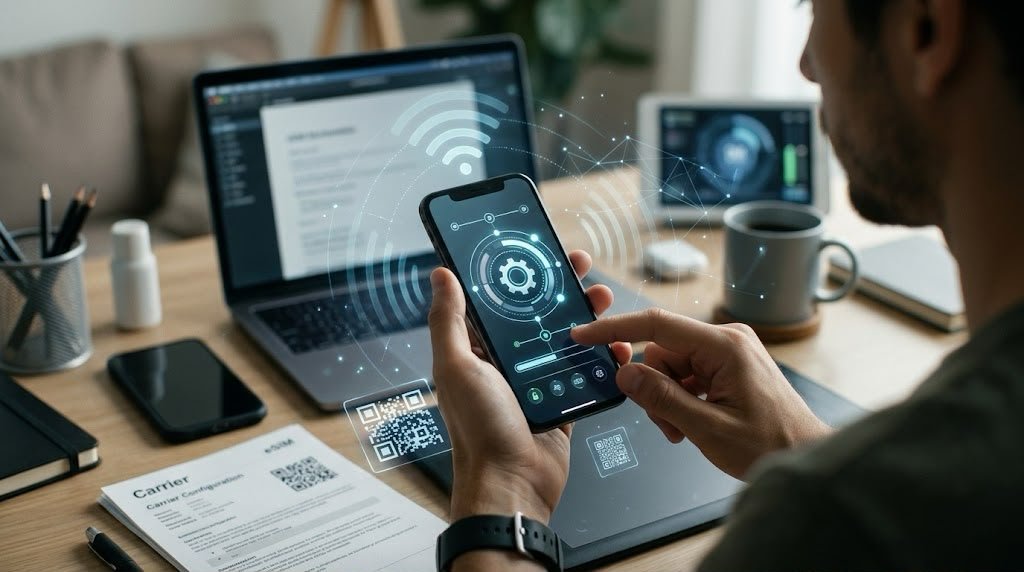
When a consumer purchases an eSIM data plan online—whether through a major domestic carrier or an international travel eSIM marketplace—the carrier’s provisioning system generates a digitally signed, encrypted cryptographic profile corresponding to that specific subscriber account. The carrier then transmits this profile package to an SM-DP+ server and provides the user with an activation mechanism, typically presented as a specialized QR code containing server address strings and matching tokens, or delivered via automated carrier app deep links.
Upon scanning the QR code with their smartphone camera or tapping an activation notification, the device establishes a secure, TLS-encrypted data session over Wi-Fi or cellular data directly with the carrier’s SM-DP+ server. The SM-DP+ server authenticates the device’s unique Electronic Serial Number (ESN) or International Mobile Equipment Identity (IMEI) against the eUICC’s secure hardware root of trust. Once authenticated, the server downloads the encrypted profile payload directly into the eUICC secure element, where it is decrypted, installed, and activated in a matter of seconds. This entire OTA provisioning handshake occurs autonomously in the background, transforming a multi-day postal delivery or retail storefront visit into an instant digital transaction.
5. The GSMA Standard: Global Interoperability and Remote SIM Provisioning Specifications
For any telecommunications technology to achieve ubiquitous global adoption across competing hardware manufacturers, software operating systems, and mobile network operators, it must be governed by rigorous, universally accepted international standards. In the mobile industry, that governing authority is the GSMA (GSM Association)—the global trade body representing the interests of mobile operators worldwide. Without GSMA standardization, carriers would develop incompatible proprietary SIM provisioning systems, trapping consumers inside walled-garden ecosystems.
These standards define exact cryptographic protocols, data exchange formats, and security certification pathways for three critical architectural entities within the eSIM ecosystem:
- EM-DS (Subscription Manager Discovery Service): A centralized directory service that helps a device locate its assigned SM-DP+ server when switching carriers globally.
- SM-DP+ (Subscription Manager Data Preparation +): The secure server managed by mobile operators or trusted third parties that generates, encrypts, and delivers eSIM profiles to devices.
- eUICC: The embedded hardware module inside the consumer device that receives, decrypts, and executes the downloaded profiles.
By enforcing strict compliance with these GSMA standards, any eSIM-enabled smartphone manufactured by Apple, Samsung, Google, or Motorola can communicate flawlessly with the SM-DP+ infrastructure of over 800 mobile network operators spanning virtually every country on Earth. This universal interoperability guarantees that consumer choice remains unhindered across global borders.
6. eSIM Technology and Dual-SIM Capabilities: Managing Multiple Mobile Profiles
One of the most transformative everyday convenience features unlocked by eSIM technology is the realization of advanced Dual-SIM functionality in modern mobile devices. For decades, using two distinct phone numbers—such as a dedicated personal number and a corporate work line—required purchasing specialized, bulky dual-SIM handsets (popular primarily in Asian markets) or carrying two entirely separate mobile phones. In Western markets, Apple and Android flagships stubbornly adhered to single physical SIM trays due to internal space constraints.
The integration of eSIM chips alongside legacy nano-SIM trays has fundamentally resolved this spatial constraint, ushering in the era of flexible multi-profile mobile devices. Modern smartphones now support sophisticated dual-SIM configurations, such as Dual SIM Dual Standby (DSDS) and Dual Active modes, blending physical hardware with digital software profiles:
- Primary Physical SIM + Secondary eSIM: Users can keep their traditional physical nano-SIM card inserted for their primary home voice and text number while simultaneously downloading an eSIM profile for local data when traveling abroad.
- Multiple Stored eSIMs + Dual Active Profiles: Users can store up to ten or twenty distinct eSIM profiles on their device, easily toggling between a personal line, a business line, and regional data plans directly through their device’s operating system settings menu without ever touching physical hardware.
This dual-SIM flexibility empowers remote workers, frequent travelers, and digital nomads to manage multiple global identities effortlessly from a single pocket-sized device. For further software integration insights on dual-SIM network management, explore documentation via Apple Support iOS Cellular Documentation Portal or tutorials on My Tech Hub Productivity Portal.
7. eSIM Technology for International Travel: Affordable Roaming Without Physical SIM Cards
Historically, international business travel and leisurely global vacations were accompanied by a universally dreaded telecommunications ritual: exorbitant international roaming fees charged by home carriers, or the frantic search for a local kiosk at foreign airports to purchase overpriced physical tourist SIM cards. Navigating language barriers, swapping fragile nano-SIM cards with paperclips, and risking the loss of your home SIM card while traveling created immense administrative and logistical friction.
eSIM technology has completely disrupted and democratized international travel connectivity through the meteoric rise of global travel eSIM providers (such as Airalo, Holafly, Nomad, and Ubigi). These specialized digital MVNOs (Mobile Virtual Network Operators) partner with tier-1 cellular networks across more than 200 countries to offer pre-packaged, region-specific or country-specific data plans that can be purchased and installed entirely via a smartphone app before boarding an international flight.
When a traveler lands at Tokyo Narita, London Heathrow, or New York JFK airport, their smartphone automatically connects to a local partner network via the pre-installed travel eSIM profile, delivering instant high-speed local data without triggering home carrier roaming penalties. Travelers retain their primary home SIM active in standby mode specifically to receive critical banking two-factor authentication SMS text messages or urgent phone calls, while routing all heavy internet data through the cheap local eSIM profile. This seamless digital handoff has effectively eliminated international roaming friction for millions of global travelers.
8. eSIM vs Physical SIM: Features, Benefits, and Pricing
| Feature | eSIM Technology | Physical SIM Card |
|---|---|---|
| SIM Type | Digital SIM built into the device | Removable plastic SIM card |
| Activation | Activated digitally through a supported carrier | Inserted and activated through a carrier |
| Device Compatibility | Requires an eSIM-compatible device | Works with devices supporting the SIM card size |
| Network Switching | Switch profiles digitally, depending on carrier support | Usually requires changing the SIM card |
| Travel Convenience | Allows users to activate supported international plans digitally | May require purchasing or inserting a local SIM |
| Security | Cannot be physically removed if a device is stolen | Can be physically removed from the device |
| Limitations | Device and carrier support are required | SIM cards can be lost, damaged, or misplaced |
| Pricing | eSIM activation may be free, but data plans can have charges | SIM cards and data plans may involve separate charges |
| Best For | Travelers, digital connectivity, and supported dual-SIM devices | Users who prefer removable SIM cards and easy transfers between compatible devices |
9. eSIM Technology Benefits: How Removing SIM Trays Transforms Smartphone and Wearable Design
To truly understand why smartphone manufacturers—led aggressively by Apple’s removal of physical SIM trays starting with the iPhone 14 lineup in the United States—pushed so hard for the industry-wide adoption of eSIM technology, one must examine the fierce internal real estate battles raging inside modern consumer electronics. The interior of a modern smartphone is an intensely crowded engineering masterpiece where every cubic millimeter of volume is fiercely contested by battery cells, camera sensor arrays, thermal cooling vapor chambers, haptic motors, and logic boards.
A traditional physical nano-SIM card assembly—comprising the metal SIM tray, internal spring-loaded connector pins, card detection switches, and protective waterproofing gaskets—occupies a surprisingly massive volumetric footprint deep inside the device chassis. Furthermore, the SIM tray cutout requires creating a permanent physical breach in the structural aluminum or titanium side rail of the phone.
By eliminating the physical SIM tray entirely, hardware engineers liberate valuable interior real estate that can be repurposed in highly impactful ways:
- Expanded Battery Capacity: Reclaiming the SIM tray volume allows engineers to pack larger lithium-ion battery cells directly into the chassis, extending daily device battery autonomy.
- Advanced Camera Optics: Freed internal space accommodates larger periscope zoom lenses, wider sensor apertures, and sophisticated stabilization modules.
- Thinner Form Factors: Eliminating structural tray cutouts enables sleeker, more structurally rigid chassis designs.
For further technical analyses on internal hardware engineering and smartphone teardowns, explore documentation via iFixit Hardware Repair Engineering Portal or hardware evaluations on My Tech Hub Hardware News.
10. eSIM Technology Benefits: Improved Water and Dust Resistance in Smartphones
In the relentless consumer electronics arms race for extreme durability, achieving higher Ingress Protection (IP) water and dust resistance ratings—such as the ubiquitous IP68 standard certifying continuous submersion in freshwater up to 1.5 meters for 30 minutes—represents a formidable engineering hurdle. Every single physical seam, button, port, and cutout machined into a smartphone’s outer metallic casing represents a potential vulnerability point where water molecules, fine dust particles, and atmospheric moisture can infiltrate the internal electronics.
The physical SIM card tray has historically been one of the weakest structural links in achieving long-term chassis hermeticity. Over months of routine usage, thermal expansion, accidental drops, and pocket lint accumulation, the tiny rubber O-ring gasket lining the perimeter of a physical SIM tray can degrade, warp, or collect debris, compromising the waterproof seal and allowing liquid ingress to trigger catastrophic motherboard corrosion.
By transitioning exclusively to eSIM technology, manufacturers permanently eliminate one of the largest structural chassis breaches on the device exterior. A solid-state smartphone devoid of a physical SIM tray features a continuous, unbroken metallic or glass side rail perimeter, dramatically enhancing structural rigidity, twist resistance, and long-term water and dust resistance reliability. This mechanical simplification ensures that devices maintain their factory water-resistance integrity over years of rugged daily wear and tear.
11. Security and Cryptography: Hardware-Backed Protection Against SIM Swapping and Theft
In the modern digital economy, where personal identity, cryptocurrency wallets, banking portals, and corporate authentication systems are inextricably linked to our mobile phone numbers, cellular accounts have become prime targets for sophisticated cybercriminals. One of the most insidious forms of cyber theft is SIM swapping (also known as SIM hijacking or port-out scams), where malicious actors socially engineer mobile carrier customer service representatives or corrupt insider employees to illicitly port a victim’s phone number over to a malicious SIM card controlled by the attacker.
Once the attacker successfully hijacks the victim’s phone number, they intercept all incoming SMS two-factor authentication (2FA) codes, password reset prompts, and bank verification alerts, granting them unfettered access to empty bank accounts, crypto holdings, and social media profiles. Physical SIM cards are inherently vulnerable to social engineering because customer support agents can be tricked into transferring accounts to a new physical SIM serial number without physical verification.
eSIM technology introduces robust, hardware-backed cryptographic security layers that drastically mitigate the threat of unauthorized SIM swapping:
- Remote Cryptographic Handshakes: Transferring an eSIM profile requires multi-factor cryptographic authentication between the carrier’s SM-DP+ server and the device’s eUICC hardware root of trust, bypassing vulnerable human customer service agents.
- Device Lock Protection: Modern operating systems require biometric authentication (Face ID or fingerprint verification) before allowing an eSIM profile to be transferred, deleted, or activated on a new handset.
These advanced cryptographic protocols ensure that your digital identity remains securely locked to your physical device hardware.
12. Carrier Flexibility and Instant Switching: Breaking Free from Carrier Lock-In
For decades, traditional mobile network operators maintained a powerful economic stranglehold over consumers through two primary mechanisms: long-term hardware subsidy contracts and carrier locking. When a consumer purchased a discounted smartphone through a carrier installment plan, the carrier locked the device’s firmware so that it would exclusively accept SIM cards issued by that specific network operator, rendering the phone useless if the user attempted to switch to a cheaper competitor or insert a local foreign SIM card while traveling.
While carrier locking was legally justified to protect against subsidy default, it created severe anti-competitive friction and restricted consumer freedom. Unlocking a phone often required navigating bureaucratic customer support queues, paying termination fees, or waiting months for carrier authorization.
eSIM technology fundamentally reshapes the carrier relationship by enabling instant digital switching and frictionless carrier evaluation. Because eSIM-enabled devices can store multiple carrier profiles simultaneously, consumers can download a secondary prepaid data plan from a competing carrier in minutes to test network coverage in their geographic area without altering their primary phone line. This digital fluidity fosters fierce market competition, forcing legacy mobile network operators to abandon restrictive contracts and compete aggressively on pricing, network quality, and customer service rather than relying on artificial hardware lock-in.
13. The Limitations of eSIM: Carrier Support Fragmentation and Regional Regulatory Hurdles
Despite its overwhelming technological superiority, sleek hardware benefits, and digital convenience, eSIM technology is not without notable adoption friction points and structural limitations that continue to frustrate certain segments of the global consumer base. When evaluating the global telecommunications landscape, eSIM maturity varies wildly depending on geographic region, carrier tier, and device category.
The primary limitation facing global eSIM adoption is carrier support fragmentation. While tier-1 national carriers in North America, Western Europe, and East Asia fully embrace digital eSIM provisioning, thousands of regional prepaid carriers, rural mobile virtual network operators (MVNOs), and budget discount brands across developing economies still lack the expensive cloud infrastructure required to support GSMA Remote SIM Provisioning (RSP) and SM-DP+ server integrations. For consumers traveling to emerging markets or relying on regional budget carriers, discovering that a local operator only issues physical plastic SIM cards remains a frustrating reality.
Furthermore, regional regulatory hurdles pose significant complications. In certain countries across Asia, the Middle East, and Africa, government telecommunications ministries enforce strict legal mandates requiring retail biometric identity verification (such as mandatory fingerprint scanning or passport photocopying) before any mobile subscriber identity can be activated. While some nations have established secure digital KYC (Know Your Customer) portals to accommodate remote eSIM activation, others legally prohibit remote OTA profile downloading for local resident lines, forcing users to visit physical retail storefronts regardless of device hardware capabilities.
14. Troubleshooting Activation Failures: QR Codes, SM-DP+ Servers, and Network Handshakes
Like any complex software-defined hardware ecosystem operating across cloud servers and cellular networks, eSIM activation is occasionally susceptible to technical glitches, handshake timeouts, and provisioning failures. For everyday consumers accustomed to simply snapping a physical plastic SIM card into a phone tray and watching signal bars appear instantly, troubleshooting an unresponsive digital eSIM profile can induce significant technical anxiety.
Common eSIM provisioning failures typically stem from three primary technological bottlenecks:
- SM-DP+ Server Congestion or Timeouts: If millions of travelers attempt to download travel eSIM profiles simultaneously during peak holiday travel seasons, carrier cloud servers can experience severe bandwidth throttling or HTTP gateway timeouts, causing profile installation to freeze mid-download.
- Network Connectivity Drops During Installation: Because downloading an encrypted eSIM profile requires a stable active internet connection (either robust Wi-Fi or cellular data), losing internet connectivity midway through the cryptographic handshake corrupts the profile installation package.
- Incorrect Activation Server Strings: Manually typing long SM-DP+ address strings or activation codes instead of scanning clean QR codes frequently introduces typographical errors that prevent the device from locating the carrier’s provisioning server.
Resolving these activation hurdles typically requires verifying active internet connections, restarting device network stack settings, contacting carrier customer support to regenerate fresh QR activation tokens, or ensuring that device firmware is updated to the latest operating system build supporting updated GSMA cryptographic certificates.
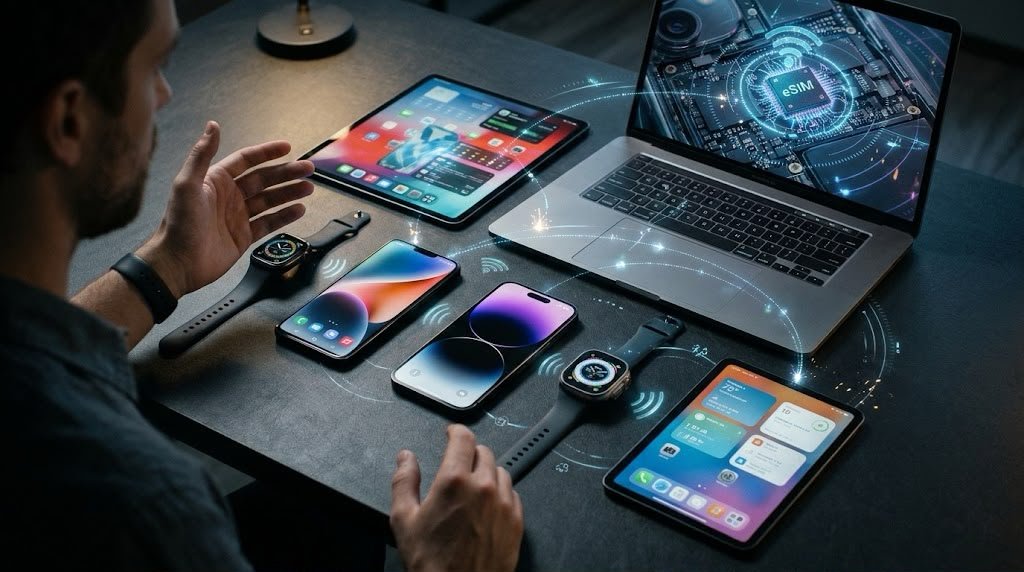
15. Device Compatibility Matrix: Apple, Android Flagships, Tablets, Laptops, and Smartwatches
Navigating the consumer technology marketplace requires a clear understanding of hardware compatibility, as the transition from physical SIM trays to eSIM-only architectures has unfolded asynchronously across different product categories and manufacturing brands. While flagship smartphones embraced eSIM integration rapidly, legacy budget handsets, rugged industrial devices, and mid-range tablets have lagged behind.
Reviewing the current compatibility matrix across major hardware categories reveals distinct industry trends:
- Smartphones: Apple initiated the aggressive shift toward eSIM exclusivity by removing physical SIM trays entirely from iPhone 14, 15, and 16 models sold in the United States, while maintaining dual physical/eSIM trays internationally. Major Android flagships—including Samsung’s Galaxy S and Z series as well as Google’s Pixel lineup—support robust dual physical/eSIM configurations globally.
- Tablets and Laptops: Premium cellular-enabled tablets (such as cellular iPad Pro and iPad Air models) and enterprise business laptops (including Dell Latitude, Lenovo ThinkPad, and Microsoft Surface devices featuring integrated cellular modems) rely extensively on eSIM modules for cellular connectivity.
- Smartwatches: Wearables—including Apple Watch Cellular models, Samsung Galaxy Watches, and LTE fitness trackers—were among the earliest pioneers of eSIM technology, as their microscopic internal volume made physical SIM trays physically impossible to engineer.
16. The Rise of Travel eSIM Providers: Airalo, Holafly, and the Disruption of Traditional Roaming Fees
The commercial explosion of eSIM technology has spawned an entirely new, highly lucrative sector within the global travel and telecommunications industry: digital travel eSIM providers. Companies like Airalo, Holafly, Nomad, Ubigi, and SimOptions have capitalized on consumer frustration with predatory international roaming fees charged by domestic mobile carriers, transforming global data connectivity into an app-based consumer commodity.
Before the mainstream proliferation of eSIMs, traditional mobile network operators generated billions of dollars in high-margin annual revenue by charging consumers ten to fifteen dollars per megabyte for international data roaming, or forcing travelers into rigid, expensive daily international day-passes. These monopolistic pricing structures penalized casual travelers and forced business professionals to endure crushing phone bills after returning from overseas trips.
Travel eSIM providers dismantled this economic model by acting as digital MVNO aggregators. By establishing direct commercial partnerships with tier-1 local cellular operators in over 200 countries, these platforms purchase bulk wholesale data blocks and resell them directly to consumers via slick mobile apps at local competitive rates. A traveler heading to Europe can purchase a 10GB regional data package for fifteen dollars, install the eSIM profile instantly via QR code, and enjoy local 5G data speeds the moment their aircraft touches down. This disruptive business model has forced legacy domestic carriers to reform their international roaming pricing structures, permanently altering consumer travel economics.
17. Intellectual Property, Patent Landscapes, and Global Corporate Rivalries in eSIM Silicon
The rapid commercial maturation of eSIM technology, eUICC secure microcontrollers, and Remote SIM Provisioning (RSP) cloud architectures has triggered an intense, multi-billion-dollar corporate race for global intellectual property dominance. Major semiconductor manufacturers, specialized secure-element fabricators, and multinational mobile network operators are fiercely patenting every conceivable breakthrough in cryptographic profile encryption, over-the-air protocol handshakes, secure eUICC partitioning, and automated MDM provisioning algorithms. Securing foundational patents in this nascent industry dictates which corporations will control global supply chains, secure silicon manufacturing licensing frameworks, and commercial distribution channels across the digital mobile infrastructure era.
This high-stakes corporate rivalry has transformed advanced semiconductor research laboratories and secure-cryptography spin-offs into prime acquisition targets. Venture capital firms, telecommunications conglomerates, and major consumer electronics manufacturers are pouring massive capital injections into engineering teams capable of solving the notoriously difficult manufacturing yield hurdles associated with EAL5+ secure element integration and ultra-low-power cellular modem coexistence. Furthermore, navigating global patent landscapes requires aggressive international legal strategies to prevent intellectual property infringement across competing jurisdictions. As patent portfolios expand rapidly, cross-licensing agreements between legacy smart-card giants and modern smartphone pioneers are beginning to emerge, laying the legal foundation for standardized commercial production.
18. Consumer Privacy, Tracking Concerns, and Regulatory Compliance in Remote Profiling
The widespread consumer transition toward software-defined subscriber identities, cloud-based SM-DP+ provisioning servers, and remote over-the-air profile downloading introduces profound consumer privacy, data security, and regulatory compliance considerations. For decades, physical SIM cards provided a comforting tactile illusion of privacy: users believed that unless someone physically stole their phone or extracted the plastic chip, their cellular identity remained secure and unobservable. Today, as mobile subscriber profiles reside as dynamic software packages downloaded across cloud networks, privacy advocates scrutinize how carrier provisioning data is handled.
This digital transformation elevates subscriber identity management from a localized hardware transaction into a sophisticated cloud security protocol. However, it also raises important questions concerning digital surveillance, metadata logging, and government access to remote telecommunications profiles. When mobile network operators and travel eSIM platforms ingest sensitive personal telemetry—including device IMEI numbers, exact geographic activation coordinates, and profile switching frequency—users surrender private network data to cloud servers managed by commercial enterprises. Ensuring rigorous end-to-end encryption, transparent data retention policies, and strict compliance with global privacy regulations such as the European Union’s GDPR (General Data Protection Regulation) represents a critical societal challenge in the ethical evolution of eSIM technology.
19. Enterprise IoT and Asset Tracking: Global Logistics Supply Chains Powered by Embedded Profiles
While mainstream commercial marketing frequently highlights eSIM technology as a sleek consumer convenience for international travelers and dual-SIM smartphone users, its most vital industrial and macroeconomic function may ultimately lie in global logistics supply chains and asset tracking. Modern international commerce relies on complex, multi-modal supply chains where high-value cargo containers, pharmaceutical shipments, aerospace components, and industrial freight traverse oceans, deserts, and international borders continuously.
Tracking these remote assets requires deploying ruggedized cellular IoT asset trackers equipped with GPS sensors and cellular modems. When a shipping container moves from a port in Shanghai through maritime shipping lanes to a distribution warehouse in Frankfurt, it crosses multiple national borders and switches between dozens of regional cellular network operators. Traditional physical SIM cards locked to a single domestic carrier would result in catastrophic roaming blackout zones or exorbitant international data fees. Industrial multi-IMSI and eSIM-enabled asset trackers solve this logistics bottleneck by storing pre-provisioned profiles from global roaming alliances. As the cargo container crosses international borders, the device communicates with local cellular towers via dynamically selected profile agreements, ensuring uninterrupted, real-time location telemetry and environmental monitoring (such as temperature and shock sensors) across the entire global supply chain journey. For further logistics analytics and enterprise IoT case studies, read reports via TechCrunch Enterprise Mobility Desk alongside supply chain guides on My Tech Hub Business Portal.
20. Enterprise Fleet Management: Remote Provisioning and Corporate Mobile Device Management (MDM)
While individual consumers celebrate eSIM technology for its travel convenience and dual-SIM flexibility, the commercial sector—specifically Enterprise IT and Mobile Device Management (MDM) operations—experiences perhaps the most dramatic operational transformation. Managing corporate smartphone fleets distributed across thousands of remote employees has historically represented a massive administrative and logistical nightmare for corporate IT departments.
Under legacy physical SIM frameworks, provisioning a new employee with a corporate mobile line required IT administrators to order physical SIM cards from cellular carriers, maintain inventory cabinets of plastic SIM cards, securely encode phone numbers, and mail physical activation kits to remote employees’ home addresses. When employees departed the company, retrieving or deactivating physical SIM cards added further security risks and administrative overhead.
eSIM technology empowers enterprise IT administrators to manage global cellular fleets entirely via cloud-based software dashboards integrated with leading MDM platforms like Microsoft Intune, VMware Workspace ONE, and Jamf. An IT administrator can provision, activate, suspend, or reassign corporate cellular profiles across thousands of employee iPhones and Android devices instantaneously with a few mouse clicks. If a corporate laptop or smartphone is lost or stolen, administrators can remotely wipe the device and revoke the eSIM profile over the air, ensuring that corporate data remains secure and unauthorized cellular usage is instantly prevented without physical device retrieval.
21. Future Horizons: Integrated SIM (iSIM) and System-on-Chip (SoC) Cellular Convergence
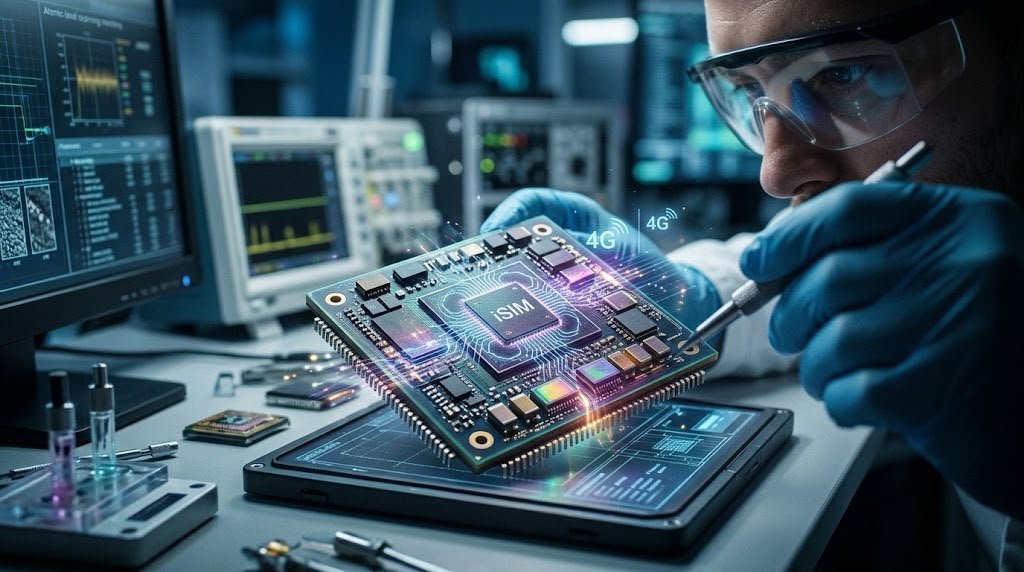
Looking far beyond the immediate horizon of embedded eUICC microchips soldered onto smartphone motherboards, visionary semiconductor architects and telecommunications engineers are charting the ultimate evolutionary trajectory of mobile subscriber identity: Integrated SIM (iSIM) technology. While an eSIM is a distinct, standalone secure hardware micro-controller chip mounted onto the device’s printed circuit board, an iSIM takes miniaturization to its absolute theoretical limit by merging the secure subscriber identity module directly into the primary application processor or cellular modem System-on-Chip (SoC) itself.
In an iSIM architecture, the tamper-resistant cryptographic secure element and eUICC operating system are partitioned directly into unused microscopic silicon real estate within the main multi-core smartphone processor or baseband modem silicon die. This eliminates the need for any dedicated external memory chip or standalone eSIM component, liberating further interior volumetric space, driving semiconductor component costs down to fractions of a cent, and slashing electrical power consumption to microscopic levels.
As iSIM technology matures and gains rigorous GSMA standardization across global silicon foundries, ultra-low-power cellular connectivity will become ubiquitous across virtually every connected object imaginable. From disposable medical sensors and smart clothing tags to micro-drones and remote environmental monitors, iSIM technology ensures that any electronic device can connect securely to global cellular networks instantly. The journey that began with credit-card-sized plastic smart cards in 1991 is culminating in microscopic silicon integration, permanently dissolving the physical boundaries of mobile connectivity.
Frequently Asked Questions (FAQ)
Q1: What is the main difference between a physical SIM card and an eSIM?
A: A physical SIM card is a removable plastic smart card that must be inserted manually into a device’s SIM tray, whereas an eSIM is a microscopic secure chip soldered permanently onto the device’s motherboard during manufacturing. An eSIM downloads carrier profiles digitally over the air (OTA) via QR code or carrier app without requiring physical hardware swaps.
Q2: Can I store multiple carrier profiles on a single eSIM?
A: Yes. An eSIM’s underlying eUICC architecture allows you to store anywhere from five to twenty distinct carrier profiles simultaneously on your device. While only one or two profiles can be actively connected to cellular networks at any given moment (depending on your device’s dual-SIM capabilities), you can switch between stored profiles instantly through your operating system settings.
Q3: Will my phone still work with an eSIM if I travel internationally?
A: Absolutely. In fact, travel is one of the primary benefits of eSIM technology. You can purchase local prepaid data plans online from international travel eSIM providers before your trip, install the digital profile instantly via QR code, and enjoy local cellular data overseas without paying expensive home carrier roaming fees.
Conclusion: Is eSIM Technology Permanently Replacing Physical SIM Cards?
So, is eSIM technology permanently replacing physical SIM cards? The definitive answer is yes, the digital transition from removable plastic smart cards to embedded silicon and integrated iSIM architectures is an irreversible global reality.
- The hardware and operational advantages are absolute. eSIM technology eliminates physical SIM trays, enhances water and dust resistance, hardens device security against SIM swapping, empowers effortless global travel, and slashes plastic waste across global supply chains.
- The future of connectivity is entirely software-defined. As global carrier support matures and iSIM silicon integration becomes standard across consumer electronics, industrial IoT, and wearable technology, the physical SIM card will soon be remembered as a nostalgic relic of early mobile history.
Evaluate your device compatibility, your international travel habits, and your carrier flexibility, and consider embracing the seamless digital freedom of eSIM technology for your mobile lifestyle.